
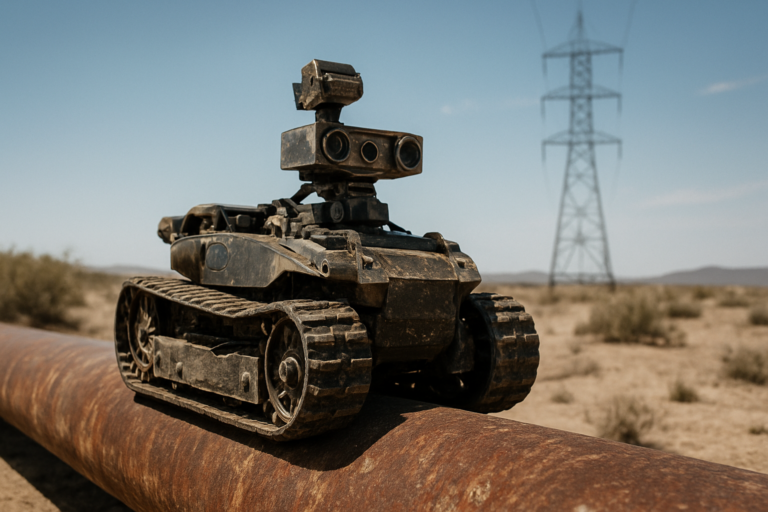
The hidden backbone of modern civilization—power grids, oil pipelines, and telecom towers demands regular inspection. Yet many of these assets stretch across mountains, deserts, or underwater routes that are dangerous for human workers. Autonomous drones and robotic crawlers are now taking over these high-risk inspections, delivering real-time data without exposing crews to electrical arcs or unstable terrain. This shift is not just a convenience—it’s a fundamental change in how we maintain critical infrastructure.
The Challenge of Hard-to-Reach Infrastructure
Transmission towers and remote pipelines share one characteristic: accessibility is both expensive and dangerous. Traditional methods require teams to climb hundreds of feet, work near energized lines, or traverse unstable ground. According to the International Energy Agency, electrical fatality rates for line workers remain significant. For pipelines, corrosion and leaks often occur in remote areas, making manual checks time-intensive. The cost of downtime for a single pipeline failure can exceed $1 million per incident.
Autonomous robotics addresses this by removing the human from the hazard.
Key advantages include:
- Safety: Drones can fly within meters of high-voltage lines without risk to personnel
- Speed: A single UAV can cover tens of kilometers of pipeline in one flight
- Data quality: High-resolution thermal cameras and LIDAR detect micro-cracks invisible to human eyes
- Consistency: Robots follow programmed patterns, eliminating human error
How Autonomous Drones Are Changing the Game
Drones equipped with AI-based computer vision can detect hot spots on transmission towers, identifying loose bolts or bird nests. In the energy sector, major utilities now deploy autonomous fleets for regular patrols. For example, a pilot program by a European grid operator reported a 30% reduction in inspection time and a 40% decrease in safety incidents. These systems use onboard processing to analyze data in real-time, sending only alerts for anomalies.
Types of drone platforms used:
- Fixed-wing UAVs for long-range corridor flights over pipelines
- Multi-rotor drones for precise close-up shots of tower hardware
- Hybrid models that can perch on structures for detailed scanning
The future includes “drone-in-a-box” systems that launch, inspect, and land autonomously.
Robotic Crawlers for Pipeline Monitoring
While drones handle aerial views, ground-based crawlers are equally vital for buried pipelines. These robots are often tracked or wheeled, climbing vertical surfaces or moving through confined spaces. They carry ultrasonic sensors, cameras, and even robotic arms for minor repairs. A 2023 report from MarketsandMarkets projects the robotic inspection market to reach $12.4 billion by 2028, driven by oil & gas, power generation, and water utilities.
Crawlers are particularly effective for:
- Underground pipeline corrosion detection
- Above-ground pipeline above-ground pipeline
- Water pipeline
- Oil pipeline
Data from these robots integrates with digital twin models for predictive maintenance.
Key Technologies Behind the Autonomy
The core enablers making this possible:
- Computer vision using convolutional neural networks to classify defects
- Edge computing for processing on the robot without cloud latency
- Sensor fusion combining LIDAR, thermal, and acoustic
- SLAM for mapping without GPS in GPS-denied environments
- Machine learning models to predict failure probability
These technologies are maturing rapidly. In 2024, a major pipeline operator in North America deployed over 100 autonomous crawlers across 5,000 km of remote pipeline, with zero human intervention.
The Business Case for Field Automation
Beyond safety, the economics are compelling. A typical manual inspection of a transmission tower costs about $1,500 per day, while a drone inspection can be under $500. For pipelines, the