
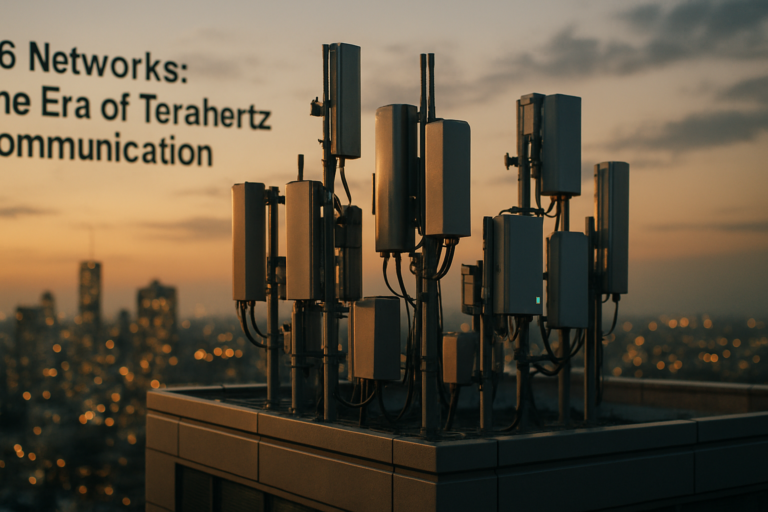
The race to define the next era of wireless connectivity is already underway, even as 5G continues its global rollout. Researchers, telecom giants, and standards bodies are now turning their attention to what comes after: 6G networks. While 5G brought us faster downloads and lower latency, 6G promises something categorically different – a leap into terahertz communication that could transmit data at speeds up to one terabit per second, roughly 100 times faster than today’s best 5G connections. This is not an incremental upgrade; it’s a fundamental reimagining of what wireless networks can do.
What Exactly Is Terahertz Communication?
The terahertz band occupies the electromagnetic spectrum between microwave and infrared frequencies, typically defined as spanning from 0.1 to 10 THz. For decades, this range was colloquially called the “terahertz gap” because generating and detecting these waves was notoriously difficult. That’s beginning to change.
Unlike 5G, which primarily uses spectrum below 6 GHz and millimeter waves up to 39 GHz, 6G will push into these higher frequencies to unlock enormous bandwidth. The physics are straightforward: higher frequencies carry more data, and the terahertz band offers spectrum that is orders of magnitude wider than everything currently allocated for mobile communications combined.
What this translates to in practical terms is staggering: instant downloads of 4K films, real-time holographic video conferencing, and the ability to stream uncompressed AR/VR environments to multiple users simultaneously without a hint of lag.
Breaking Down the Speed and Latency Gains
To appreciate the scale of the shift, consider where we stand today:
- 5G delivers peak data rates of approximately 10 Gbps with latency around 1 millisecond
- 6G is projected to achieve peak rates of 1 Tbps (1,000 Gbps) with latency as low as 0.1 milliseconds
- Network reliability is expected to reach 99.99999% – often called “seven nines” – making near-perfect connectivity the baseline
The jump in speed matters beyond simple throughput. It enables entirely new classes of applications that were previously impossible due to bandwidth or latency constraints. When a network responds in 0.1 milliseconds, the physical distance between devices becomes nearly irrelevant – your input travels, is processed, and returns before your brain even registers the action.
The Hyper-Realistic Sensory Experience
One of the most frequently cited promises of 6G is “multi-sensory telepresence” – the ability to transmit not just sight and sound, but touch, smell, and even taste. The concept of the “Tactile Internet” has been discussed for years, but 6G and terahertz bandwidth make it technically feasible.
Here’s how this might work in practice:
- Holographic communication: Instead of a flat video call, participants appear as life-sized holograms that move naturally and maintain eye contact. The terahertz bandwidth needed to stream volumetric video for a single hologram is roughly 500 Gbps – achievable only with 6G.
- Haptic feedback: Remote surgery, industrial teleoperation, and even virtual shopping can include realistic touch feedback. When you handle a product in a virtual store, you’d feel its texture and weight.
- Digital twin environments: Entire factories, cities, or even the human body can be continuously mirrored in digital form, with sensors streaming data in real time. The resolution and density of these digital twins require the enormous data throughput of terahertz links.
This is not speculative fiction. Research labs at institutions including the University of Tokyo, MIT, and Samsung’s 6G research division are already prototyping these experiences. By the time 6G is commercially deployed, the foundational sensory technologies will have matured alongside the network itself.
Beyond Smartphones: 6G Infrastructure
The 6G era will extend far beyond mobile devices. The architecture will blend terrestrial base stations with satellite constellations and airborne platforms, creating a three-dimensional network covering the entire planet – including oceans, deserts, and polar regions.
- Terrestrial nodes: Ultra-dense deployments of small cells leveraging terahertz backhaul links between base stations. These will be far smaller and more numerous than current cell towers, merging with street furniture, building facades, and infrastructure.
- Non-terrestrial networks: Low-Earth-orbit satellites will provide coverage in remote regions, while high-altitude platforms (essentially solar-powered drones or airships) will serve as temporary nodes for events or disaster recovery.
- Integrated sensing and communication: 6G base stations won’t just transmit data; they’ll also function as radar and imaging systems. Your network will be able to detect its environment, recognizing gestures, identifying objects, and even monitoring physiological signals from a distance.
This convergence of communication and sensing is a defining characteristic of 6G that 5G never fully addressed.
The Hard Road Ahead: Challenges and Barriers
Despite the promise, terahertz communication presents formidable engineering obstacles. The most significant is propagation loss – terahertz waves attenuate rapidly with distance and are easily absorbed by atmospheric gases like water vapor. A terahertz signal traveling just a few hundred meters in rain can lose over 90% of its power.
Engineers are pursuing several workarounds:
- Extremely narrow beamforming: Adaptive antenna arrays can steer tightly focused beams toward devices, compensating for path loss through concentration rather than raw power.
- Reconfigurable intelligent surfaces: Programmable metamaterial panels placed on buildings can reflect and shape terahertz waves around obstacles, essentially turning walls and windows into active network elements.
- Shorter cell radii: The practical range of a tera