
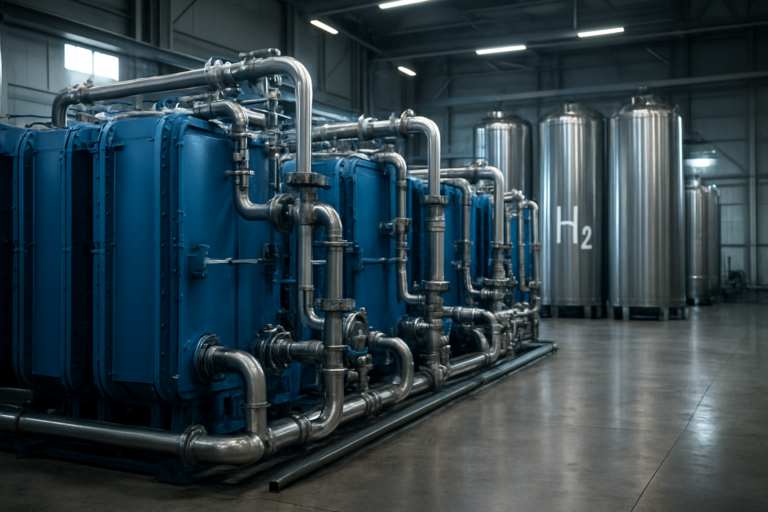
The global race to decarbonize heavy industry and shipping is entering a new phase. After years of being dismissed as too expensive or inefficient, green hydrogen is now emerging as a serious contender to replace fossil fuels in sectors where electrification alone cannot work. Steelmaking, cement production, chemical manufacturing, and ocean freight collectively account for nearly a third of global carbon emissions—and each one faces unique energy demands that batteries struggle to meet.
The solution increasingly points to hydrogen produced via electrolysis using renewable energy. But scaling this fuel from pilot projects to industrial reality requires solving two major challenges: making electrolyzers affordable enough to compete with grey hydrogen (produced from natural gas), and building a storage and distribution network that can handle a light, leak-prone gas. This article explores the technology, economics, and infrastructure behind the hydrogen pivot.
How Electrolysis Works at Scale
At its core, electrolysis splits water into hydrogen and oxygen using electricity. When that electricity comes from solar, wind, or hydropower, the resulting hydrogen is labelled “green.” The two main technologies vying for dominance are alkaline electrolyzers and proton exchange membrane (PEM) electrolyzers.
- Alkaline electrolyzers are the older, cheaper option. They use a liquid potassium hydroxide electrolyte and operate at lower current densities. They’re robust but less flexible in responding to variable renewable power.
- PEM electrolyzers use a solid polymer membrane. They can ramp up and down quickly, making them ideal for pairing with intermittent renewables. However, they rely on expensive precious metal catalysts like iridium and platinum.
Recent advances are driving down costs. According to the International Energy Agency, the levelized cost of green hydrogen could fall to between $2 and $3 per kilogram by 2030, down from around $5 today. That still needs to reach $1–$1.50 to compete with grey hydrogen, but rapid scaling of manufacturing capacity is expected to close the gap.
Key Trends in Electrolyzer Deployment
| Metric | 2020 | 2025 (projected) | 2030 (target) |
|---|---|---|---|
| Global electrolyzer capacity (GW) | 0.3 | 8–10 | 50+ |
| Largest plant size (MW) | 20 | 200 | 1,000 |
| PEM stack cost ($/kW) | 1,200 | 700 | 400 |
The push from gigawatt-scale projects, particularly in Europe, the Middle East, and Australia, is accelerating learning curves. For example, the NEOM green hydrogen project in Saudi Arabia aims to produce 600 tonnes per day by 2026, using 4 GW of solar and wind.
The Storage Challenge: Keeping Hydrogen From Leaking
Hydrogen is the smallest molecule in the universe, which makes it notoriously difficult to store and transport. It can embrittle metals, leak through microscopic gaps, and has a very low volumetric energy density—about three times less than natural gas at the same pressure.
Three main storage approaches are being scaled for industrial use:
- Compressed gas storage – Hydrogen is compressed to 350–700 bar and stored in cylindrical tanks made of carbon-fiber composites. This is the most mature method but energy-intensive (10–15% of the hydrogen’s energy is lost during compression).
- Liquid hydrogen storage – Cooling hydrogen to -253°C reduces its volume by a factor of 800. However, liquefaction consumes about 30% of the hydrogen’s energy, and boil-off losses remain significant. Used mainly for space launch and some niche shipping applications.
- Chemical carriers – Hydrogen is bonded to other molecules like ammonia, methanol, or liquid organic hydrogen carriers (LOHCs). These can be stored and transported at ambient conditions, then dehydrogenated at the point of use. Ammonia is emerging as a preferred option for maritime fuel because it can also be burned directly.
For heavy industry, on-site storage will likely rely on a combination of compressed gas (for daily use) and ammonia (for seasonal backup). In the shipping sector, ports are beginning to retrofit bunkering facilities to handle ammonia and liquid hydrogen.
Decarbonizing Heavy Manufacturing with Hydrogen
Steelmaking: Replacing Coke with Hydrogen
Traditional steelmaking uses coking coal to remove oxygen from iron ore, releasing massive amounts of CO₂. Hydrogen can perform the same chemical reduction, with water vapor as the only byproduct. Sweden’s HYBRIT project—a joint venture between SSAB, LKAB, and Vattenfall—already produced the world’s first fossil-free steel in 2021 using green hydrogen. The process requires roughly 3.5 tonnes of hydrogen per tonne of steel, and at current hydrogen costs, green steel commands a premium of 20–30%. But as hydrogen prices fall and carbon taxes rise, that gap is narrowing.
Cement and Chemicals
Cement production emits CO₂ both from burning fuel to heat kilns (to over 1,400°C) and from the chemical decomposition of limestone. Hydrogen can replace fossil fuels for heating, but the process emissions from limestone remain. Carbon capture and storage (CCS) is still needed for full decarbonization—though hydrogen can reduce the energy penalty by providing high-temperature heat efficiently.
In chemicals, hydrogen is already a core feedstock for ammonia and methanol production. Switching from natural gas-based “grey” hydrogen to green hydrogen directly slashes emissions in these sectors. For example, Yara International, the world’s largest ammonia producer, is building a 500 MW electrolyzer in Norway to supply green ammonia by 2026.
Shipping: Hydrogen’s Next Frontier
Maritime shipping accounts for nearly 3% of global emissions. Current vessels burn heavy fuel oil, and battery-electric propulsion is only viable for short routes. Hydrogen-based fuels—particularly ammonia and methanol—are seen as the most scalable alternatives.
Several prototype vessels are already in operation:
- Hydrogen-fueled ferries – The MF Hydra in Norway runs on compressed hydrogen and fuel cells, with a range of about 300 km.
- Ammonia-powered engines – MAN Energy Solutions has developed a two-stroke ammonia engine designed for ocean-going container ships. The first retrofits are scheduled for