
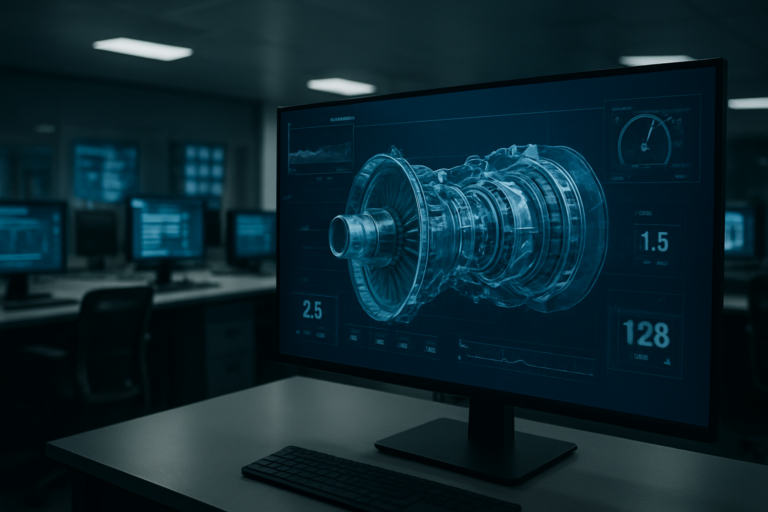
Imagine being able to predict the precise moment a jet engine will need maintenance, optimize a factory production line in real time, or test a skyscraper’s emergency systems under hurricane-force winds — all without touching a single physical object. That’s the promise of digital twins, a technology that’s moving beyond buzzword status into the core of the industrial metaverse. By creating high-fidelity virtual replicas of physical assets, digital twins allow engineers, operators, and decision-makers to simulate, analyze, and control real-world systems with unprecedented accuracy.
At its simplest, a digital twin is a virtual model that mirrors a physical object, process, or system. But unlike a static 3D CAD file, a digital twin is alive with data. It continuously receives real-time inputs from sensors on the physical counterpart — temperature, vibration, pressure, location, and more. This constant feedback loop means the twin evolves alongside its real-world twin, reflecting wear, environmental changes, and operational adjustments. The result is a living simulation that can be used to test scenarios, predict failures, and optimize performance before implementing changes in the physical world.
What Makes Digital Twins a Game Changer
The shift from static modeling to dynamic simulation is profound. Traditional simulations are one-off analyses. Digital twins, on the other hand, enable continuous learning and adaptation. Here’s why they are becoming indispensable in the industrial metaverse:
- Real-time visibility: Operators can monitor every detail of an asset’s performance from a central dashboard, often with geospatial overlays.
- Predictive maintenance: By analyzing data patterns, digital twins can forecast when a component will fail, reducing unplanned downtime by up to 30% according to McKinsey.
- Cost savings: Industrial companies using digital twins report maintenance cost reductions of 10–20% and overall equipment effectiveness improvements.
- Remote collaboration: Multiple stakeholders can interact with the same virtual model, enabling global teams to work together without travel.
- What-if analysis: Engineers can simulate extreme operating conditions — from thermal stress to cyberattacks — without risking actual equipment.
From Factory Floors to Wind Farms: How Industries Are Using Digital Twins
Digital twins are not limited to any single sector. Their ability to mirror complex systems makes them valuable wherever physical assets are critical.
Manufacturing and Assembly Lines
In automotive and electronics manufacturing, digital twins model entire production lines. They simulate throughput, detect bottlenecks, and test changes in layout or robot programming. BMW uses digital twins to design and validate assembly processes, cutting changeover times by 30%. The technology also enables “lights-out” factories where machines operate autonomously, guided by twin predictions.
Energy and Utilities
Wind farms, power plants, and electrical grids leverage digital twins to optimize energy output and prevent failures. Siemens uses digital twins of gas turbines to simulate combustion dynamics, improving efficiency while reducing emissions. In renewable energy, twins of solar panels or wind turbines track degradation and schedule cleaning or repairs based on real-time weather data.
Aerospace and Defense
Aircraft engines are among the most complex machines ever built. Rolls-Royce creates digital twins for each of its jet engines, monitoring thousands of parameters in flight. This allows the company to offer “power by the hour” services — guaranteeing uptime because they already know when a bearing will need replacement. The U.S. Air Force is developing digital twins for entire fighter jets to simulate mission scenarios and predict structural fatigue.
Healthcare and Human Physiology
Digital twins are even extending to biology. Researchers build virtual models of human organs — heart, lungs, brain — to simulate diseases and test drug interactions. In personalized medicine, a patient’s digital twin could help doctors predict how they will respond to a specific treatment. While still early, these applications could revolutionize clinical trials and reduce animal testing.
The Industrial Metaverse: Where Digital Twins Live
The term “industrial metaverse” refers to the convergence of digital twins, augmented reality, AI, and 5G into a persistent virtual environment where physical and digital worlds merge. In this vision, every factory, warehouse, and supply chain has a living digital twin. Workers wearing AR glasses can see performance data overlaid on a machine. AI agents autonomously adjust processes based on twin simulations. Collaboration happens globally in shared virtual spaces.
Major players like NVIDIA’s Omniverse, Microsoft’s Azure Digital Twins, and Siemens Xcelerator are building platforms that make this vision attainable. They provide the compute power and simulation engines needed to render massive twins — sometimes entire cities — in real time.
Challenges to Overcome
Despite the potential, digital twins are not plug-and-play. Three major hurdles remain:
- Data integration: Most industrial equipment was not designed to stream data continuously. Retrofitting sensors and standardizing protocols is expensive and time-consuming.
- Computational cost: High-fidelity simulations of complex systems require enormous processing power. Cloud and edge computing help, but latency and bandwidth can still be issues.
- Security and trust: A digital twin that mirrors a critical infrastructure asset also becomes a potential target for cyberattacks. Securing the data pipeline and ensuring model accuracy are non-negotiable.
The market is responding. According to a 2024 report by MarketsandMarkets, the global digital twin market is expected to grow from $12.6 billion in 2024 to $73.5 billion by 2029, at a compound annual growth rate of 42.3%. That pace reflects both the technology’s maturity and the urgent need for efficiency in resource-constrained industries.
Looking Ahead: Autonomous Twins and Self-Optimizing Systems
The next frontier is the “autonomous twin” — a digital replica that not only mirrors a physical asset but also takes action to optimize it without human intervention. In a smart factory, for example, a twin could detect that a conveyor belt motor is overheating, reduce its speed, and reroute parts to another line — all while logging the event and ordering a replacement part. The industrial metaverse will make this possible by providing a seamless bridge between simulation and reality.
We are also seeing the rise of “twin of the organization” — comprehensive digital replicas of entire companies that simulate supply chains, financial flows, and workforce dynamics. These organizational twins could