
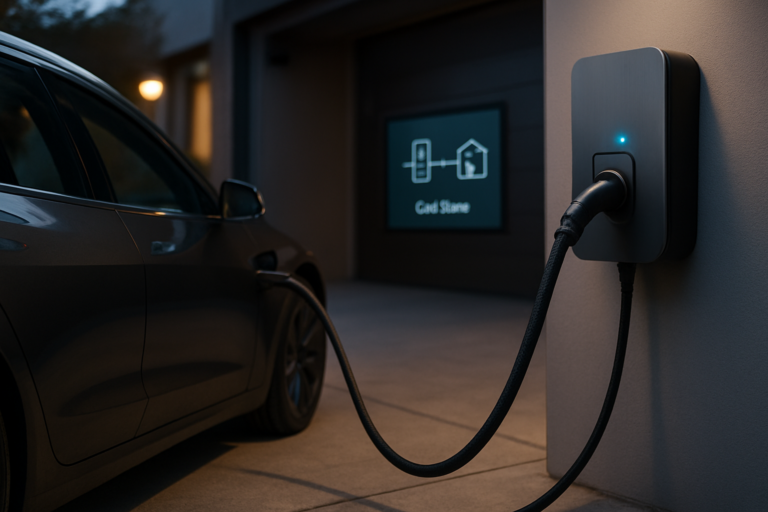
The car you drive to work every day might soon do more than just get you from point A to point B. Imagine it earning you money while sitting in your garage, or helping keep the lights on in your neighborhood during a heatwave. That’s the promise of Vehicle-to-Grid (V2G) technology—a system that turns electric vehicles into mobile power plants, capable of sending electricity back to the grid when it’s needed most.
At its core, V2G is about bidirectional energy flow. Instead of simply drawing power from the grid to charge the battery, a V2G-equipped EV can also discharge that stored energy back into the grid. This seemingly simple reversal has profound implications for energy management, renewable integration, and the economics of electric mobility.
How V2G Works
The magic happens through a bidirectional charger. Unlike a standard charger that only converts AC (alternating current) from the grid into DC (direct current) for the battery, a bidirectional charger can also convert DC from the battery back into AC to feed the grid. This requires both the vehicle and the charging station to support the protocol—usually CHAdeMO or CCS with V2G capability.
The Bidirectional Charging Ecosystem
- Vehicle: The EV must have a compatible onboard charger and battery management system that can handle frequent charge/discharge cycles without excessive degradation.
- Charger: The wallbox or public station must be bidirectional, often with an integrated inverter and communication module.
- Grid Connection: The utility or aggregator sends signals (via cellular or Wi-Fi) to the charger, telling it when to charge or discharge based on grid conditions.
- Owner Control: The driver sets preferences—for example, “I want to maintain 80% battery for tomorrow’s commute, but the rest can be used for grid services.”
When the grid is under stress—say, during a hot summer afternoon when air conditioners are running full blast—the utility can request power from a fleet of parked EVs. Each vehicle contributes a small amount, but aggregated, thousands of EVs can provide megawatts of capacity within seconds.
Why V2G Matters
The global energy transition is heavily dependent on intermittent renewable sources like solar and wind. These sources generate power when the sun shines or wind blows, not necessarily when demand peaks. Traditionally, grid operators have had to rely on peaker plants—natural gas turbines that are expensive, dirty, and inefficient—to fill the gap.
V2G offers a cleaner, faster, and potentially cheaper alternative. According to a 2023 study by the University of Delaware, a single EV participating in V2G services could earn between $2,000 and $5,000 per year, depending on market rates and driving patterns. That’s enough to offset a significant portion of the vehicle’s lease or purchase cost.
Benefits at a Glance
- Grid Stability: EVs can respond in milliseconds to frequency deviations, providing faster response than traditional power plants.
- Renewable Integration: Store excess solar or wind energy during the day and feed it back during evening peaks.
- Revenue for Owners: Drivers can monetize their parked vehicle, turning a depreciating asset into an income stream.
- Reduced Infrastructure Costs: Utilities can defer building new substations or peaker plants by leveraging distributed EV batteries.
- Emergency Backup: In a blackout, a V2G-capable EV can power a home for days (also known as Vehicle-to-Home, or V2H).
Real-World Implementations
V2G isn’t just a lab concept. Pilot projects are running worldwide. In Japan, Nissan’s LEAF to Home system has been available since 2013, allowing owners to power their houses during natural disasters. In the UK, the EDF and Nuvve partnership launched a V2G fleet for UPS delivery vans, demonstrating that commercial vehicles can also participate. Denmark has been a leader, using V2G to balance its wind-heavy grid.
A 2022 report from the International Energy Agency noted that if all EVs sold globally in 2023 were V2G-capable, they would provide about 10% of the world’s peak electricity demand—