
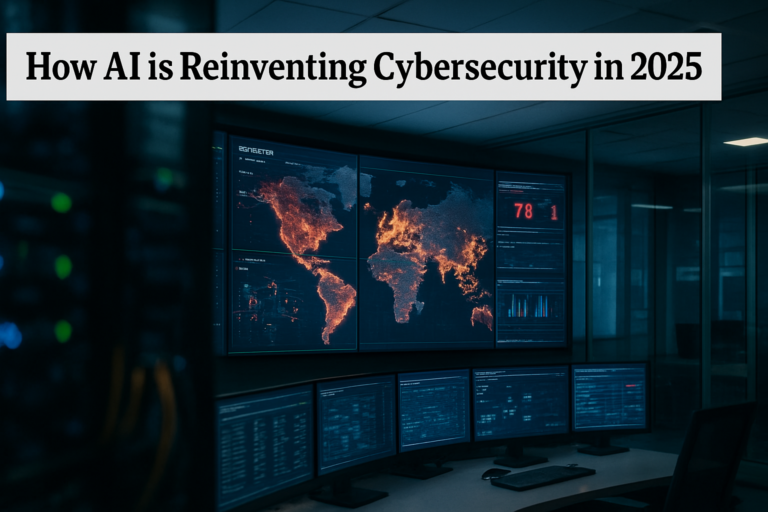
The cybersecurity landscape of 2025 looks nothing like it did even a few years ago. Cybercriminals now deploy AI-generated phishing campaigns at machine speed, while ransomware gangs use automated vulnerability discovery to breach networks in minutes. Defenders who relied solely on signature-based detection have been left behind. The reason is simple: the human brain and traditional rule-based systems can no longer keep pace with attacks that evolve faster than a patch can be deployed.
Enter artificial intelligence. This is the year AI stops being a buzzword and becomes the operational backbone of enterprise defense. From predictive threat hunting to self-healing systems, AI is not just assisting security teams — it is fundamentally reinventing how organizations detect, respond to, and recover from attacks.
The Changing Threat Landscape in 2025
To understand why AI is indispensable, you first have to understand the scale of the problem. Each year, the numbers get starker.
- Cybercrime is projected to cost the global economy $10.5 trillion annually by 2025, according to Cybersecurity Ventures.
- The average cost of a single data breach reached $4.88 million in 2024, the highest figure ever recorded in IBM’s Cost of a Data Breach Report.
- Ransomware attacks now occur roughly every 11 seconds, with threat actors leveraging AI to automate target selection and payload delivery.
Traditional security tools rely on known indicators of compromise — essentially, fingerprints of past attacks. But modern threats are polymorphic. They change their code, evade sandboxes, and hide inside legitimate network traffic. AI, by contrast, learns what normal behavior looks like and flags anomalies the moment they appear. That shift from reactive to predictive is the core of the 2025 cybersecurity revolution.
How AI Is Reinventing Cybersecurity
AI’s influence on cybersecurity is not a single monolithic feature; it spans the entire security lifecycle. Here is a look at the most impactful transformations happening right now.
Predictive Threat Detection
Instead of waiting for a breach to occur, AI-powered platforms analyze massive datasets to forecast attacks before they materialize. Machine learning models process billions of log entries, network flows, and endpoint telemetry points every day, looking for subtle patterns that indicate planning and reconnaissance.
For example, an AI system might notice a sequence of unusual DNS queries, followed by a spike in outbound traffic to a rarely used server, and correlate that with a newly disclosed vulnerability in a popular software package. Within seconds, it classifies this as a likely precursor to exploitation and alerts the security operations center (SOC). This predictive capability turns what used to be a five-hour manual investigation into a five-second automated warning.
Automated Incident Response
Speed is everything in a breach. The average time to identify and contain a breach in 2024 was 258 days, according to IBM — far too long for a threat actor to move laterally, steal data, and establish persistence.
AI-driven security orchestration, automation, and response (SOAR) platforms now handle containment actions in real time. A confirmed malware outbreak can trigger an automated response chain:
- The infected endpoint is isolated from the network.
- Credential tokens are revoked and rotated.
- Firewall rules are updated to block the attacker’s command-and-control server.
- A forensic snapshot is captured for later analysis.
These actions happen in seconds, without human intervention, minimizing the blast radius. Humans remain in the loop for complex decisions, but routine containment is now the domain of software.
AI-Enhanced Identity and Access Management
Stolen credentials remain the top attack vector in 2025. Passwords alone are no longer sufficient. AI is enabling a leap forward in identity verification through behavioral biometrics and continuous authentication.
Unlike static multi-factor authentication, AI-based systems learn how each user types, moves the mouse, and navigates applications. When an account behaves differently — such as a login at 3 a.m. from an unfamiliar location combined with jerky, unnatural mouse movements — the system flags it as high-risk and escalates authentication requirements. This makes credential stuffing and session hijacking considerably harder to execute.
Zero Trust Architecture Powered by AI
Zero Trust is now the dominant security framework in enterprise environments. The