
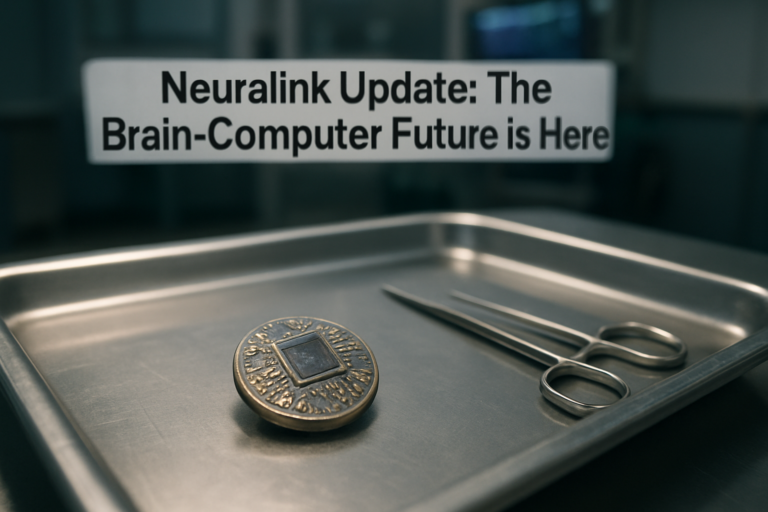
The idea of controlling a computer with your mind has long been the stuff of science fiction. But in 2024, that fiction became reality. Neuralink, Elon Musk’s neurotechnology company, implanted its first brain-computer interface (BCI) in a human patient. The result? A paralyzed individual moving a cursor just by thinking. This wasn’t a lab demo or a staged press event—it was a peer-reviewed milestone published in medical journals. The brain-computer future is no longer a distant promise; it is happening now, and it is evolving faster than most people realize.
What Is Neuralink and Why Does It Matter?
Neuralink is a company developing implantable brain-machine interfaces. Its core device, often called the “Link,” is a coin-sized chip surgically placed into the skull. Ultra-thin, flexible threads—thinner than a human hair—fan out into the brain tissue to read neural signals. These signals are then decoded by algorithms and translated into digital commands.
Unlike earlier BCIs that required bulky external hardware or invasive open-brain surgery, Neuralink’s approach is minimally invasive. The device is inserted by a specialized robot that avoids blood vessels, reducing scarring and infection risk. Once implanted, the Link is wireless and rechargeable, allowing patients to move freely.
The significance goes far beyond novelty. For people with paralysis, locked-in syndrome, or severe motor disabilities, a BCI can restore independence. It can enable communication, control of prosthetic limbs, or operation of computers and smartphones. Neuralink’s first human trial, named PRIME Study, focuses on helping quadriplegics control external devices with thought alone.
The Latest Neuralink Update: What Has Changed?
Neuralink has made several critical advances since its first human implant in January 2024. Here are the key updates:
- First Patient Success: Noland Arbaugh, a 29-year-old quadriplegic, received the Link and within weeks was able to play chess, browse the internet, and use a computer mouse—all with his mind. He reported that the device felt “intuitive” and required minimal training.
- Improved Algorithm Stability: Early issues with electrode signal drift were addressed through software updates. The device now maintains consistent performance over months, a major hurdle for long-term BCI viability.
- Second Implant Approved: In mid-2024, Neuralink received FDA approval for a second human implant, expanding the trial to more participants. This marks a shift from proof-of-concept to scalable testing.
- Wireless Charging and Data Transfer: The Link’s battery life has been extended to over 12 hours, with wireless charging via a custom cap. Data streams continuously to a smartphone app, allowing patients to calibrate settings independently.
- Blindness Restoration Research: Neuralink announced a separate program, “Blindsight,” aimed at restoring vision by stimulating the visual cortex. Early animal studies show promising results in generating artificial visual patterns.
These updates are not incremental—they represent a leap from laboratory curiosity to functional medical device.
How Brain-Computer Interfaces Are Transforming Healthcare
The immediate impact of Neuralink’s technology is in neurorehabilitation. But the potential applications span multiple medical fields.
Restoring Movement and Communication
For patients with spinal cord injuries, stroke, or ALS, BCIs can bypass damaged neural pathways. The Link reads motor cortex signals and sends them to a computer, which then controls a cursor, wheelchair, or robotic arm. This restores a degree of agency that is life-changing.
Treating Neurological Disorders
Neuralink’s high-resolution electrode arrays can also stimulate specific brain regions. This opens the door to treating epilepsy, Parkinson’s disease, chronic depression, and obsessive-compulsive disorder. Deep brain stimulation (DBS) already exists, but Neuralink’s system is far more precise and adaptable.
Sensory Restoration
The “Blindsight” project targets the visual cortex. If successful, it could provide rudimentary vision to people who have lost their sight due to eye damage or optic nerve injury. Similarly, auditory cortex stimulation might help with certain forms of deafness.
The Ethical Landscape: Promise vs. Peril
With any transformative technology, ethical questions arise. Neuralink is no exception.
- Privacy of Thought: If a device reads neural signals, who owns that data? Could it be hacked or misused? Neuralink claims encryption and local processing, but the risk remains theoretical.
- Equity and Access: BCIs are expensive to implant and maintain. Will they only be available to the wealthy? Musk has stated a goal of reducing cost to a few thousand dollars, but that is years away.
- Cognitive Enhancement: Once BCIs can improve memory or learning speed, they become not just medical devices but enhancement tools. This raises fairness concerns in education and employment.
- Long-Term Safety: The human body reacts to foreign objects. Inflammation, scar tissue, and device degradation are real risks. Neuralink’s animal testing faced scrutiny, though human trials have so far shown no serious adverse effects.
The conversation around BCIs must include regulators, bioethicists, and patient advocacy groups. The technology is moving faster than policy can keep up.
The Road Ahead: What to Expect in the Next Five Years
Neuralink is not alone in the BCI race. Competitors like Synchron (with a stent-based implant) and Blackrock Neurotech are also advancing. But Neuralink’s combination of high channel count, wireless design, and aggressive timeline gives it a unique edge.
- 2025–2026: Expanded human trials with dozens of participants. Focus on refining the user interface and reducing surgical time.
- 2027: Potential FDA approval for commercial use in paralysis and communication disorders.
- 2028–2030: Consumer-grade applications