
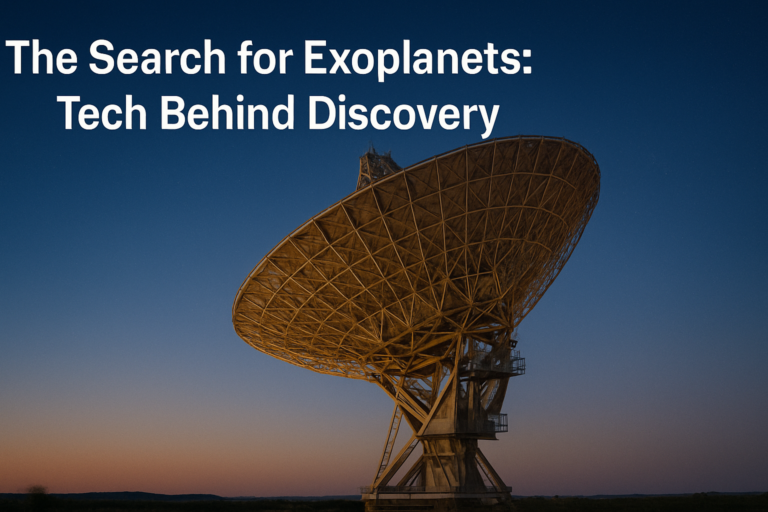
Every star you see in the night sky could be hiding a family of planets. A decade ago, we knew of none outside our solar system. Today, astronomers have confirmed over 5,500 exoplanets, and the count keeps climbing. This explosive growth didn’t happen by accident—it’s the direct result of a quiet technological revolution in telescopes, sensors, and data processing. The search for exoplanets is not just an astronomical endeavor; it’s a showcase of human ingenuity, where precision engineering meets big data. Let’s look under the hood of the machines that are rewriting our place in the cosmos.
The Transit Method: How Kepler Changed Everything
The most successful planet-hunting technique is the transit method. It works like a cosmic shadow play: when a planet passes in front of its host star, it blocks a tiny fraction of the star’s light. By measuring that dip in brightness (typically less than 1%), scientists can infer the planet’s size and orbital period.
NASA’s Kepler Space Telescope (launched 2009) was the pioneer. It stared at a single patch of sky in the Cygnus region for nearly a decade, monitoring over 150,000 stars simultaneously. The results were staggering:
- Over 2,600 confirmed exoplanets.
- Showed that rocky, Earth-sized planets are common.
- Revealed the existence of “super-Earths” and mini-Neptunes.
Kepler’s photometer was a marvel: it could detect brightness changes of just 20 parts per million. That’s like noticing a flea crawling across a car headlight from a mile away.
TESS (Transiting Exoplanet Survey Satellite), launched in 2018, expanded the search. Instead of a single patch, TESS covers almost the entire sky. It uses four wide-field cameras, each equipped with a 10.5-cm aperture, to monitor the brightest stars for transits. As of 2025, TESS has discovered over 400 confirmed exoplanets, with thousands more candidates waiting for follow-up.
Key hardware components:
- High-precision CCD detectors
- Ultra-stable pointing systems
- Large field-of-view optics (TESS covers 24° × 24° per camera)
- Onboard data storage and downlink for continuous monitoring
Radial Velocity: Detecting Wobbles
The transit method only works if the planet’s orbit is aligned with our line of sight. For planets that don’t transit, astronomers use the radial velocity (RV) technique. As a planet tugs gravitationally on its star, the star wobbles—moving slightly toward and away from Earth. This shift alters the star’s spectral lines via the Doppler effect.
Measuring these tiny velocity changes—often just meters per second—requires extreme spectral precision. The HARPS (High Accuracy Radial velocity Planet Searcher) instrument on the 3.6-meter telescope in Chile is a workhorse. Its spectrograph is enclosed in a vacuum chamber and temperature-controlled to within a few thousandths of a degree to avoid thermal drift.
- HARPS can detect radial velocity variations of ~1 m/s.
- Future instruments like ESPRESSO (also on VLT) aim for 10 cm/s precision.
- Combined with transit data, RV gives planetary density—key to understanding composition.
Direct Imaging and Microlensing
Directly photographing an exoplanet is incredibly hard because the planet is billions of times fainter than its star. Yet technology is catching up. Coronagraphs block the star’s light, allowing instruments like the James Webb Space Telescope (JWST) to capture images of young, hot planets.
- JWST’s NIRCam and MIRI instruments use coronagraphs for high-contrast imaging.
- The Nancy Grace Roman Space Telescope (launch 2027) will carry a coronagraph instrument with 1000:1 contrast ratio improvement over current tech.
Gravitational microlensing relies on Einstein’s general relativity. When a foreground star passes near a background star, its gravity bends and magnifies light. If the foreground star has a planet, the magnification pattern gets a telltale deviation. This method can detect planets as small as Mars and at large distances from their star—where other methods struggle.
- Microlensing surveys like OGLE and MOA have found dozens of planets.
- Future space missions (e.g., WFIRST/Roman) will use microlensing to find free-floating planets.
The Role of AI and Big Data
Kepler’s raw light curves—timed brightness measurements—contain thousands of points. Initially, scientists visually inspected every curve to look for transit signals. But with 150,000+ stars, that’s not scalable. Enter machine learning.
In 2017, Google AI researchers trained a neural network on labeled Kepler data. The model, called AstroNet, found two previously missed planets. Its success came from learning subtle