
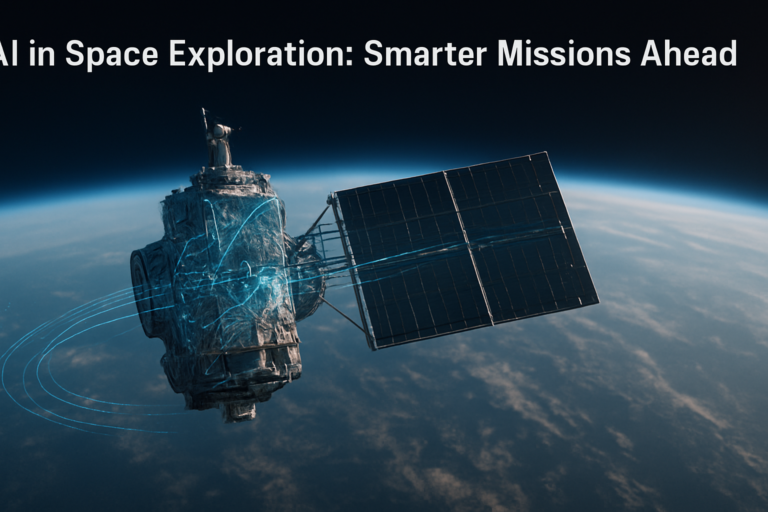
The final frontier is no longer just for human explorers—artificial intelligence is now steering the course of space missions. From guiding rovers across Martian craters to analyzing massive streams of data from distant galaxies, AI has become the silent co-pilot of modern space exploration. As agencies like NASA, ESA, and private players like SpaceX and Blue Origin push deeper into the solar system, they are increasingly relying on machine learning and autonomous systems to overcome the immense challenges of distance, time delay, and complexity.
AI in space exploration isn’t about replacing astronauts—it’s about making missions smarter, faster, and more resilient. In an environment where a single wrong calculation can cost billions and risk lives, AI provides the adaptability needed to navigate the unknown.
How AI is Transforming Space Missions
Spacecraft have always been heavily programmed, but traditional software follows rigid rules. AI introduces flexibility. Machine learning models can be trained on vast datasets of planetary surfaces, orbital mechanics, or telescope images, enabling spacecraft to make real-time decisions without waiting for commands from Earth.
Autonomous Navigation and Rovers
One of the most visible applications is in autonomous navigation for planetary rovers. NASA’s Perseverance rover, which landed on Mars in 2021, uses an AI system called AutoNav to drive around obstacles and choose efficient paths across the Jezero Crater. Previously, rovers like Opportunity relied on human operators to plan each movement—a slow, painstaking process. Perseverance can cover more ground in a single day than its predecessors could in a week.
- Self-driving algorithms process stereo camera images to build 3D terrain maps.
- Obstacle avoidance runs on dedicated onboard processors, reducing latency.
- AI prioritizes science targets, such as rocks with unusual spectral signatures.
Beyond rovers, AI is used for landing systems. The “terrain relative navigation” on the Perseverance descent stage used pre-loaded maps and real-time image matching to steer away from hazardous boulders—a feat impossible without machine learning.
AI in Spacecraft Operations and Maintenance
Satellites and deep-space probes often operate millions of kilometers from Earth. Signal delays—up to 20 minutes one-way to Mars—make remote control impractical for time-sensitive tasks. AI enables spacecraft to self-diagnose and correct anomalies.
Predictive Maintenance and Anomaly Detection
The European Space Agency’s (ESA) OPS-SAT mission has tested machine learning models that monitor satellite health data in real time. By analyzing telemetry from temperature sensors, gyroscopes, and power systems, AI can predict component failures before they happen. This shifts satellite operations from reactive to proactive.
Key benefits include:
- Reduced downtime by scheduling repairs during maintenance windows.
- Lower communication bandwidth usage—alerts are sent only when issues are flagged.
- Extended operational lifetime through optimized power and thermal management.
For example, a recurrent neural network (RNN) trained on historical telemetry can detect subtle deviations in battery voltage that precede a short circuit. Such models are now being integrated into next-generation satellite platforms.
Deep-Space Data Analysis: Finding Needles in a Cosmic Haystack
Modern telescopes and space observatories generate petabytes of data. The James Webb Space Telescope (JWST) alone streams over 50 gigabytes of raw observations per day. Manually sifting through that data to identify new galaxies, exoplanets, or asteroids is impossible.
AI-Powered Exoplanet Discovery
AI has already proven its worth in exoplanet hunting. The Kepler space telescope’s data was analyzed by a neural network called AstroNet, which discovered two previously undetected exoplanets, including Kepler-90i. Machine learning models can identify the faint, periodic dimming of stars caused by transiting planets—pattern recognition that humans often miss.
In 2023, researchers used a convolution neural network (CNN) to analyze data from NASA’s TESS mission, identifying over 300 candidate exoplanets in a few hours—a task that would have taken weeks for human scientists.
Classifying Galactic Objects
AI also classifies galaxies, supernovae, and asteroids. The Zooniverse project harnesses citizen scientists, but machine learning now complements it. Google’s AI trained on Hubble images can now classify galaxies with 98% accuracy, helping astronomers focus on the most unusual objects.
AI and Human Spaceflight
While much of the focus is on robotic missions, AI plays a growing role in crewed spaceflight. The International Space Station (ISS) uses AI assistants like CIMON (Crew Interactive MObile companioN), developed by Airbus and IBM, to help astronauts with experiments and procedures. CIM