
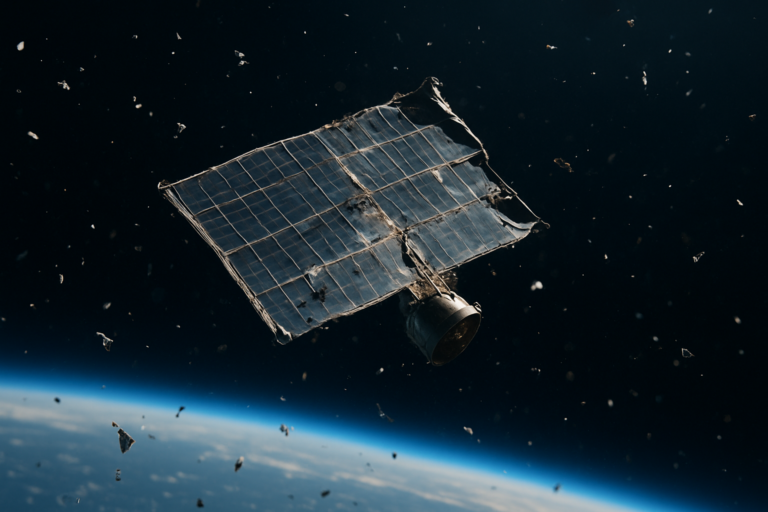
The vast emptiness of space is an illusion. In reality, low Earth orbit (LEO) is becoming a congested highway of active satellites, derelict spacecraft, spent rocket stages, and millions of fragments—collectively known as space debris. What was once a pristine environment is now littered with humanity’s leftovers, and the invisible cloud of junk orbiting our planet is growing at an alarming rate. For every functioning satellite—whether for communication, navigation, Earth observation, or defense—the threat of a catastrophic collision is no longer theoretical. It is a daily operational reality.
The Scale of the Problem
The numbers are staggering. According to the European Space Agency (ESA), there are over 36,500 objects larger than 10 cm tracked in orbit. Additionally, there are an estimated 1 million pieces of debris between 1 cm and 10 cm, and over 130 million pieces smaller than 1 cm. Even a fleck of paint traveling at 7.8 km/s (roughly 28,000 km/h) can puncture a satellite’s hull or shatter a solar panel.
- Largest contributors: China’s 2007 anti-satellite test (Fengyun-1C) and the 2009 Iridium-Cosmos collision each added thousands of debris fragments.
- Recent events: In 2021, Russia’s destructive ASAT test (Cosmos 1408) created over 1,500 trackable pieces.
- Growth rate: ESA reports that the total mass of objects in orbit exceeds 10,000 metric tons, and the number of debris objects is increasing by roughly 200–300 per year due to fragmentation events.
Why Space Debris Matters
Every satellite operator must dodge debris on a weekly, sometimes daily, basis. The consequences of a collision range from minor damage to total loss of the satellite, generating even more debris in a cascade effect known as Kessler Syndrome.
Collision Risks and Real Incidents
- 2009 Iridium-Cosmos Collision: Two intact satellites—one active—collided, creating over 2,000 new fragments.
- 2016 Sentinel-1A impact: A small debris particle (less than 1 cm) hit a solar panel of ESA’s radar satellite, causing a 1% power loss.
- 2023 ISS evasions: The International Space Station performed three debris avoidance maneuvers in 2023 alone, each costing fuel and scientific time.
Impact on Critical Infrastructure
We rely on satellites for:
- Global communications (including broadband from SpaceX, OneWeb, Amazon)
- GPS and timing services (banking, power grids, air travel)
- Weather forecasting and climate monitoring
- Defense and intelligence
- Internet connectivity in remote areas
A single debris-induced failure of a key satellite could disrupt navigation systems, delay weather updates, or sever communication links in conflict zones.
The Kessler Syndrome Threat
Proposed by NASA scientist Donald Kessler in 1978, the theory predicts that once debris density reaches a critical threshold, collisions become self-sustaining. Each breakup creates more fragments, increasing the probability of further collisions—a runaway chain reaction that could render certain orbital bands unusable for generations.
We are not there yet, but the tipping point may be closer than we think. Studies suggest that in LEO altitudes between 600–900 km, where many Earth observation and communication satellites reside, the debris density is already high enough to cause periodic collisions.
How We Track and Avoid Debris
Two major organizations maintain space debris catalogs: the U.S. Space Surveillance Network (SSN) and the European Space Surveillance and Tracking (EUSST) system. They track objects larger than about 10 cm using ground-based radars and optical telescopes.
Conjunction Alerts
When a satellite’s predicted orbit comes within a few kilometers of a tracked debris object, an alert is issued. Operators then decide whether to perform a collision avoidance maneuver, which typically involves firing thrusters to raise or lower the orbit—a fuel-intensive process that shortens the satellite’s mission life.
- Average maneuvers per satellite: 1–2 per year for Starlink; for Hubble, 4 per year.
- False alarm rate: Many alerts are low-probability, but cautious operators err on the side of moving.
Mitigation: What Is Being Done
The space community has recognized the urgency. Several strategies are under implementation or development.
Design and End-of-Life Rules
- 25-Year Rule: Since 2002, many agencies require satellites to deorbit within 25 years of mission end; however, the rule is not universally followed.
- Passivation: Draining fuel and batteries at end of life to prevent explosions.
- Lower orbits: New mega-constellations like Starlink operate at ~550 km, where atmospheric drag naturally removes debris within a few years.
Active Debris Removal (ADR)
Several missions are planned or underway:
- ClearSpace-1 (ESA): Planned for 2026 to capture a defunct payload adapter using robotic arms.
- Astroscale’s ELSA-d: Demonstrated magnetic capture of debris in orbit (2021–2023).
- Japan’s JAXA: Experimented with electrodynamic tether technology.
Regulatory and Policy Efforts
The United Nations Committee on the Peaceful Uses of Outer Space (COPUOS) has adopted guidelines, but they are non-binding. The U.S. Federal Communications Commission (FCC) recently adopted a new rule requiring deorbiting timelines for satellite constellations. Yet enforcement remains inconsistent.
The Future: Can We Clean Up Space?
The technical and economic hurdles are immense. ADR missions cost hundreds of millions of dollars per target, and the legal framework for removing another country’s spacecraft is murky. Nonetheless, commercial startups and national space agencies are investing in solutions.
Promising Technologies
- Laser ablation: Ground- or space-based lasers can nudge debris by vaporizing surface material.
- Harpoon and net capture: RemoveDEBRIS satellite (2018) tested a net and harpoon successfully.
- Sails and drag devices: Deployable sails increase drag to deorbit satellites faster.
- Robotic arms: Precision capture for large debris.
Conclusion
Space debris is not a distant future problem—it is a present-day challenge that threatens the orbital infrastructure we depend on. Without aggressive mitigation and removal efforts, we risk losing the very satellites that enable modern life. The choices made today by operators, regulators, and innovators will determine whether Earth’s orbit remains a sustainable resource or becomes a hazardous junkyard. The clock is ticking, and every new launch adds another layer of risk—but also brings new opportunities to build a cleaner, safer space environment.