
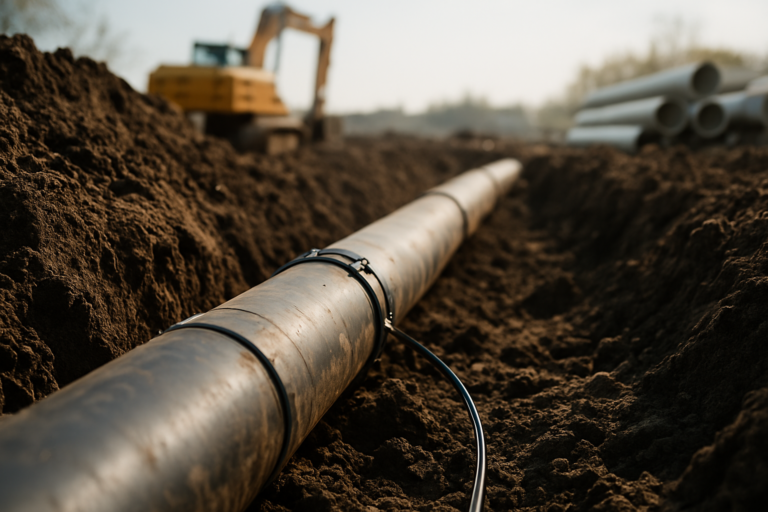
Every day, thousands of kilometers of underground pipelines carry oil, gas, water, and chemicals beneath our cities and industrial zones. These assets are invisible, often aging, and vulnerable to leaks, ground movement, and accidental damage. Traditional inspection methods require excavation or expensive periodic surveys, leaving long intervals where failures can go undetected. Distributed fiber sensing (DFS) changes that by turning a simple fiber optic cable into a continuous, real‑time monitoring system that can “hear” and “feel” changes along the entire length of a buried pipeline.
How Distributed Fiber Sensing Works
Distributed fiber sensing relies on the fact that light traveling through a glass fiber is subtly altered by external stimuli. By sending a laser pulse down the fiber and analyzing the backscattered light, a single interrogator unit at one end can measure thousands of points along the cable simultaneously. The two most common techniques are Distributed Acoustic Sensing (DAS) and Distributed Temperature Sensing (DTS).
Acoustic Sensing (DAS) for Leak Detection
DAS uses the fiber to detect acoustic vibrations. When a liquid or gas escapes a pipeline under pressure, it creates a distinct acoustic signature—a hiss, a jetting sound, or a low‑frequency rumble. The DAS system picks up these vibrations along the fiber, often up to 50 km from the interrogator. Advanced algorithms filter out background noise (traffic, construction) and pinpoint the leak’s location within a few meters.
Temperature Sensing (DTS) for Thermal Anomalies
DTS measures the temperature profile along the fiber. A leak of hot oil or cold water creates a thermal anomaly that stands out against the surrounding soil temperature. DTS can also detect ground freezing or thawing that might compromise pipeline stability. Combined, DAS and DTS provide a comprehensive picture of asset health.
Applications in Pipeline Integrity
Distributed fiber sensing is deployed across a wide range of underground infrastructure, from long‑distance transmission lines to urban water networks. Key applications include:
- Leak detection and localization – DAS can identify leaks as small as 1% of the flow rate, often within minutes of occurrence.
- Third‑party intrusion detection – Excavation, drilling, or heavy machinery near a pipeline generates ground vibrations that DAS recognizes and alerts operators.
- Ground movement monitoring – Landslides, subsidence, or seismic activity strain the fiber, causing changes in the backscattered light that indicate structural shifts.
- Cathodic protection monitoring – Fiber can be used to measure voltage gradients along the pipe, verifying that corrosion protection systems are working.
- Temperature profiling for product quality – In heated pipelines (e.g., heavy crude), DTS ensures the product stays above pour‑point temperatures.
Advantages Over Traditional Methods
Traditional pipeline monitoring relies on periodic patrols, aerial surveys, or inline inspection tools (pigs) that travel through the pipe. These methods are expensive, require service interruption, and leave long blind periods. Distributed fiber sensing offers several distinct benefits:
- Continuous, real‑time coverage – The fiber acts as a sensor 24/7, providing alerts within seconds of an event.
- Long range – A single interrogator can monitor 50–100 km of pipeline, reducing equipment cost per kilometer.
- Passive and safe – The fiber itself carries no electricity, making it ideal for hazardous environments.
- Minimal excavation – Fiber can be installed in the same trench as the pipeline or retrofitted into existing conduits.
- High spatial resolution – Events can be located to within 1–10 m, depending on the system.
Real‑World Deployments and Statistics
Distributed fiber sensing is no longer experimental. Major oil and gas companies, water utilities, and pipeline operators have adopted the technology. For example:
- A 2019 study by the Pipeline Research Council International found that DAS achieved a leak detection probability of >95% for leaks as small as 0.5