
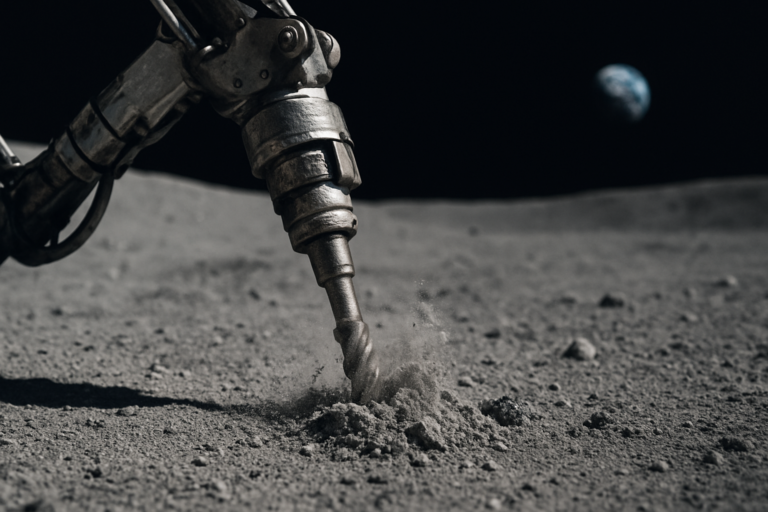
The moon has long been a symbol of human ambition, but its most profound impact may soon be measured in economic terms. What was once the stuff of science fiction—mining the lunar surface for valuable resources—is rapidly becoming a tangible, near-term business proposition. This shift from pure exploration to extraction is not merely a technological challenge; it represents a potential reordering of global industries, from energy to manufacturing, and it is unfolding faster than many realize.
The core driver of this lunar gold rush is the moon’s unique resource endowment, a body of materials radically different from Earth’s. The lunar regolith, the fine, powdery layer covering the surface, is rich in oxygen, silicon, and metals like aluminum, iron, and titanium. But the most economically transformative resources are far more exotic. Helium-3, an isotope rare on Earth, is abundant on the moon, deposited by the solar wind over billions of years. It is a potential fuel for next-generation nuclear fusion reactors, promising clean, safe, and nearly limitless energy. A single Space Shuttle payload of Helium-3 could theoretically power the entire United States for a year. Then there is water ice, locked in permanently shadowed craters at the poles. Water is the lifeblood of space exploration—it provides drinking water, breathable oxygen, and, when split into hydrogen and oxygen, rocket fuel. The ability to refuel spacecraft on the lunar surface would dramatically lower the cost of deep-space missions, including manned trips to Mars.
The economic logic is compelling: why launch expensive resources from Earth’s deep gravity well when you can source them from a celestial body with one-sixth the gravity? This concept, known as In-Situ Resource Utilization (ISRU), is the bedrock upon which lunar industry will be built. According to a 2023 report from the World Economic Forum, the global space economy is projected to reach $1.8 trillion by 2035, with significant growth driven by access to extraterrestrial resources. While initial operations will be capital-intensive, the long-term payoff for infrastructure and energy companies is staggering.
Private enterprise is already leading the charge. Companies like SpaceX and Blue Origin are developing heavy-lift launch vehicles that can deliver cargo to the lunar surface at a fraction of current costs. ispace, a Japanese lunar robotics company, is conducting commercial missions to prospect for resources. Meanwhile, Lockheed Martin and Northrop Grumman are designing landers and habitats for NASA’s Artemis program, which explicitly aims to establish a long-term human presence and develop a lunar economy. The US government, through the Artemis Accords, has also set a legal framework for resource extraction, asserting the right to own and sell resources mined from the moon. This is not mere speculation; it is a deliberate, funded strategy.
The technological innovations required for moon mining are equally significant and will inevitably have spillover effects on Earth. Here are the key areas of development:
- Autonomous Robotics: Mining systems must operate without human intervention for long periods. This is driving breakthroughs in AI-driven navigation, hazard avoidance, and remote operation in extreme environments.
- Advanced Power Systems: Solar power is abundant on the moon, but two-week-long nights require robust energy storage. This is pushing the development of high-capacity, durable batteries and novel concepts like nuclear fission reactors for surface power.
- Extraction & Processing: The challenge of digging, crushing, and chemically processing the abrasive and static-charged lunar regolith is immense. Engineers are developing new materials and techniques for dust mitigation and efficient mineral separation.
- In-Space Manufacturing: 3D printing using lunar regolith as feedstock is being tested to build habitats, roads, and landing pads, dramatically reducing the need for supplies from Earth.
Despite the excitement, significant barriers remain. The initial cost of developing and deploying the necessary infrastructure is astronomical—literally and figuratively. Estimates for a full-scale lunar mining operation run into tens of billions of dollars. Furthermore, the regulatory landscape is still nascent. The 1967 Outer Space Treaty prohibits national appropriation of celestial bodies, but the legal status of commercial resource rights is contested. This ambiguity creates risk for investors and operators.
The environmental and ethical considerations also demand attention. The moon is a pristine scientific archive of the early solar system. Poorly managed mining operations could destroy valuable geological sites. International cooperation and robust regulations will be crucial to ensure lunar development is sustainable and beneficial for all humanity, not just a handful of companies and nations.
Yet, the momentum is undeniable. We are standing at the precipice of a new economic frontier, one defined not by geography, but by gravity. The first trillionaire, it has been said, will be made in space. While that may be an ambitious prediction, the path to that fortune begins with the dust beneath a robotic rover’s treads on the Sea of Tranquility. Moon mining is not a distant fantasy; it is the next great industrial revolution, and its foundations are being laid right now. The question is no longer if we will mine the moon, but who will profit, how sustainably, and what that future will look like.