
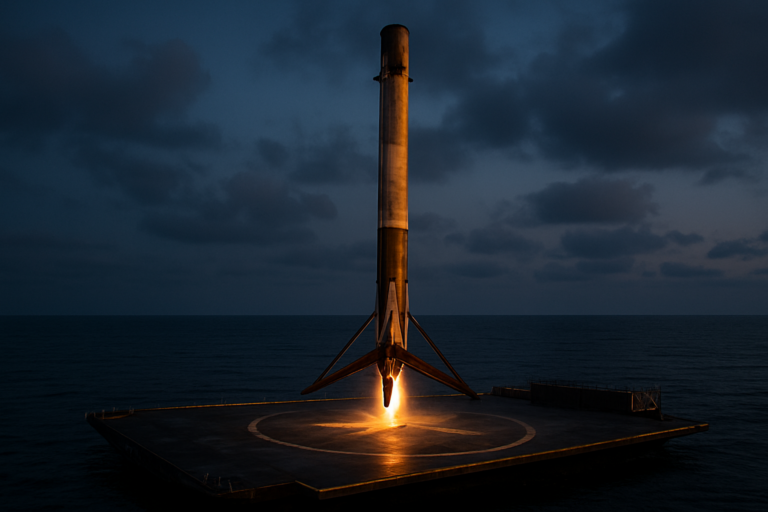
The sight of a rocket booster gently touching down on a drone ship, its landing legs absorbing the final impact, was once the stuff of science fiction. Today, it is a routine spectacle, a testament to a paradigm shift in aerospace engineering. This transformation was not gradual; it was a revolution spearheaded by one company: SpaceX. The concept of reusable rockets, long dismissed as impractical, has fundamentally altered the economics and ambition of space travel. By proving that rockets can be flown, recovered, and flown again, SpaceX has not just changed a single industry—it has rewritten the rules of what is possible.
For decades, the space industry operated on a disposable model. Every launch was a single-use event. The most expensive and complex components of a rocket—the first stage, the engines, the avionics—were either discarded into the ocean or left to burn up in the atmosphere. This approach made space access prohibitively expensive, costing hundreds of millions of dollars per launch. The underlying assumption was that rockets were inherently expendable, a cost of doing business in the final frontier. This mindset stifled innovation and limited access to space to only the wealthiest governments and corporations.
SpaceX, founded by Elon Musk in 2002, challenged this orthodoxy from the outset. The company’s core philosophy was that reusability was the key to making humanity a multi-planetary species. The logic was simple: if you could reuse the most expensive part of the rocket, the cost per launch would plummet. The challenge, however, was immense. No one had successfully landed an orbital-class rocket booster vertically. The physics were brutal, requiring precise control, rapid engine restarts, and a landing platform that could hold steady in the ocean.
The journey was marked by spectacular failures. Early attempts at landing the Falcon 9’s first stage on a drone ship ended in explosions, with the rocket tipping over or crashing into the deck. These public failures, streamed live for the world to see, were not signs of defeat but rather data points in an aggressive iterative design process. Each crash taught engineers something new about throttle control, grid fin aerodynamics, and landing leg deployment. The persistence paid off. In December 2015, SpaceX achieved the first-ever successful landing of an orbital rocket booster on land. A few months later, in April 2016, they nailed the first landing on a drone ship at sea.
The impact of this achievement cannot be overstated. The Falcon 9, once a single-use vehicle, became a reusable workhorse. Today, a single Falcon 9 first stage can fly multiple times, with some boosters logging over a dozen missions. This reusability has driven launch costs down dramatically. Where a traditional expendable launch might cost $200 million or more, a SpaceX Falcon 9 launch is priced at around $67 million. This reduction has opened the door for a new wave of commercial space activity, from satellite mega-constellations like Starlink to dedicated rideshare missions for small satellites.
The economic ripple effects are profound. Lower launch costs have made space more accessible to startups, universities, and developing nations. It has enabled the deployment of massive satellite networks for global internet coverage, Earth observation, and scientific research. The cost savings also allow SpaceX to reinvest in more ambitious projects, such as the Starship program, which aims to create a fully reusable super-heavy lift vehicle capable of carrying humans to the Moon and Mars. Without the financial breathing room provided by Falcon 9 reusability, such ambitious goals would remain out of reach.
Beyond economics, reusable rockets have changed the operational tempo of spaceflight. In the expendable era, a launch campaign could take months of preparation. With a proven, flight-tested booster, the turnaround time between launches has shrunk to just a few weeks. This rapid cadence has allowed SpaceX to achieve launch frequencies that were previously unimaginable. In 2023 alone, the company conducted nearly 100 orbital launches, a pace that would have required an entire fleet of expendable rockets from any other provider. This operational efficiency is a direct result of reusability.
The technology behind these landings is a marvel of modern engineering. The Falcon 9’s first stage is equipped with grid fins that steer it through the atmosphere, cold gas thrusters for attitude control, and a powerful engine that can throttle down to a precise level for landing. The drone ships, named “Of Course I Still Love You” and “Just Read the Instructions,” are autonomous platforms equipped with GPS and dynamic positioning systems to maintain their position within a few meters. The entire landing sequence is automated, with the rocket’s computer making thousands of calculations per second to ensure a safe touchdown.
The success of SpaceX has forced the entire aerospace industry to adapt. Competitors like United Launch Alliance (ULA) and Blue Origin are now developing their own reusable rocket systems. ULA’s Vulcan Centaur is designed with an engine module that can be detached and recovered mid-air, while Blue Origin’s New Glenn features a fully reusable first stage. Even traditional space agencies like NASA and ESA are exploring reusability for future launch vehicles. The genie is out of the bottle; the era of disposable rockets is ending.
However, the path to reusability is not without its challenges. Refurbishing a flown booster still requires significant inspection and maintenance. Some components, like the heat shield and landing legs, experience wear and tear. The long-term durability of engines after multiple flights is still being studied. Yet, the data so far is encouraging. SpaceX has demonstrated that boosters can fly multiple times with minimal refurbishment, and the company continues to push the boundaries of how many times a single rocket can be reused.
The implications of this technology extend far beyond Earth’s orbit. Reusable rockets are the foundational technology for a future where space travel becomes routine and affordable. They enable the construction of large space stations, the mining of asteroids, and the eventual colonization of other planets. The cost reductions achieved by SpaceX have already made it feasible to consider missions that were previously dismissed as too expensive. For example, the Artemis program, which aims to return humans to the Moon, relies on SpaceX’s Starship as a lunar lander—a vehicle that is itself designed for full reusability.
In the broader context of technological innovation, the story of reusable rockets is a powerful lesson in challenging assumptions. The aerospace industry spent decades believing that reusability was impossible or uneconomical. SpaceX proved that with the right engineering culture, a willingness to fail, and a long-term vision, even the most entrenched paradigms can be overturned. The company’s approach—rapid prototyping, iterative testing, and a focus on cost reduction—has become a model for innovation in other industries, from electric vehicles to satellite internet.
As we look to the future, the impact of reusable rockets will only grow. The cost of launching payloads into space is expected to continue falling, potentially reaching a few hundred dollars per kilogram. This will unlock entirely new markets, such as space-based manufacturing, orbital tourism, and even large-scale solar power generation. The infrastructure for a spacefaring civilization is being built, one landing at a time. SpaceX did not just change everything; it made everything else possible.