
The global push toward renewable energy and carbon neutrality has placed unprecedented demands on electricity grids. Wind farms in the North Sea, solar plants in the Sahara, and hydropower stations in Scandinavia generate clean power, but they are often far from where it is needed most. The solution lies beneath the waves: High-Voltage Direct Current (HVDC) subsea interconnects. These undersea cables are transforming how nations exchange electricity, enabling efficient, long-distance transmission that was unimaginable just a few decades ago.
What Makes HVDC Subsea Interconnects Different?
Traditional alternating current (AC) transmission loses significant energy over long distances, especially underwater. The capacitance of AC cables causes reactive power losses, limiting practical undersea cable lengths to about 50–80 kilometers. HVDC overcomes this by converting AC to DC at the sending end, transmitting it as direct current, and converting it back to AC at the receiving end. This eliminates reactive losses and allows efficient transmission over distances exceeding 1,000 kilometers.
The core technology relies on voltage-source converters (VSC) or line-commutated converters (LCC). Modern VSC-based HVDC systems use insulated-gate bipolar transistors (IGBTs) to control voltage and power flow with high precision. They also enable black-start capability—restoring power after a blackout—and can connect weak AC grids that would otherwise be unstable.
Key Advantages for Cross-Border Energy Exchange
- Lower Losses Over Distance: HVDC losses are around 3% per 1,000 km, compared to 6–8% for HVAC.
- Bidirectional Flow: Power can be sent in either direction, allowing countries to export surplus renewable energy and import when needed.
- Asynchronous Connection: HVDC links can connect grids operating at different frequencies or phases, which is impossible with AC.
- Smaller Cable Cross-Section: DC cables require less copper or aluminum for the same power capacity, reducing cost and installation complexity.
- Environmental Footprint: Subsea cables have minimal visual impact and can be buried to protect marine habitats.
Landmark Projects That Prove the Concept
The world’s longest subsea HVDC interconnector is the North Sea Link (NSL), a 720 km cable between Norway and the UK, operational since 2021. With a capacity of 1,400 MW, it allows the UK to import Norwegian hydropower when wind is low, and export excess wind power to Norway. In its first year, NSL reduced CO₂ emissions by an estimated 23 million tonnes.
Other notable projects include:
- NorNed (580 MW, 580 km) – between Norway and the Netherlands, operational since 2008.
- BritNed (1,000 MW, 260 km) – between the UK and the Netherlands, operational since 2011.
- Viking Link (1,400 MW, 765 km) – between the UK and Denmark, completed in 2023.
- NEMO Link (1,000 MW, 140 km) – between the UK and Belgium, operational since 2019.
- COBRAcable (700 MW, 325 km) – between the Netherlands and Denmark, operational since 2019.
In Asia, the Bakun–Similajau link (1,100 km) in Malaysia and the Champa–Kurukshetra link in India demonstrate the technology’s viability for long overland and subsea routes. India’s North-East–West HVDC corridor, though primarily overhead, includes subsea sections in the Sundarbans.
The Technology Behind the Cables
A modern HVDC subsea cable is a sophisticated composite. The conductor is typically copper or aluminum, surrounded by layers of insulation (cross-linked polyethylene or mass-impregnated paper), a metallic sheath, and multiple armoring layers of steel wires. The entire assembly can be over 30 cm in diameter and weighs up to 50 kg per meter.
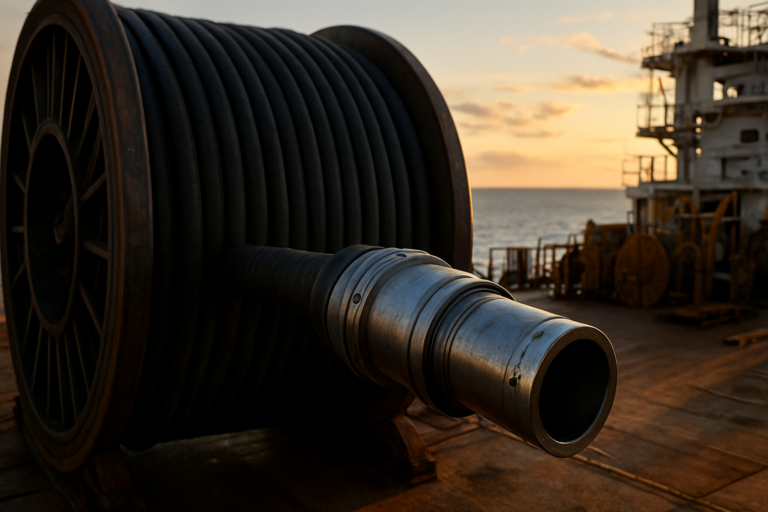
Cable-laying vessels carry enormous carousels that hold up to 10,000 tonnes of cable. The cable is paid out at a controlled speed, guided by remotely operated vehicles (ROVs) that bury it 1–3 meters below the seabed to protect against fishing trawls and anchors. The process can lay 5–10 km per day, depending on water depth and weather.
Integrating Renewable Energy at Scale
HVDC subsea interconnects are not just about trading electricity—they are critical for balancing variable renewable generation. The European Network of Transmission System Operators (ENTSO-E) estimates that by 2030, Europe will need over 100 GW of cross-border interconnection capacity to integrate 60% renewable electricity. Projects like the German–Norwegian interconnectors (NordLink, 1,400 MW) already allow Germany to export solar power during peak hours and import Norwegian hydropower at night.
Similarly, the Dogger Bank Wind Farm (3.6 GW) in the UK will use HVDC platforms to transmit power to shore via subsea cables. Each platform converts the wind farm’s AC output to DC for efficient transmission over long distances to an onshore converter station, where it is turned back into AC and fed into the national grid. Without HVDC, the reactive power losses on a cable of that length would make the project uneconomical.
Interconnectors also smooth out the natural variability of renewables. When the wind drops in the North Sea, power can flow in from Norwegian reservoirs; when wind output peaks, surplus electricity can be exported instead of curtailed. In effect, the subsea link turns separate national systems into one larger, more balanced resource pool.
Challenges and Risks
- High upfront cost – Converter stations and specialised cable-laying vessels make projects capital-intensive, often running into billions of euros.
- Long lead times – Permitting across multiple countries, seabed surveys and manufacturing bottlenecks for HVDC cable can stretch timelines to a decade.
- Cable faults – Anchors, fishing gear and seabed movement can damage cables, and offshore repairs take weeks.
- Regulatory alignment – Countries must agree on market rules, capacity allocation and cost sharing before power can flow.
- Security – Recent incidents involving damaged undersea infrastructure have made physical protection and monitoring a priority.
The Road Ahead: Meshed Offshore Grids
Today most interconnectors are point-to-point links. The next step is a meshed offshore grid, where multiple wind farms and countries connect through shared HVDC hubs. Advances in HVDC circuit breakers and multi-terminal voltage-source converters are making this technically possible, and initiatives around the North Sea aim to build such hubs in the 2030s. Longer links are also being proposed, such as connecting Europe with North African solar resources.
Conclusion
HVDC subsea interconnects are quietly becoming the backbone of cross-border energy exchange. By moving large amounts of power efficiently over long distances, they let countries share renewable resources, improve grid stability and reduce reliance on fossil fuels. Costs and permitting remain hurdles, but as more projects prove their value, the underwater highways of electricity will only grow in importance.