
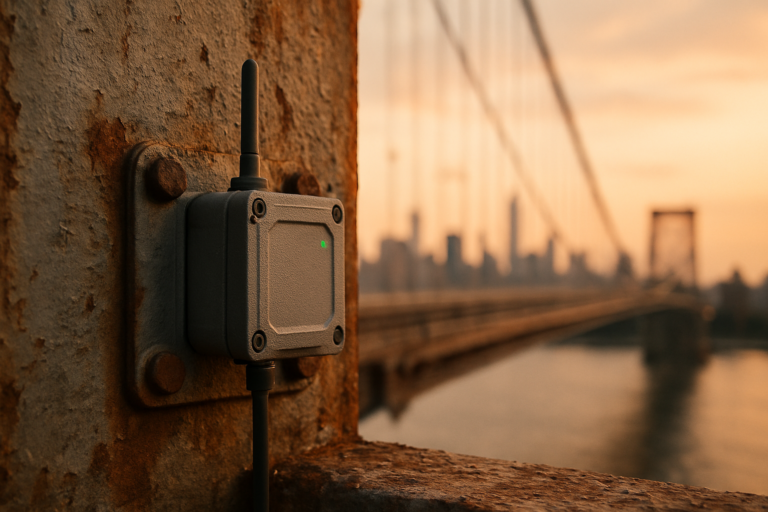
Every day, millions of people drive over bridges, walk through tunnels, and work in high-rise buildings without thinking about the structures holding them up.
Yet much of the world’s infrastructure is ageing. Many bridges and tunnels were built decades ago, and traditional inspection—engineers visually checking structures every year or two—can miss damage that develops between visits. Cognitive infrastructure changes that by combining sensors, connectivity and artificial intelligence so structures can effectively monitor their own health and warn us before problems become dangerous.
What Is Cognitive Infrastructure?
Cognitive infrastructure refers to bridges, tunnels, dams, buildings and other assets equipped with sensor networks and AI models that continuously analyse their condition. Instead of a snapshot inspection, owners get a constant stream of data about strain, vibration, tilt, cracks, corrosion and environmental conditions. AI turns that raw data into insights: where damage is forming, how fast it is growing and what action is needed.
How AI-Driven Structural Health Monitoring Works
- Sensing – Strain gauges, accelerometers, fibre-optic sensors, tilt meters, acoustic emission sensors and corrosion probes are installed at critical points.
- Connectivity – Data is transmitted through wired networks, LoRaWAN, cellular IoT or 5G to edge gateways and the cloud.
- Analysis – Machine-learning models learn the structure’s normal behaviour under traffic, wind and temperature changes, then flag anomalies that may indicate damage.
- Visual inspection with AI – Drones and cameras capture images that computer-vision models scan for cracks, spalling and rust far faster than human reviewers.
- Decision support – Dashboards and digital twins rank risks and recommend maintenance, load restrictions or closures.
Key Benefits
- Early warning – Detect fatigue cracks, settlement or cable deterioration long before they are visible.
- Safer public spaces – Automatic alerts can trigger traffic restrictions when a structure behaves abnormally, for example after an earthquake or flood.
- Lower lifecycle costs – Condition-based maintenance replaces costly emergency repairs and unnecessary scheduled work.
- Longer service life – Accurate data helps engineers safely extend the life of ageing assets instead of replacing them prematurely.
- Better planning – Governments can prioritise limited budgets based on real condition data.
Real-World Applications
Long-span bridges such as Hong Kong’s Tsing Ma Bridge and many cable-stayed bridges worldwide have used permanent monitoring systems for years. Today, the approach is spreading to tunnels, metro systems, dams, stadiums and tall buildings. After high-profile bridge collapses, several countries have accelerated programmes to instrument critical structures and combine sensor data with AI analytics.
Challenges to Overcome
- Cost of retrofitting – Installing sensors on existing structures can be expensive and disruptive.
- Power and durability – Sensors must survive harsh conditions for many years, ideally with low-power or energy-harvesting designs.
- Data quality and false alarms – Models must separate real damage from normal variations caused by weather and traffic.
- Standards and skills – Engineers need clear guidelines and training to trust and act on AI recommendations.
- Cybersecurity – Connected infrastructure must be protected from tampering.
The Future: Self-Aware Cities
As sensor costs fall, cognitive infrastructure will extend from individual landmark structures to entire networks. City-wide digital twins will combine data from bridges, roads, pipes and buildings, allowing authorities to predict how assets will respond to heavy traffic, floods or earthquakes. Some researchers are even developing self-healing concrete and smart materials that can sense and repair micro-cracks on their own.
Conclusion
AI-driven structural health monitoring turns static concrete and steel into intelligent, communicative assets. By continuously sensing and analysing their own condition, cognitive infrastructure helps prevent failures, cut maintenance costs and keep people safe. For ageing infrastructure around the world, giving structures the ability to “speak” may be one of the smartest investments we can make.