
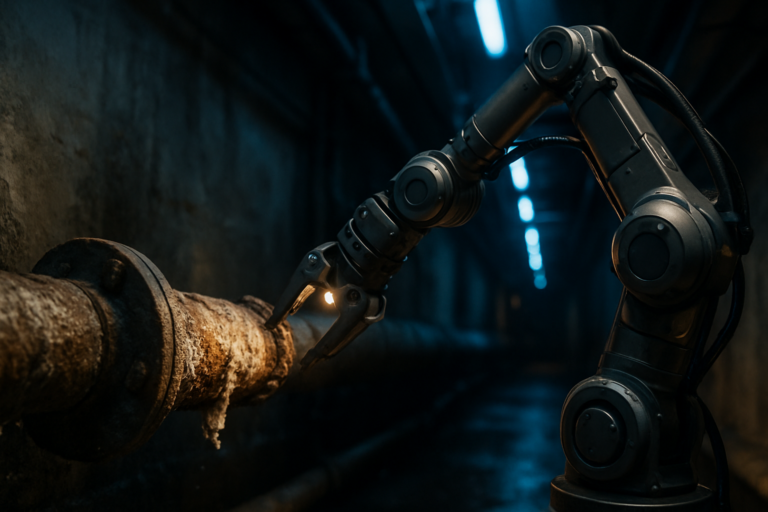
The lights flicker, the water stops flowing, and somewhere beneath the street, a pipe has ruptured. In most cities, this triggers a slow, expensive chain of human intervention: detection, inspection, excavation, and repair. But what if the infrastructure could heal itself? What if sensors detected the leak before it became a crisis, and a robotic system sealed it without a single human stepping into a muddy trench?
This is not science fiction. Autonomous infrastructure—powered by self-healing systems, intelligent sensors, and specialized robotics—is already moving from research labs into real-world deployment. The promise is massive: reduced downtime, lower maintenance costs, extended asset life, and a dramatic reduction in service disruptions. For utilities, transportation networks, and urban systems, this shift represents the next frontier of operational resilience.
The Anatomy of a Self-Healing System
A self-healing infrastructure system is built on three core layers: sensing, decision-making, and actuation. Each layer must work in near real-time, with minimal latency, to detect a fault, diagnose its severity, and execute a repair.
Intelligent Sensors: The Nervous System
At the foundation are dense networks of sensors embedded in critical infrastructure. These can be acoustic sensors that listen for the specific sound of a water leak, strain gauges that detect micro-cracks in a bridge, or temperature sensors monitoring power cables for overheating. Modern sensor nodes are low-power, wireless, and capable of edge computing—meaning they can process data locally and only send alerts when anomalies are detected.
A 2023 study by the International Water Association found that smart sensor networks can reduce water loss from leaks by up to 30% in urban distribution systems. For a city like London, which loses roughly 25% of its water to leaks, that translates to billions of liters saved annually.
AI and Digital Twins: The Brain
Raw sensor data is meaningless without context. This is where artificial intelligence and digital twin technology come in. A digital twin is a virtual replica of a physical asset—a pipeline, a power grid, or a road network—that continuously updates with real-world data. AI models running on the twin can simulate thousands of failure scenarios, identify patterns that precede breakdowns, and recommend the optimal repair strategy.
For example, a self-healing electrical grid can detect a faulted line, isolate the damaged section, and reroute power through alternative pathways in milliseconds—all without human input. This capability, known as fault location, isolation, and service restoration (FLISR), is already deployed in several smart grid projects across Europe and Asia.
Robotics and Drones: The Hands
Once a fault is identified and a repair plan is generated, the physical work begins. Here, robotics takes center stage. Specialized robots can crawl through pipes to seal cracks with epoxy, climb utility poles to replace damaged insulators, or fly drones to inspect high-voltage transmission lines.
One notable example is the PipeFish robot developed by researchers at the University of Sheffield. It swims through water mains, using sonar and cameras to detect leaks, then deploys a sealing mechanism that patches the pipe from the inside. The entire operation happens without digging a single trench.
Real-World Applications
Self-healing systems are not a monolithic technology; they are being adapted to different types of infrastructure with unique challenges.
- Water Distribution: Autonomous leak detection and repair systems can reduce non-revenue water loss by 20–40%. In Singapore, the national water agency PUB has deployed a network of sensors and robotic crawlers that continuously monitor the 5,500-kilometer pipe network.
- Power Grids: Self-healing grids use automated switches and reclosers to isolate faults and restore service. According to a 2022 report by the Electric Power Research Institute, utilities using FLISR technology have reduced outage duration by an average of 50–70%.
- Roads and Bridges: Embedded sensors in concrete can detect the onset of corrosion or cracking. When a threshold is crossed, a robotic system can inject self-healing materials—such as bacteria-based concrete or polymer sealants—directly into the affected area.
- Telecommunications: Fiber optic cables can be equipped with monitoring systems that detect breaks and trigger robotic splicing units to repair the connection. This is particularly valuable for undersea cables, where repair costs can exceed $1 million per incident.
Challenges and Considerations
Despite the clear advantages, widespread adoption of self-healing infrastructure faces several hurdles.
Cost of deployment: Retrofitting existing infrastructure with sensors and robotics is expensive. A 202