
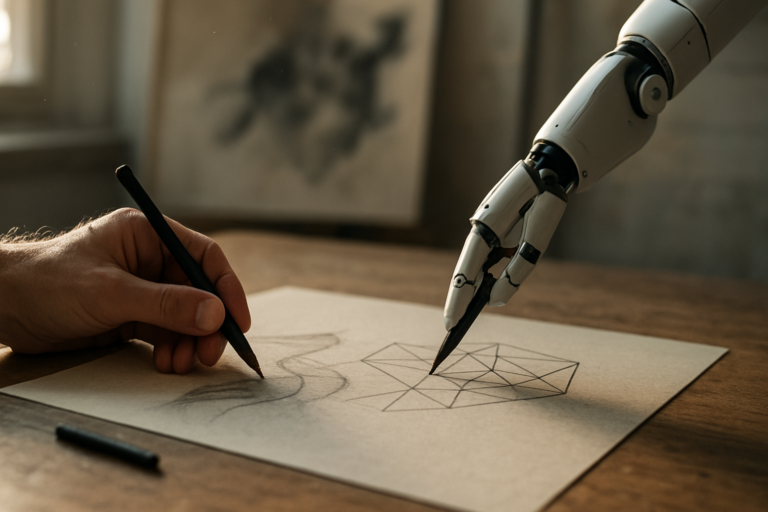
The debate around artificial intelligence and creativity has moved from science fiction to the daily news. We see AI-generated paintings winning art competitions, language models writing poetry, and algorithms composing symphonies. But does any of this count as real creativity? And if it does, what does that mean for the human creators who have long held the monopoly on original expression?
The answer is not a simple yes or no. The line between AI-generated output and human-made art is blurring faster than most people realize. To understand where we are — and where we are heading — we need to look at how each side creates, what drives them, and where the two worlds collide.
How Human Creativity Works
Human creativity is messy, emotional, and deeply personal. It draws from lived experience, memory, subconscious connections, and intentional meaning. When a painter chooses a color, it’s not just a wavelength of light — it’s a mood, a memory, a statement. When a writer crafts a metaphor, it’s woven from years of reading, feeling, and thinking.
Key characteristics of human creativity:
- Intentionality: Every creative choice carries purpose, even if the artist can’t fully articulate it.
- Emotional resonance: Art often reflects the creator’s inner world, evoking empathy or catharsis in the audience.
- Contextual awareness: Humans understand cultural, historical, and social nuances that shape meaning.
- Imperfection and serendipity: Mistakes can become breakthroughs, and happy accidents are embraced.
This complexity makes human creativity feel authentic. We value it because we know it comes from a conscious mind that struggles, feels joy, and experiences life.
How AI “Creates”
AI systems, particularly generative models like GPT-4, DALL-E, and Stable Diffusion, do not create in the same way. They are pattern-matching engines trained on massive datasets of human-created content. When you prompt an AI to write a poem or generate an image, it statistically predicts the most likely sequence of words or pixels based on its training data.
What AI can do:
- Rapid iteration: Generate hundreds of variations in seconds.
- Style mimicry: Imitate the style of any artist, writer, or composer with high fidelity.
- Novel combinations: Merge concepts that no human might have thought to combine.
- Scale and consistency: Produce large volumes of content without fatigue.
But AI lacks:
- Conscious experience: It does not feel joy, sadness, or inspiration.
- Intentional meaning: It does not “mean” anything by its output; it simply produces what the pattern suggests.
- True originality: Every output is derived from existing human work, even if the combination is new.
This raises a fundamental question: can creativity exist without consciousness?
Where the Line Blurs
The most interesting developments happen when humans and AI work together. In creative fields, AI is increasingly used as a tool — not a replacement. A graphic designer might use DALL-E to generate rough concepts, then refine them by hand. A novelist might use GPT to overcome writer’s block or generate dialogue variations. A musician might feed a melody into an AI that suggests harmonic progressions.
In these cases, the line between human and machine becomes fluid. Who is the “creator” of a song where the human wrote the lyrics and the AI composed the arrangement? Or a painting where the human chose the theme and the AI rendered the details?
Examples of collaboration:
- Art: The portrait “Edmond de Belamy” was created by a GAN and sold for $432,500 at Christie’s — but the human team curated the training data and selected the final output.
- Writing: AI-assisted journalism tools help reporters generate summaries, but humans still investigate, interview, and add context.
- Music: AI tools like AIVA compose classical pieces, but human composers often edit and orchestrate the final version.
A 2023 study by Adobe found that 72% of creative professionals already use AI tools in their workflow, with most reporting that it enhances rather than replaces their creativity. The blurring line is not a threat — it’s a transformation.
The Unique Value of Human Creativity
Despite AI’s impressive capabilities, human creativity retains distinct advantages. Audiences still crave authenticity and emotional depth. A poem written by a human who has experienced loss resonates differently than one generated by an algorithm, even if the words are technically similar.
Human creativity also thrives on:
- Cultural intuition: Understanding subtle references, irony, and subtext that AI often misses.
- Ethical judgment: Deciding what should or should not be created.
- Personal voice: A unique perspective shaped by an individual’s life story.
- Risk-taking: Breaking rules deliberately, not just statistically deviating.
AI can mimic these qualities, but it cannot embody them. The line blurs precisely because AI’s output can be indistinguishable from human work in a blind test — but the process and intent remain fundamentally different.
What This Means for the Future
The future of creativity is not AI versus humans — it is AI with humans. The most