
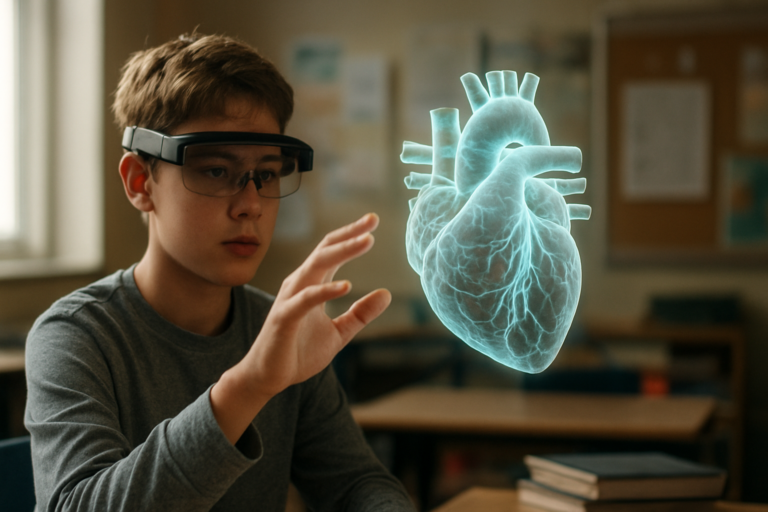
For decades, the classroom has been defined by its tools: the chalkboard, the textbook, the projector, and eventually, the laptop. While digital screens brought the world into the classroom, they largely trapped learning within a two-dimensional rectangle. We scroll, we click, we watch. But a profound shift is underway. Augmented Reality (AR) is pushing education beyond the screen, layering digital information directly onto the physical world. This isn’t just about making lessons cooler; it’s about fundamentally rewiring how we absorb, interact with, and retain information. We are moving from passive consumption to active, immersive discovery.
What is Augmented Reality in Education?
Before diving into its impact, it’s crucial to distinguish AR from its more famous cousin, Virtual Reality (VR). VR creates a fully immersive digital environment, shutting out the real world. AR, on the other hand, overlays digital content—3D models, text, animations, data—onto the real world. Think of it as the real world with a digital enhancement layer. A student doesn’t need to put on a bulky headset and leave the classroom; they can simply point a tablet or wear lightweight smart glasses to see a beating heart hover over their desk, or watch a historical battle unfold on the football field outside their window.
The global augmented reality in education market was valued at approximately USD 11.3 billion in 2023 and is projected to grow to over USD 68.7 billion by 2030, according to a report by Grand View Research. This explosive growth is driven by a single, powerful realization: passive learning is failing to keep pace with an interactive world.
The Key Benefits of Bringing AR into the Classroom
The theoretical appeal of AR is strong, but the practical benefits for educators and students are where the true value lies.
Enhanced Engagement and Motivation
The biggest hurdle in modern education isn’t a lack of information; it’s a lack of attention. When a student can manipulate a 3D model of a molecule or walk around a virtual pyramid, learning becomes a game. The “wow” factor of AR triggers curiosity, transforming a disengaged student into an active explorer. Studies have shown that classrooms incorporating AR see a measurable increase in participation and a decrease in off-task behavior. The technology taps into the natural human instinct for exploration.
Improved Retention and Understanding
We often hear the statistic that people remember 10% of what they read and 90% of what they do. AR facilitates “doing.” By allowing students to interact with abstract concepts physically, AR bridges the gap between theoretical knowledge and practical understanding. Research from the University of Maryland demonstrated that students who learned using AR interfaces showed significantly higher recall rates than those using traditional 2D screens. Complex subjects like anatomy, physics, and engineering become tangible. Instead of memorizing the parts of a cell from a diagram, a student can walk around a giant 3D cell, zooming in on the nucleus and mitochondria.
Safe and Scalable Practical Training
For subjects requiring hands-on practice—medicine, chemistry, engineering—AR offers a risk-free environment. Medical students can practice complex surgical procedures on virtual patients. Chemistry students can mix volatile compounds in a virtual lab without the danger of explosions. This not only saves costs on physical materials but also allows for infinite repetition, which is critical for mastering complex skills. It democratizes access to expensive lab equipment and rare specimens.
Bridging the Gap Between Theory and Practice
AR allows for contextual learning. Imagine a physics lesson on velocity where students use an AR app to track the speed of a real car moving across the parking lot. Or a geography lesson where tectonic plates shift beneath their feet on a classroom floor. This contextualization makes learning relevant, answering the age-old student question: “When will I ever use this in real life?”
Real-World Applications Transforming the Curriculum
AR is not a futuristic concept; it is actively being deployed across various disciplines right now.
STEM Education
This is AR’s strongest suit. Apps like JigSpace and Anatomy 4D allow students to dissect virtual frogs, explore the solar system, and take apart a jet engine. In chemistry, AR visualizes molecular structures in 3D, making it easier to understand bonding and geometry. In mathematics, 3D graphs and geometric shapes can be rotated and examined from every angle, providing a concrete visual for abstract equations.
History and the Humanities
Platforms like TimeLooper allow students to witness historical events from their classroom. They can stand in the middle of the Great Fire of London or walk through an ancient Mayan city. This creates an emotional connection to history that textbooks simply cannot achieve. It turns dates and names into stories and experiences.
Language Learning
AR can label objects in the real world with their foreign language names. Point a phone at a table, and it says “la table” in French. This immersive contextualization helps build vocabulary faster than flashcards. Interactive AR characters can even hold basic conversations, providing a low-pressure environment for practicing a new language.
Special Education
AR provides a multi-sensory learning environment that can be tailored for students with learning disabilities. Visual, auditory, and kinesthetic learners all benefit from the dynamic content. For students on the autism spectrum, AR can provide safe, controlled environments to practice social scenarios or manage sensory overload by providing calming visual overlays.
Challenges to Overcome
Despite its immense potential, AR in education is not without its hurdles.
Cost and Hardware
While smartphones and tablets have made AR accessible, dedicated AR glasses remain expensive. Equipping an entire school district with the necessary hardware is a significant financial barrier. The digital divide could widen if AR tools are only available to well-funded schools.
Teacher Training
The technology is only as good as its implementation. Many teachers feel underprepared to integrate AR into their lesson plans. Professional development and easy-to-use authoring tools are essential for widespread adoption. If a teacher cannot easily create or adapt AR content, the technology will sit on a shelf.
Screen Time Concerns
Critics argue that AR adds to the already high screen time of students. The goal of AR, however, is to make screen time more active and beneficial rather than passive scrolling. The “beyond the screen” aspect of AR glasses (which free up the hands and eyes) directly addresses this criticism, moving the experience into a spatial computing paradigm.
Content Development
Creating high-quality, curriculum-aligned AR content is expensive and time-consuming. While many apps exist, a cohesive library of standards-based AR lessons is still developing. Schools need content that seamlessly maps to their existing curriculum, not just a collection of standalone novelty apps.
The Future of Learning: Immersive and Intelligent
The next decade will see AR become a standard tool in the educator’s kit, not just a novelty. The convergence of AR with Artificial Intelligence (AI) will create adaptive learning environments. Imagine an AR tutor that detects when a student is struggling with a concept and automatically adjusts the 3D model to simplify it or provide a different visual metaphor.
The hardware itself is evolving rapidly. The bulky headsets of the past are giving way to sleek, everyday glasses similar to the Ray-Ban Meta smart glasses. As these devices become lighter, more powerful, and more affordable, the “screen” will disappear entirely. Learning will happen everywhere—in the classroom, on the playground, at home. Haptic feedback and spatial audio will allow students to “feel” the texture of a rock or the pulse of an artery.
The shift from flat screens to spatial computing is the most significant evolution in educational technology since the internet. It promises a world where learning is not a passive act of memorization, but an active process of exploration and discovery. By bringing the digital and physical worlds together, AR in education is not just enhancing the curriculum; it is redefining the very nature of what it means to learn. The classroom of the future is not a room at all, but the entire world, augmented by knowledge.