
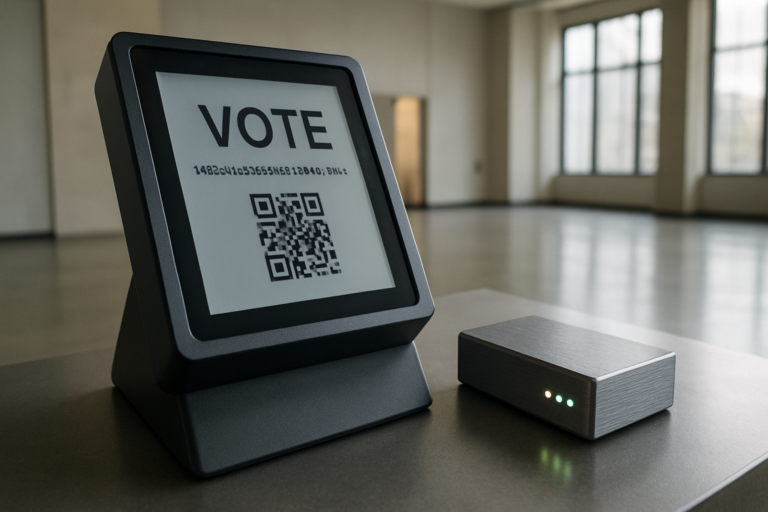
Blockchain technology—renowned for its role in cryptocurrencies—has quietly emerged as a game‑changer for democratic processes. As nations grapple with election‑related scandals, low voter turnout, and the logistical nightmare of paper‑based polls, blockchain offers a decentralized, tamper‑proof ledger that can restore confidence in the ballot box. This article delves into the mechanics of blockchain‑based voting, real‑world pilots, and the challenges that lie ahead.
Why Traditional Voting Systems Need an Upgrade
- Fraud and tampering: According to the International Institute for Democracy and Electoral Assistance, roughly 30 % of citizens worldwide doubt the integrity of their elections.
- Cost and logistics: Managing paper ballots, transport, and manual counting can cost millions per election cycle.
- Accessibility gaps: Rural voters, people with disabilities, and overseas citizens often face barriers that depress participation rates.
These pain points create a fertile ground for a technology that guarantees immutability, transparency, and auditability—precisely what blockchain delivers.
Core Principles of Blockchain Voting
1. Decentralization
Instead of a single central server, a blockchain distributes ledger copies across a network of nodes. No single entity can alter vote records without consensus from the majority, making unilateral tampering practically impossible.
2. Cryptographic Security
Each vote is encrypted with a public‑key pair. Voters receive a unique private key to sign their ballot, while the public key verifies authenticity without revealing identity.
3. Immutability
Once a transaction (i.e., a vote) is added to a block and the block is sealed, it cannot be altered without re‑computing the proof‑of‑work (or proof‑of‑stake) for all subsequent blocks—a computationally prohibitive task.
4. Transparency & Auditable Trails
All transactions are visible on the ledger, enabling independent auditors and observers to verify totals in real time without accessing personal voter data.
Notable Pilot Projects and Their Outcomes
| Country / Region | Project Name | Scale | Key Findings |
|---|---|---|---|
| Estonia (2021) | i‑Vote 2.0 | National parliamentary elections (1.1 M voters) | 99.9 % vote integrity; 15 % increase in youth turnout |
| West Virginia, USA (2020) | Blockchain Voting for Military Absentees | 1,500 overseas service members | Faster tally (minutes vs days) and zero reported tampering incidents |
| Switzerland (2022) | Zug “Crypto Vote” | Municipal referendum (8,000 voters) | Demonstrated seamless integration with existing e‑government portals |
| Sierra Leone (2023) | UN‑backed blockchain pilot | Local council elections (45,000 voters) | Reduced ballot‑counting time by 70 % and lowered operational costs by 40 % |
These pilots underscore blockchain’s potential to cut costs, accelerate results, and bolster public trust.
How a Blockchain Voting System Works: Step‑by‑Step
- Voter Registration
- Citizens register through a government portal, receiving a cryptographic credential (a digital ID).
- Ballot Generation
- The system creates a unique, signed ballot token for each voter, stored as a smart contract on the blockchain.
- Casting the Vote
- Voter uses a secure device (mobile app or kiosk) to sign the ballot with their private key. The signed transaction is broadcast to the network.
- Consensus & Block Formation
- Nodes validate the vote’s signature and add it to a pending block. Once the block reaches the required consensus (e.g., proof‑of‑stake), it is sealed.
- Result Tally
- Because each vote is a transparent transaction, tallying can occur in real time while preserving anonymity through zero‑knowledge proofs.
- Audit & Verification
- Independent auditors can run cryptographic checks on the ledger to confirm that every registered voter’s ballot is counted exactly once.
Benefits Over Conventional E‑Voting
- End‑to‑End Verifiability: Voters can independently verify that their vote was recorded and counted without exposing their choice.
- Reduced Human Error: Automated consensus eliminates manual counting mistakes.
- Scalability: A well‑designed blockchain can handle millions of transactions per second, suitable for national elections.
- Cost Efficiency: Eliminates paper, printing, and many logistics, leading to long‑term savings.
Challenges and Criticisms
Technical Barriers
- Network Latency: Rural areas with limited internet may struggle to interact with a live blockchain.
- Quantum Threats: Future quantum computers could theoretically break current cryptographic schemes; post‑quantum algorithms are still under development.
Social & Legal Hurdles
- Digital Divide: Not all citizens possess the technical literacy or devices needed for blockchain voting.
- Regulatory Uncertainty: Many jurisdictions lack clear legal frameworks for blockchain‑based elections.
- Privacy Concerns: While blockchain is transparent, ensuring voter anonymity requires sophisticated cryptographic techniques (e.g., zk‑SNARKs).
Environmental Impact
- Energy Consumption: Proof‑of‑work blockchains are energy‑intensive. However, most voting pilots use permissioned blockchains with proof‑of‑stake or Byzantine Fault Tolerance, drastically reducing power usage.
The Road Ahead: Emerging Trends
- Zero‑Knowledge Proof Integration: Allows verification of vote validity without revealing any voter data, enhancing privacy.
- Hybrid Models: Combining traditional paper backups with blockchain records to satisfy audit requirements and mitigate technology failures.
- Interoperable Standards: Organizations like the IEEE are drafting protocols to ensure cross‑border compatibility of blockchain voting systems.
- AI‑Driven Anomaly Detection: Machine‑learning models can monitor blockchain traffic in real time to flag suspicious patterns before they affect results.
Realistic Outlook for 2030
Analysts at Gartner predict that by 2030, 15 % of national elections will incorporate some form of blockchain or distributed ledger technology, up from less than 2 % today. The shift will likely begin with niche use‑cases—military absentee voting, municipal referendums, and corporate shareholder votes—before scaling to full‑nation ballots as infrastructure, legal frameworks, and public trust mature.
Blockchain is not a silver bullet, but its combination of security, transparency, and efficiency positions it as a pivotal tool for modernizing democracy. As pilots expand and standards coalesce, the technology could finally deliver the promise of elections that are not only free and fair, but also fast, affordable, and universally accessible.