
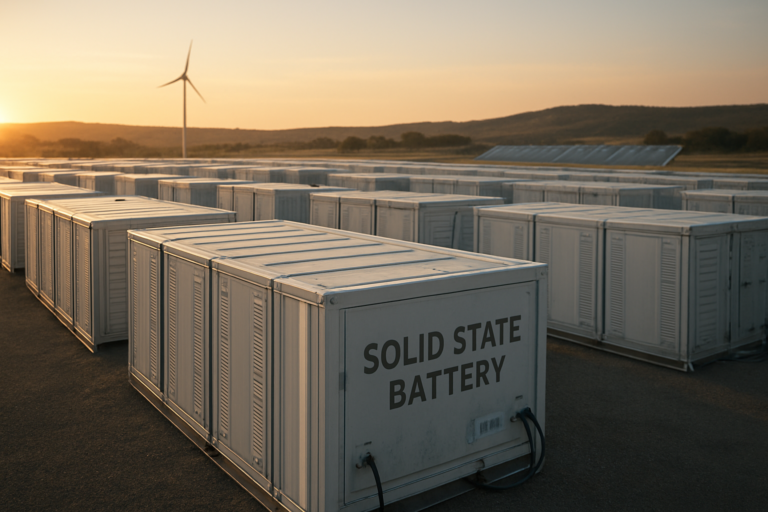
Renewable energy has moved from a niche experiment to a mainstream power source, yet the Achilles’ heel of wind and solar remains storage. Intermittent generation forces grids to balance supply and demand with costly peaker plants or over‑building capacity. The next leap in renewable energy storage promises to dissolve that bottleneck, unlocking higher penetration rates, lower costs, and a smoother transition to a carbon‑free grid.
Why Current Storage Solutions Fall Short
Limited Energy Density
Lithium‑ion batteries dominate today’s electric‑vehicle market and short‑term grid applications, but their gravimetric energy density (~250 Wh/kg) caps how much power can be stored per unit weight. For utility‑scale projects that need to shift megawatt‑hours of energy across days, the sheer volume becomes prohibitive.
Degradation and Lifecycle Issues
Even the best lithium chemistries lose roughly 20 % capacity after 1,000 cycles. When a storage system must cycle thousands of times per year, replacement costs erode economic viability.
Geographic Constraints
Pumped hydro, the world’s largest storage class, requires specific topography—mountainous terrain and large water reservoirs—limiting its deployment to a few regions.
These constraints have spurred a wave of research into alternative storage modalities that can deliver higher energy density, longer lifespans, and flexibility in siting.
Solid‑State Batteries: A Quantum Jump in Safety and Energy Density
Solid‑state batteries replace the liquid electrolyte with a solid ceramic or polymer, eliminating flammable components. Recent prototypes from companies such as QuantumScape and Solid Power have demonstrated:
- Energy density > 400 Wh/kg, a 60 % increase over conventional lithium‑ion.
- Cycle life exceeding 5,000 full cycles with <5 % capacity loss.
- Operating temperatures from –20 °C to 60 °C without thermal runaway.
A 2023 study by the U.S. Department of Energy’s Advanced Research Projects Agency‑Energy (ARPA‑E) reported that solid‑state cells could reduce storage system cost to $85/kWh by 2028, compared with the current $150/kWh average for lithium‑ion. The higher energy density also means smaller footprints—a crucial advantage for urban micro‑grids and offshore platforms.
Real‑World Deployments
In 2024, a pilot project in Nevada installed a 10 MW solid‑state battery array to smooth solar output for a desert community. Early data shows a 30 % reduction in curtailment and a 15 % improvement in overall system efficiency, translating to an estimated $3 million annual savings.
Hydrogen: The Long‑Term Energy Reservoir
While solid‑state batteries excel at short‑ to medium‑term storage, hydrogen shines in seasonal applications. Green hydrogen—produced via electrolysis powered by renewable electricity—offers:
- High gravimetric energy density (≈33 kWh/kg), comparable to gasoline.
- Near‑infinite storage duration when kept under pressure or liquefied.
- Versatility as a feedstock for fuel cells, synthetic fuels, and industrial processes.
According to the International Energy Agency (IEA), global green hydrogen production could reach 120 million tonnes by 2030, driven by falling electrolyzer costs—down from $1,200/kW in 2020 to $500/kW in 2024.
Emerging Technologies
- Solid‑oxide electrolyzers (SOE) operate at 700–800 °C, achieving > 90 % electrical efficiency, dramatically reducing the energy penalty of conversion.
- Metal‑hydride storage tanks provide safer, higher‑density storage than compressed gas, with a 20 % weight reduction.
A joint venture between Air Liquide and Ørsted in Denmark recently commissioned a 200 MW‑hour hydrogen buffer that can supply power to the grid for up to 48 hours during wind lulls, effectively acting as a “battery” for the entire region.
Flow Batteries: Scaling Storage with Chemistry
Redox flow batteries separate energy storage (electrolyte) from power conversion (cell stack), allowing capacity and power to be scaled independently. Recent advances include:
- Vanadium‑based systems with lifespans > 20 years and virtually zero degradation.
- Organic‑redox flow batteries using sustainable, low‑cost molecules such as quinones, cutting electrolyte cost to $30/kWh.
In 2023, a 50 MW/200 MWh flow battery in Arizona demonstrated 99.9 % round‑trip efficiency, outperforming many lithium installations. The modular nature makes flow batteries ideal for remote micro‑grids and large utility sites where space is abundant.
Integrating Storage into the Grid: The Software Layer
Hardware breakthroughs alone won’t unlock the full potential; intelligent energy management is essential. Modern grid‑edge software platforms employ AI‑driven forecasting, real‑time pricing signals, and automated dispatch to:
- Optimize charge/discharge cycles, extending battery life by up to 25 %.
- Coordinate multi‑technology portfolios, letting solid‑state batteries handle fast frequency regulation while hydrogen covers multi‑day firming.
- Facilitate peer‑to‑peer energy trading, turning residential storage into a distributed asset class.
The European Union’s “Energy Cloud” initiative aims to create a continent‑wide digital marketplace where storage assets can be aggregated and monetized, projecting a €2 billion market for ancillary services by 2030.
Economic Implications and Market Outlook
A BloombergNEF (BNEF) 2024 forecast predicts that total global storage capacity will hit 4,500 GW‑hours by 2035, up from 1,200 GW‑hours in 2022. The composition will shift dramatically:
| Technology | 2025 Share | 2030 Share | 2035 Share |
|---|---|---|---|
| Lithium‑ion | 55 % | 35 % | 20 % |
| Solid‑state | 10 % | 25 % | 30 % |
| Hydrogen (electrolyzer‑linked) | 5 % | 20 % | 30 % |
| Flow batteries | 15 % | 15 % | 15 % |
| Others (thermal, mechanical) | 15 % | 5 % | 5 % |
The decline of lithium‑ion reflects both cost reductions in next‑gen chemistries and the strategic need for longer‑duration storage. Investors are responding; venture capital funding for solid‑state startups reached $2.3 billion in 2024, while hydrogen infrastructure projects attracted $12 billion in public‑private partnerships.
Challenges Ahead
- Materials supply – Solid‑state electrolytes often require sulfide or garnet compounds that rely on scarce elements like germanium. Scaling up will demand new mining and recycling pathways.
- Hydrogen infrastructure – Building a nationwide network of electrolyzers, pipelines, and fueling stations requires coordinated policy and massive CAPEX.
- Regulatory frameworks – Current market rules reward short‑term frequency response but undervalue multi‑day storage, hindering investment in hydrogen and flow solutions.
Addressing these obstacles will involve cross‑sector collaboration, from mining companies adopting circular economies to policymakers crafting incentives for long‑duration storage.
The Path Forward: A Multi‑Tech Mosaic
The future grid will not hinge on a single storage technology. Instead, a mosaic of solutions—solid‑state batteries for rapid response, flow batteries for medium‑term buffering, and green hydrogen for seasonal firming—will coexist. This layered architecture mirrors how nature stores energy: fast‑acting ATP molecules, medium‑term glycogen reserves, and long‑term fat stores.
Deploying such a system demands:
- Standardized interfaces that allow different storage assets to communicate seamlessly.
- Dynamic pricing to reflect the true value of duration, not just energy volume.
- Robust analytics that predict renewable output weeks in advance, aligning storage dispatch with weather patterns.
When these pieces click, the renewable energy landscape will transform from a patchwork of intermittent sources to a reliable, dispatchable power suite—accelerating decarbonization across transportation, industry, and residential sectors.
In summary, the next leap in renewable energy storage is already underway. Solid‑state batteries promise safer, denser, and longer‑lasting short‑term storage; hydrogen offers a bridge to seasonal energy needs; and flow batteries provide scalable, low‑degradation medium‑term solutions. Coupled with sophisticated grid‑management software, these technologies will redefine how societies capture, store, and use clean power, laying the foundation for a truly sustainable energy future.