
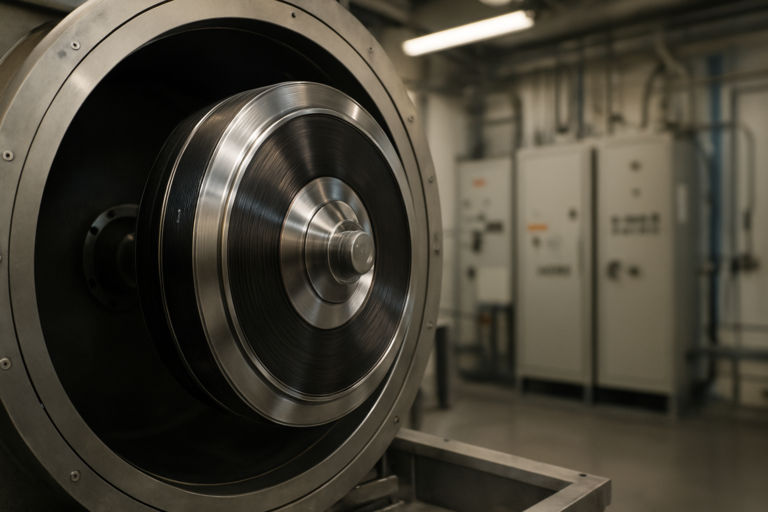
When the grid needs a lightning-fast injection of power—measured in milliseconds—few technologies can match the response time of an advanced flywheel. Unlike chemical batteries that rely on electrochemical reactions, flywheels store energy in the form of kinetic energy: a spinning rotor that can release or absorb power almost instantly. This makes them ideal for frequency regulation, uninterruptible power supplies (UPS), and smoothing the variability of renewable energy sources.
In recent years, flywheel energy storage has evolved from niche industrial applications to a serious contender in the grid-scale storage landscape. With improvements in materials, magnetic bearings, and power electronics, modern flywheels can spin at tens of thousands of revolutions per minute (RPM) and store megawatt-hours of energy. Let’s dive into how they work, where they excel, and why they matter for a decarbonized grid.
How Advanced Flywheels Work
At its core, a flywheel system is elegantly simple. A rotor (the flywheel) is accelerated to high speed using an electric motor. The kinetic energy is stored as rotational energy, and when needed, the motor acts as a generator, converting that rotational energy back into electricity.
Advanced flywheels differ from traditional designs in three key areas:
- Composite rotors: Modern flywheels use carbon-fiber or glass-fiber composites that are both strong and lightweight, allowing much higher rotational speeds without risk of catastrophic failure. Speeds of 30,000 to 60,000 RPM are common.
- Magnetic bearings: Instead of mechanical bearings, active magnetic bearings levitate the rotor, eliminating friction and enabling near-vacuum operation. This dramatically reduces energy loss and extends system life to 20–30 years.
- Power electronics: Fast-acting inverters and controllers allow the flywheel to respond to grid signals in under 4 milliseconds—faster than any battery or generator.
The result is a system with high cycle life (hundreds of thousands of charge/discharge cycles with minimal degradation), high power density, and a small physical footprint compared to battery banks of equivalent power.
Key Applications in Modern Grids
1. Frequency Regulation
Grid frequency must stay within a narrow band (e.g., 50 Hz ± 0.1 Hz in Europe). When supply and demand mismatch, frequency drifts. Flywheels can inject or absorb power in real time to correct these deviations. According to a 2022 study by the U.S. Department of Energy, flywheel systems for frequency regulation can achieve round-trip efficiencies above 85% and respond 10 times faster than traditional thermal generators.
2. Uninterruptible Power Supply (UPS)
Data centers, hospitals, and industrial processes require seamless power during grid disturbances. Flywheels provide ride-through power for seconds to minutes, bridging the gap until backup generators start. Unlike lead-acid batteries, flywheels don’t suffer from thermal runaway or capacity fade over time. Major tech companies like Google and Microsoft have deployed flywheel-based UPS systems in some of their data centers.
3. Renewable Energy Smoothing
Solar and wind power are inherently variable. Flywheels can smooth out short-term fluctuations (seconds to minutes) that batteries alone handle inefficiently due to their slower response and cycle-life limitations. For example, a 20 MW flywheel installation in New York helps stabilize the output of a nearby wind farm, reducing curtailment and improving power quality.
4. Grid Inertia Support
As synchronous generators (coal, gas, nuclear) retire, grid inertia—the resistance to frequency change—declines. Flywheels can provide synthetic inertia by emulating the behavior of a spinning mass. This is increasingly valuable in grids with high renewable penetration. A 2021 report from the International Renewable Energy Agency (IRENA) noted that flywheels could supply up to 10% of a grid’s inertia requirements in some regions.
Advantages Over Batteries
While lithium-ion batteries dominate the energy storage market, flywheels offer distinct benefits:
- Lifespan: Flywheels can operate for 20+ years with no capacity degradation, whereas batteries typically need replacement every 8–12 years.
- Cycle life: Flywheels can handle hundreds of thousands of deep cycles without wear. Batteries degrade after a few thousand cycles.
- Power vs. energy: Flywheels excel at high power output for short durations (seconds to minutes), making them perfect for frequency regulation and UPS. Batteries are better for longer-duration storage (hours).
- Environmental impact: Flywheels contain no toxic chemicals, are fully recyclable, and have a lower carbon footprint over their lifecycle.
However, flywheels have lower energy density—they store less energy per unit volume than batteries—and are not suitable for long-duration storage beyond 15–30 minutes. This makes them a complementary technology, not a replacement.
Real-World Deployments and Statistics
- The largest flywheel storage plant in the world is the Beacon Power facility in Stephentown, New York, with 200 flywheels providing 20 MW of power for frequency regulation.
- In Europe, the UK’s National Grid ESO has contracted flywheel storage for balancing services since 2018.
- A 2023 market analysis by Grand View Research valued the global flywheel energy storage market at $450 million, projected to grow at 8.5% CAGR through 2030.
- Flywheel systems for UPS applications have achieved reliability rates of 99.9999% (six nines) in data center trials.
Challenges and Future Outlook
Despite their advantages, flywheels face barriers to widespread adoption:
- High upfront cost: Advanced composite rotors and magnetic bearings are expensive, though costs are declining as manufacturing scales.
- Energy density: For applications requiring hours of storage, batteries remain more cost-effective.
- Safety concerns: Rotor failure at high speeds can be catastrophic, though containment systems and real-time monitoring have greatly reduced risks.
Ongoing research focuses on using high-temperature superconductors for magnetic bearings, which could further reduce losses, and on hybrid systems that pair flywheels with batteries for optimal performance. The U.S. Department of Energy’s ARPA-E program has funded several projects exploring next-generation flywheel materials.
Conclusion
Advanced flywheels are not a silver bullet for grid storage, but they fill a critical niche: ultra-fast, high-cycle, high-power applications that demand reliability and longevity. As renewable energy penetration increases and grid inertia declines, flywheels will play an essential role in maintaining stability. Their ability to respond in milliseconds, operate for decades, and degrade gracefully makes them a compelling choice for frequency regulation, UPS, and smoothing services.
For grid operators and large energy consumers, understanding the strengths of kinetic energy storage is key to building a resilient, low-carbon energy system. Flywheels may be a centuries-old concept, but modern materials and power electronics have turned them into a 21st-century workhorse.