
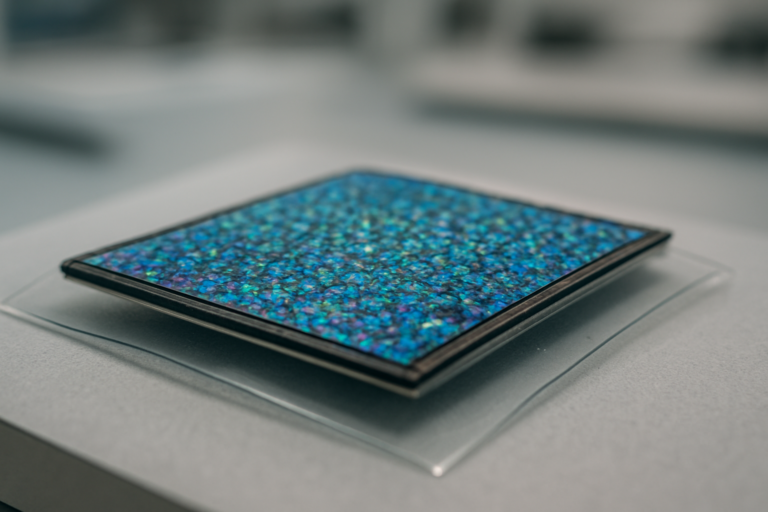
The solar energy revolution has been powered by silicon for decades, but a new contender is rapidly rewriting the rules. Perovskite solar cells—named after the crystal structure of calcium titanate—have emerged as the most exciting breakthrough in photovoltaics since the first commercial silicon panel. With laboratory efficiencies soaring from under 4% in 2009 to over 25% today, these thin-film devices promise to make solar energy cheaper, lighter, and more versatile than ever before. But what exactly makes perovskites so special, and can they overcome the hurdles standing between the lab and your rooftop?
The Rise of Perovskite Solar Cells
Perovskites are not a single material but a family of compounds with a specific crystal structure (ABX₃). In solar cells, the most common perovskite is methylammonium lead iodide (CH₃NH₃PbI₃). The journey began in 2009 when Japanese researcher Tsutomu Miyasaka first used a perovskite material as a light absorber in a dye-sensitized solar cell, achieving a modest 3.8% efficiency. What followed was nothing short of a scientific sprint. By 2012, solid-state perovskite cells crossed 10% efficiency. Today, the certified record stands at 25.7% for a single-junction cell, and when paired with silicon in tandem configurations, efficiencies exceed 33%—surpassing the theoretical limit of silicon alone.
The speed of this progress is unprecedented. Silicon solar cells took over 40 years to reach comparable efficiency gains. Perovskites did it in a decade, and the pace shows no sign of slowing.
Why Perovskite? Key Advantages
High Efficiency at Low Cost
The most compelling advantage is the combination of high efficiency and low manufacturing cost. Perovskite materials have exceptional light absorption—they can capture photons across a broad spectrum using a film just a few hundred nanometers thick. In contrast, silicon requires wafers hundreds of micrometers thick. This means perovskite cells use far less material and can be produced with simple, low-temperature processes like spin-coating, inkjet printing, or slot-die coating.
According to the National Renewable Energy Laboratory (NREL), the levelized cost of electricity for perovskite solar cells could drop to below $0.03 per kilowatt-hour in mass production, undercutting both silicon and fossil fuels.
Flexibility and Versatility
Unlike rigid silicon panels, perovskite films can be deposited on flexible substrates like plastic or metal foil. This opens up applications that were previously impossible: lightweight solar blankets for camping, power-generating window films, curved surfaces on vehicles, and even integration into clothing. The ability to be semi-transparent also makes them ideal for building-integrated photovoltaics (BIPV), where windows double as power generators.
Rapid Manufacturing
Perovskite cells can be manufactured using roll-to-roll printing, similar to how newspapers are printed. This high-throughput process dramatically reduces production time and capital expenditure. A factory producing silicon panels requires billion-dollar investments and complex vacuum chambers; a perovskite factory could be built for a fraction of that cost and produce panels in minutes rather than hours.
Challenges and Solutions
Despite the promise, perovskite solar cells face three major hurdles: stability, toxicity, and scalability.
Stability Issues
Perovskites are notoriously sensitive to moisture, oxygen, heat, and UV light. Early cells degraded within minutes in ambient air. While encapsulation and material engineering have improved lifetimes—some lab cells now retain 90% efficiency after 1,000 hours of continuous operation—commercial viability requires 25-year lifespans comparable to silicon. Researchers are exploring 2D/3D hybrid perovskites, additive engineering, and advanced encapsulation techniques to address this. A 2023 study from Oxford PV demonstrated a tandem cell with 29.5% efficiency and promising stability under accelerated aging tests.
Lead Toxicity
The most efficient perovskites contain lead, raising environmental and health concerns. However, the amount of lead in a perovskite cell is minuscule—about 0.3 grams per square meter, compared to 10 grams in a typical lead-acid car battery. Moreover, lead in perovskites is chemically bound and less leachable than in other forms. Researchers are also developing lead-free alternatives using tin, bismuth, or antimony, though these currently lag in efficiency and stability. Tin-based perovskites have reached over 14% efficiency, and ongoing work aims to close the gap.
Scaling Up
Translating lab-scale successes (typically 1 cm² cells) to commercial-scale modules (100 cm² or larger) has proven difficult. Larger areas often suffer from defects, pinholes, and non-uniform coatings. Advanced deposition techniques like chemical vapor deposition and blade coating are being optimized. Companies like Saule Technologies and Oxford PV are already piloting production lines, and the first commercial perovskite modules are expected to hit the market by 2025–2026.
Applications and Future Outlook
The future of perovskite solar cells lies not in replacing silicon entirely but in complementing it. Tandem cells—where a perovskite layer sits atop a silicon cell—can capture more of the solar spectrum, pushing efficiencies beyond 30%. This is the most likely path to commercialization, as it leverages existing silicon infrastructure while adding a performance boost.
Beyond tandems, perovskites will enable niche applications where silicon cannot go: lightweight portable chargers for drones and IoT devices, semi-transparent windows that generate electricity, and even space-based solar power, where high power-to-weight ratios are critical. The U.S. Department of Energy’s Perovskite Startup Prize and initiatives like the European Perovskite Initiative are accelerating commercialization.
According to a 2024 report by IDTechEx, the perovskite solar cell market is projected to reach $1.5 billion by 2030, driven by BIPV and tandem products.