
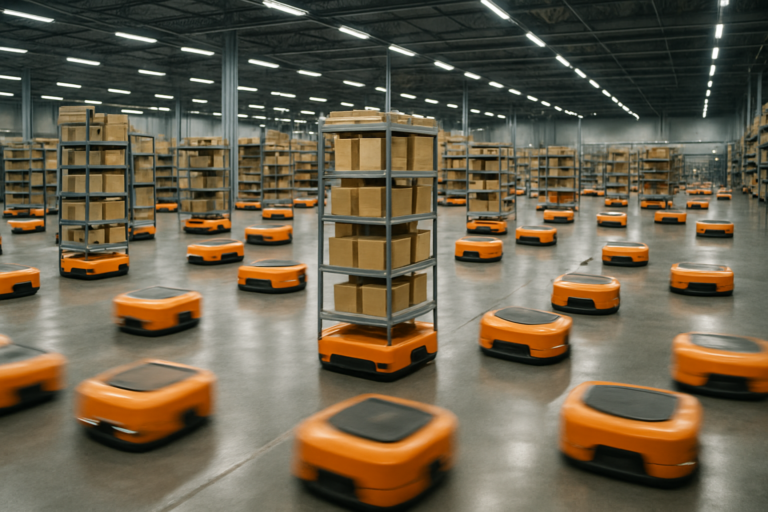
Imagine a factory floor where hundreds of thumb-sized robots sort packages without any central controller, or a fleet of drones that autonomously map and spray a field, adapting in real-time to obstacles and weather. This is not science fiction – it is swarm intelligence in action. Inspired by the collective behavior of ants, bees, and birds, swarm intelligence applies the principles of decentralization, local interactions, and emergence to autonomous robotic systems. In industrial and logistics settings, these coordinated autonomous systems are already reducing costs, increasing efficiency, and handling tasks too complex for a single robot.
What Is Swarm Intelligence?
Swarm intelligence (SI) refers to the collective behavior of decentralized, self-organized systems – natural or artificial. When applied to robotics, a swarm consists of many simple agents (robots or drones) that follow a few local rules and communicate with nearby peers. There is no single leader or central command; instead, global patterns emerge from local interactions. Key characteristics include:
- Decentralization: Each agent makes decisions based on its own sensors and local information.
- Scalability: Adding more agents does not degrade performance; it often improves it.
- Robustness: If a few agents fail, the swarm continues functioning.
- Flexibility: The same rules can adapt to different environments and tasks.
A classic example is the ant colony – individual ants follow simple pheromone trails, yet together they find the shortest path to food. Robotic swarms replicate this using wireless communication and shared mapping.
How Swarm Robotics Works in Practice
Swarm robots typically run on lightweight processors and are equipped with sensors (cameras, LiDAR, IMU) and simple actuators. They communicate via Wi-Fi, Bluetooth, or infrared to share positional data and task status. Control algorithms are often based on models like:
- Particle Swarm Optimization (PSO): Used for path planning and resource allocation.
- Ant Colony Optimization (ACO): For routing and task assignment.
- Bee Algorithm: For search-and-rescue or mapping.
Because each robot runs a relatively simple program, the swarm can be deployed rapidly and at low per-unit cost – a key advantage over monolithic industrial robots.
Real-World Applications
1. Warehouse Logistics
Amazon’s Kiva robots (now Amazon Robotics) are a celebrated swarm example. Over 200,000 autonomous drive units glide across warehouse floors, lifting and moving shelves to packing stations. They communicate with each other to avoid collisions, optimize traffic flow, and handle peak demand. The result: fulfillment times cut by up to 75% and warehouse space utilization increased by 50%. Other companies like Ocado use similar swarm-based systems for grocery order picking.
2. Precision Agriculture
Drone swarms are transforming farming. A swarm of small, inexpensive drones can cover a large field in minutes, taking multispectral images to identify crop health, pest hotspots, or irrigation needs. They coordinate to avoid redundant coverage and can adapt to wind and terrain. Starting in 2023, the European Union funded the “SwarmFarm” project, demonstrating autonomous weeding robots that work in groups, reducing herbicide use by 90%.
3. Construction and Inspection
Building inspection often requires scaffolding and human risk. Swarms of micro-drones can crawl over steel structures, using tactile sensors to detect cracks or corrosion. In Japan, the “Hive” system deploys dozens of small inspection drones to map bridge undersides in hours – a task that would take weeks for a crew.
4. Search and Rescue
After an earthquake or avalanche, search teams face dangerous, time-critical conditions. Swarm robots can blanket a disaster zone, each carrying a heat sensor and microphone. They triangulate survivor locations and relay maps to coordinators. In a 2022 test by the Swiss Federal Institute of Technology, a swarm of 50 quadcopters found and marked an underground survivor in 12 minutes – 30% faster than a single drone.
5. Military and Defense
Defense agencies worldwide are developing drone swarms for surveillance, electronic warfare, and coordinated strikes. The U.S. Navy’s “LOCUST” program launches multiple autonomous boats that patrol together, sharing threat data. Such systems rely on robust encryption and decentralized command to avoid single points of failure.
Key Technical Challenges
Despite their promise, swarm intelligence systems face hurdles:
| Challenge | Description |
|---|---|
| Communication Bandwidth | Many agents creating dense data streams can saturate wireless channels. |
| Collision Avoidance | Scalable collision avoidance algorithms must be computationally light. |
| Fault Tolerance | Swarms must gracefully handle robot failures without cascade effects. |
| Energy Management | Small batteries limit runtime; coordinated recharging strategies are needed. |
| Security | Adversarial jamming or spoofing could disrupt swarm coordination. |
Researchers are addressing these with machine learning, blockchain-based verification, and ultra-low-power radios.
The Future of Swarm Intelligence
The global autonomous robot swarm market is projected to reach $12.5 billion by 2030, growing at a CAGR of 28% (MarketsandMarkets, 2024). As hardware costs fall and 5G/6G networks enable low-latency communication, we will see swarms deployed in:
- Last-mile delivery: Swarms of ground bots and drones that coordinate package handoffs.
- Underwater exploration: Fleets of autonomous underwater vehicles mapping pipelines.
- Smart cities: Swarms of sensor-laden drones monitoring traffic, air quality, and infrastructure health.
One of the most exciting frontiers is the integration of swarm intelligence with AI planning systems. Rather than pre-programming every behavior, swarms will learn from experience using reinforcement learning – adapting to novel situations in real time.
Conclusion
Swarm intelligence offers a powerful paradigm for tackling complex, dynamic tasks that are too difficult for single robots or too expensive for human labor. By embracing decentralization, robustness, and emergence, these coordinated autonomous systems are already reshaping logistics, farming, construction, and defense. As technology advances, the hum of thousands of tiny, intelligent machines working together may become the soundtrack of our future industries.