
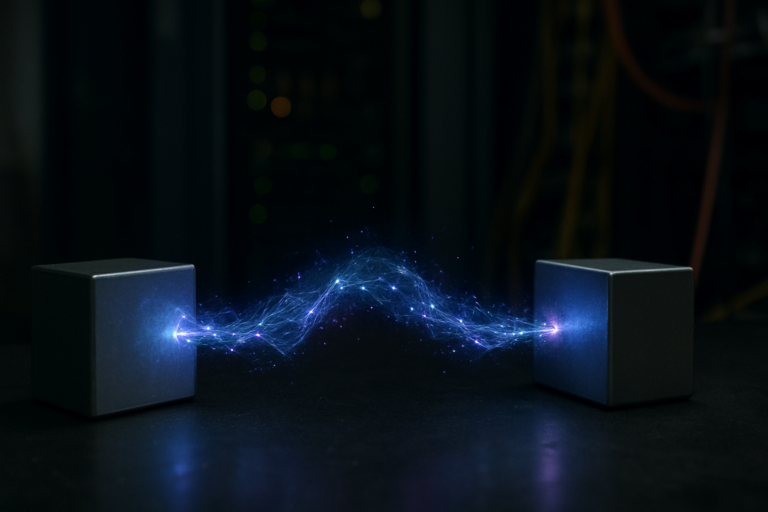
Imagine a world where data breaches are a relic of the past, where every email, financial transaction, and government secret is transmitted with absolute certainty that no one—not even the most powerful supercomputer—can intercept or decode it. This isn’t science fiction; it’s the promise of the quantum internet. By harnessing the bizarre laws of quantum mechanics, particularly entanglement and superposition, researchers are building a communication network that is, by its very nature, unhackable. While still in its infancy, quantum internet is poised to redefine cybersecurity, global finance, and even the way we think about privacy.
What Makes Quantum Internet Different?
To understand why quantum internet is so revolutionary, we first have to look at how today’s internet works. Classical data travels as bits—0s and 1s—encoded in electrical pulses or light signals. These bits can be copied, read, or intercepted without the sender or receiver knowing. Encryption algorithms (like RSA or AES) try to protect data, but they rely on mathematical problems that quantum computers might eventually crack.
Quantum internet, on the other hand, uses qubits (quantum bits). Qubits can exist in multiple states simultaneously (superposition) and, more importantly, can be entangled—a phenomenon where two particles become linked so that measuring one instantly influences the other, no matter how far apart they are. This property allows for two game-changing capabilities:
- Quantum Key Distribution (QKD): Any attempt to eavesdrop on a quantum transmission disturbs the qubits, immediately alerting the parties to a breach.
- Quantum Teleportation: Not of matter, but of quantum states—information can be transferred instantly across long distances without physically moving particles.
These features make quantum internet inherently secure. Even if an attacker intercepts the signal, they cannot extract useful information without corrupting it.
The Science Behind Unbreakable Communication
The core mechanism is quantum key distribution. In a typical QKD protocol (like BB84), Alice (sender) encodes random bits into photons and sends them to Bob (receiver). Because of the no-cloning theorem, an eavesdropper (Eve) cannot copy the photons without introducing errors. After transmission, Alice and Bob compare a small portion of their bits publicly; if the error rate is within an acceptable range, they know the channel is secure. They then use the remaining bits as a secret key for classical encryption.
Current implementations of QKD can already secure fiber-optic links up to a few hundred kilometers. However, to build a global quantum internet, we need quantum repeaters—devices that can extend entanglement over thousands of kilometers without breaking the fragile quantum states. While repeaters remain a major technical challenge, progress is accelerating. In 2022, Chinese scientists successfully demonstrated entanglement distribution over 1,200 kilometers using the Micius satellite, proving that global-scale quantum networks are feasible.
Real-World Applications and Use Cases
The quantum internet isn’t just about making our current online activities safer—it unlocks entirely new capabilities:
- Secure Government and Military Communications: Diplomatic cables, intelligence data, and military command channels can be protected from even the most sophisticated state-sponsored hackers.
- Financial Sector Protection: Banks and stock exchanges could use QKD to secure high-frequency trading and transaction clearing, eliminating the risk of man-in-the-middle attacks.
- Quantum Cloud Computing: A quantum internet can link multiple quantum computers together, forming a distributed quantum cloud. This would allow researchers to solve problems far beyond the reach of any single machine.
- Voting and Identity Verification: Tamper-proof quantum networks could enable unhackable electronic voting systems and digital identity authentication.
- Long-Distance Quantum Sensors: Entanglement can synchronize sensors across continents, enabling ultra-precise measurements for GPS-free navigation, gravitational wave detection, or geological monitoring.
Current Challenges and Milestones
Despite its promise, the quantum internet is not yet ready for prime time. The main hurdles include:
- Decoherence: Qubits are extremely sensitive to environmental noise—vibrations, temperature changes, even stray light. Maintaining entanglement over long distances requires near-perfect isolation.
- Quantum Repeaters: As mentioned, these are essential for long-haul networks. Current prototypes only operate at low speeds and with high error rates.
- Infrastructure Overhaul: Existing fiber-optic cables can carry qubits, but they need additional components (like photon sources and detectors) that are not yet mass-produced.
- Standardization: There is no universal protocol for quantum networking. Different research groups use different hardware and software, making interoperability a future challenge.
Nevertheless, significant milestones have been achieved. In 2023, the Delft University of Technology in the Netherlands demonstrated a three-node quantum network using nitrogen-vacancy centers in diamond. In the United States, the Department of Energy has outlined a plan for a national quantum internet, with testbeds already operating in Chicago and New York. The EU’s Quantum Internet Alliance is working on a European-scale network by 2030.
The Path Forward
Experts predict that we will see the first commercial quantum-encrypted links within the next five to ten years, likely for specialized applications like banking or government communications. A true global quantum internet, capable of connecting millions of users, is probably two decades away. But the foundational pieces are falling into place.
One of the most exciting developments is the integration of quantum key distribution with existing telecom infrastructure. Companies like Toshiba and ID Quantique already sell QKD systems for short-range links. As quantum repeaters mature, these islands of security will merge into a continent-spanning fabric.
The quantum internet will also coexist with classical internet. Most of our everyday web browsing and streaming won’t require quantum-level security. Instead, the quantum layer will act as a secure backbone for the most sensitive data, while classical networks handle the rest.
Conclusion
The quantum internet is not merely an upgrade to our current network—it’s a paradigm shift. By leveraging the fundamental laws of nature, it offers a level of security that no amount of computational power can break. While technical challenges remain, the progress in recent years has been breathtaking. Governments, universities, and tech giants are investing heavily, racing to be the first to deliver unbreakable communication.
In a world where cyberattacks cost trillions of dollars annually and privacy is increasingly scarce, the quantum internet shines as a beacon of hope. It may take time, but the future of communication is being built, one entangled photon at a time.