
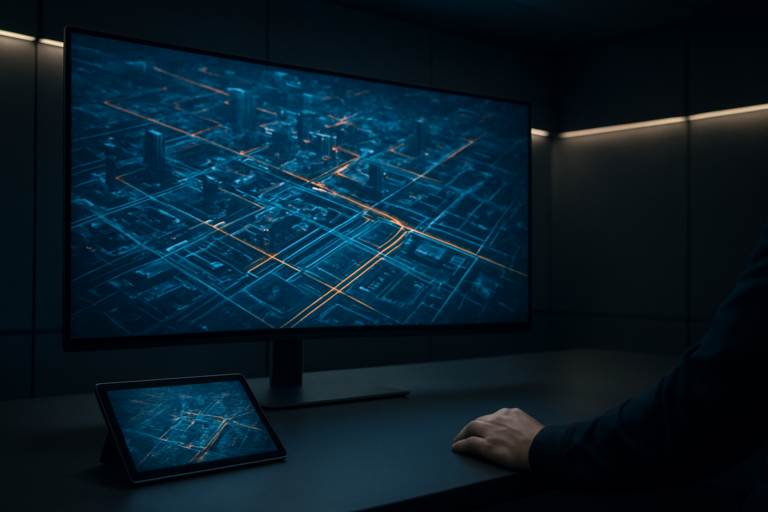
Imagine a world where a factory could predict its own breakdowns, a bridge could report its own stress fractures, and a city could simulate traffic jams before they happen. This is not a scene from a science fiction novel; it is the reality of digital twins. As part of the broader Industry 4.0 revolution, digital twins are transforming how we design, manage, and optimize physical assets. These virtual replicas, fed by a constant stream of real-time data from IoT sensors, allow engineers and planners to see the future, preventing failures and maximizing efficiency.
At its core, a digital twin is a dynamic software model that mirrors a physical object, system, or process. Unlike a static 3D CAD file, a digital twin lives and breathes, constantly updating itself based on data from its real-world counterpart. This continuous synchronization creates a powerful feedback loop. By running simulations on the twin, operators can test scenarios, predict outcomes, and implement changes in the virtual world before applying them to the physical one. This capability is reshaping industries from manufacturing to urban development.
The Mechanics of a Virtual Replica
The power of a digital twin lies in its three core components:
- The Physical Asset: This could be anything from a single wind turbine to an entire oil refinery. It is equipped with IoT sensors that measure performance, temperature, vibration, and other critical metrics.
- The Virtual Model: This is the digital counterpart, a sophisticated simulation that uses physics-based algorithms and machine learning to mirror the physical asset’s behavior.
- The Data Connection: This is the vital link. Real-time data flows from the physical asset to the virtual model, while insights and commands flow back, enabling closed-loop optimization.
This architecture allows for a level of granularity previously impossible. For example, a digital twin of a jet engine can simulate the wear and tear on each individual blade, predicting maintenance needs with remarkable accuracy. According to a report by MarketsandMarkets, the digital twin market is projected to grow from $10.1 billion in 2023 to $110.1 billion by 2028, a compound annual growth rate of over 60%. This explosive growth is fueled by the tangible ROI that digital twins deliver.
Revolutionizing Predictive Maintenance
One of the most impactful applications of digital twins is in predictive maintenance. Traditional maintenance strategies are either reactive (fixing things after they break) or preventive (servicing equipment on a fixed schedule). Both are inefficient. Reactive maintenance leads to costly downtime, while preventive maintenance often replaces parts that still have useful life.
Digital twins change this paradigm. By analyzing real-time sensor data alongside historical performance, the twin can identify subtle anomalies that precede a failure. For instance, a slight increase in vibration in a motor or a minor temperature spike in a bearing can be flagged days or even weeks before a catastrophic breakdown occurs.
- Reduced Downtime: Unplanned downtime in industrial manufacturing can cost up to $260,000 per hour, according to a study by Siemens. Digital twins can reduce this by up to 50%.
- Optimized Spare Parts Inventory: By predicting exactly when a component will fail, companies can order parts just-in-time, reducing inventory carrying costs.
- Extended Asset Lifespan: Continuous monitoring and targeted interventions prevent minor issues from escalating, extending the operational life of expensive machinery.
Transforming Urban Planning
Beyond the factory floor, digital twins are becoming essential tools for smart cities. Urban planners are using these virtual replicas to model entire cityscapes, from traffic patterns and energy grids to water distribution and waste management. This holistic view allows for unprecedented optimization of urban infrastructure.
Consider the challenge of traffic congestion. A city digital twin can ingest data from traffic cameras, GPS sensors in vehicles, and public transit systems. Planners can then simulate the impact of a new bike lane, a closed road, or a change in traffic light timing. They can see, in real-time, how a minor change in one neighborhood might ripple across the entire city. This capability is not just about efficiency; it is about building more livable, sustainable cities.
- Energy Optimization: Simulating building energy consumption to optimize heating and cooling systems, reducing carbon footprints.
- Disaster Response: Modeling flood or earthquake scenarios to develop more effective evacuation plans and resource allocation strategies.
- Infrastructure Planning: Testing the impact of new developments, like a new stadium or a housing complex, on existing utilities and transportation networks.
The Role of Simulation and IoT
The effectiveness of a digital twin is directly proportional to the quality of its data and the fidelity of its simulation. Advanced simulation software now incorporates physics, thermodynamics, and material science to create highly accurate models. When combined with the data from a dense IoT sensor network, these simulations can achieve near-perfect parity with the real world.
This convergence of simulation and IoT is creating new possibilities for autonomous optimization. In a smart factory, a digital twin can not only predict that a machine will overheat but can also automatically adjust its operating parameters to prevent the overheating, all without human intervention. This level of automation is a cornerstone of the Industry 4.0 vision.
Challenges and the Road Ahead
Despite their immense potential, digital twins are not without challenges. The primary hurdles include:
- Data Integration: Consolidating data from disparate legacy systems and new IoT devices remains a complex task.
- Computational Power: Running high-fidelity simulations in real-time requires significant processing power, often necessitating cloud or edge computing solutions.
- Cybersecurity: A digital twin is a detailed blueprint of a physical asset. Protecting this data from cyberattacks is paramount, as a compromised twin could lead to physical damage.
However, as cloud computing becomes cheaper and AI algorithms become more sophisticated, these barriers are steadily lowering. The future points toward digital twins becoming a standard tool for any organization that relies on complex physical infrastructure. They are moving from a competitive advantage to a competitive necessity.
In conclusion, digital twins represent a profound shift in how we interact with the physical world. By creating a living, breathing virtual replica of our most critical assets, we gain the power to see into the future. We can prevent failures, optimize performance, and build more resilient systems. For industries and cities alike, the question is no longer whether to adopt digital twins, but how quickly they can integrate this transformative technology into their core operations. The era of real-time infrastructure optimization has truly begun.