
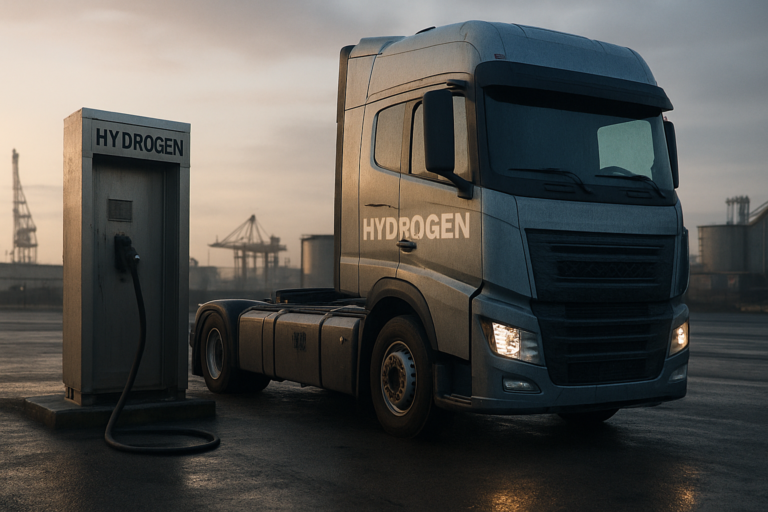
The rumble of a diesel engine has long been the soundtrack of global commerce. For decades, heavy transport—the trucks, trains, and ships that move our goods—has relied almost exclusively on fossil fuels. But that sound is fading. A quieter, cleaner alternative is emerging from the exhaust pipes of the future: hydrogen fuel cells. While battery electric vehicles dominate the passenger car market, the immense energy demands of long-haul trucking and industrial processes require a different solution. Hydrogen, the most abundant element in the universe, is now being engineered to power the heaviest loads on Earth.
Why Heavy Transport Needs a Different Solution
Battery electric vehicles (BEVs) are excellent for light-duty applications, but they face significant limitations in heavy transport. The weight of the batteries required to power a fully loaded 40-ton truck over 500 miles is prohibitive. A battery pack large enough for such a journey can weigh several tons, reducing the truck’s payload capacity and increasing its total operating cost. Recharging times also pose a logistical nightmare for fleets that operate on tight schedules. A driver can refuel a diesel truck in 15 minutes; a battery truck can take hours to recharge, even with high-power chargers.
Hydrogen fuel cells solve these problems by decoupling energy storage from weight. A hydrogen fuel cell generates electricity through an electrochemical reaction between hydrogen and oxygen, producing only water vapor as a byproduct. The hydrogen itself is stored in lightweight, high-pressure tanks, allowing a truck to carry enough energy for 500 to 800 miles on a single fill. Refueling takes just 10 to 15 minutes, matching the convenience of diesel.
The Technology Behind the Tank
A hydrogen fuel cell electric vehicle (FCEV) is essentially an electric vehicle that generates its own electricity onboard. The system consists of three key components: the fuel cell stack, hydrogen storage tanks, and a small buffer battery. The fuel cell stack combines hydrogen from the tanks with oxygen from the air, creating an electrical current that powers the electric motors. The buffer battery captures energy from regenerative braking and provides extra power during acceleration.
This architecture offers a distinct advantage for heavy-duty applications. The fuel cell stack can be scaled to provide high continuous power output, while the hydrogen tanks can be sized to meet range requirements without adding significant weight. For example, the Nikola Tre FCEV, a Class 8 truck designed for long-haul routes, carries 70 kilograms of hydrogen at 700 bar pressure, providing a range of over 500 miles. The entire system weighs roughly the same as a comparable diesel powertrain, but emits only water.
Green Hydrogen: The Missing Link
The environmental benefits of hydrogen fuel cells depend entirely on how the hydrogen is produced. Currently, over 95% of hydrogen is made from natural gas through a process called steam methane reforming, which releases carbon dioxide. This is known as “gray” hydrogen and does little to reduce emissions. The true promise lies in “green” hydrogen, produced by splitting water using renewable electricity via electrolysis.
Green hydrogen is a zero-carbon fuel from production to consumption. When used in a fuel cell, the only emission is water vapor. The challenge today is cost and scale. Green hydrogen is currently two to three times more expensive than gray hydrogen. However, falling renewable energy costs and government subsidies are rapidly closing the gap. The U.S. Department of Energy’s Hydrogen Shot initiative aims to reduce the cost of clean hydrogen to $1 per kilogram by 2031, which would make it competitive with diesel on a per-mile basis.
Real-World Applications: Where Hydrogen is Winning
Hydrogen fuel cells are already proving their worth in specific, high-demand sectors.
- Long-Haul Trucking: Companies like Toyota, Hyundai, and Nikola have deployed fuel cell trucks in pilot programs across California, Europe, and Japan. The Port of Los Angeles operates a fleet of hydrogen-powered heavy-duty trucks to move cargo, reducing local air pollution in a region that suffers from some of the worst diesel emissions in the country.
- Rail and Marine: Hydrogen-powered trains, such as the Coradia iLint in Germany, are replacing diesel locomotives on non-electrified routes. In shipping, ferries and short-sea vessels are being retrofitted with fuel cells to eliminate sulfur oxide and nitrogen oxide emissions in coastal cities.
- Industrial Processes: Beyond transport, hydrogen is being used to decarbonize steelmaking, cement production, and chemical manufacturing. These industries require high-temperature heat that is difficult to supply with electricity. Hydrogen can be burned directly or used in fuel cells to provide clean heat and power.
Infrastructure: The Chicken-and-Egg Problem
The biggest barrier to widespread adoption is the lack of hydrogen refueling infrastructure. Building a network of hydrogen stations is expensive—each station can cost $1 to $2 million—and requires a reliable supply of green hydrogen. Currently, there are only about 50 public hydrogen stations in the United States, nearly all in California. For long-haul trucking to succeed, stations must be spaced every 200 to 300 miles along major freight corridors.
Governments and private companies are investing heavily to solve this. The Infrastructure Investment and Jobs Act in the U.S. allocated $8 billion for regional clean hydrogen hubs. Europe’s Hydrogen Strategy aims to install 40 gigawatts of electrolyzer capacity by 2030. These investments are beginning to create a network effect: as more stations are built, more trucks can be deployed, driving down costs and increasing demand.
The Road Ahead
Hydrogen fuel cells are not a silver bullet. They are less energy-efficient than battery electric systems when measured from well to wheel—about 30% efficiency versus 70% for BEVs. But efficiency is not the only metric. For applications where battery weight, charging time, and range are critical, hydrogen offers a superior solution. The heavy transport sector is uniquely suited to this technology.
The transition will not happen overnight. It requires coordinated investment in production, storage, and distribution infrastructure. But the momentum is building. Major manufacturers are committing to hydrogen-powered fleets, and the cost of green hydrogen is falling faster than many analysts predicted. By 2030, hydrogen fuel cells could power a significant portion of the world’s heavy transport, reducing emissions and improving air quality in the communities that bear the brunt of diesel pollution.
The future of heavy transport is not electric in the way we think of cars. It is chemical, silent, and clean. It runs on the most abundant element in the universe, and it is already on the road.