
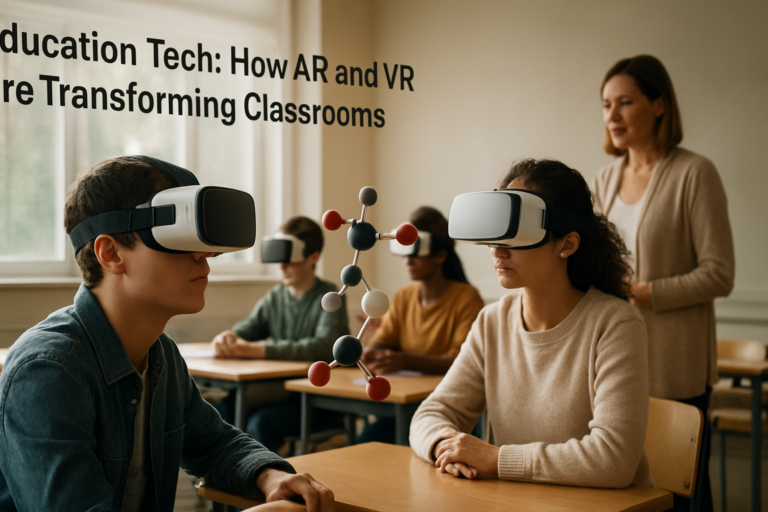
Imagine a history lesson where students don’t just read about ancient Rome—they walk through its bustling forums, hear the clatter of chariots, and feel the dust of the Colosseum. Or a biology class where they shrink to the size of a cell and navigate the intricate pathways of DNA. This is not science fiction; it is the reality of augmented reality (AR) and virtual reality (VR) in education today.
Education technology, or EdTech, is undergoing a seismic shift. The global EdTech market, valued at $123.4 billion in 2022, is projected to exceed $348 billion by 2030, with AR and VR leading the charge. These immersive tools are transforming classrooms from passive learning environments into dynamic, interactive spaces where students engage with content in ways previously unimaginable. Let’s explore how AR and VR are reshaping education, the statistics backing their rise, and what this means for the future of learning.
The Core Difference: AR vs. VR in Education
Before diving into applications, it’s essential to understand the distinction. Augmented reality overlays digital information onto the real world—think of a student pointing a tablet at a textbook page and watching a 3D volcano erupt on their desk. Virtual reality, on the other hand, replaces the real world entirely, immersing users in a computer-generated environment via headsets.
Both technologies share a common goal: to make learning experiential. Research from PwC shows that VR learners are up to 4 times more focused than their e-learning counterparts, and they complete courses 4 times faster. Meanwhile, AR has been shown to improve knowledge retention by up to 70% compared to traditional methods, according to a study by the University of Maryland.
How AR is Enhancing Classroom Engagement
AR brings abstract concepts to life without requiring expensive hardware. In elementary schools, apps like “Quiver” allow students to color 2D drawings that then animate into 3D objects via a smartphone. In higher education, medical students use AR to visualize anatomy layers over a physical mannequin, practicing procedures without risk.
- Interactive Textbooks: Publishers like Pearson and McGraw-Hill are embedding AR markers in textbooks. When scanned, they trigger videos, 3D models, or quizzes. This bridges the gap between reading and doing.
- Language Learning: Apps like “Mondly AR” place virtual characters in the classroom, enabling students to practice conversations with AI-powered avatars that respond in real-time.
- Field Trips Without Boundaries: Google Expeditions, now integrated with AR, lets teachers bring the Great Barrier Reef or the surface of Mars into the classroom, turning a desk into a portal.
A 2023 report by Deloitte found that 68% of K-12 teachers using AR reported increased student participation, and 72% noted improved understanding of complex topics. The technology’s accessibility is key—most AR experiences require only a smartphone or tablet, which are already common in schools.
VR: Immersive Learning That Transforms Understanding
VR takes immersion a step further, creating entire simulated worlds. For subjects where physical presence is impossible—like space exploration or historical events—VR offers unparalleled depth.
- Science and Medicine: Stanford University’s “Virtual Human Interaction Lab” uses VR to teach empathy by simulating life as a refugee or a person with color blindness. In medical schools, platforms like “Osso VR” allow students to perform virtual surgeries, reducing errors in real operations by 230%, according to a study in the Journal of Surgical Education.
- History and Culture: The “TimeLooper” app lets students experience historical events, like the signing of the Declaration of Independence, from a first-person perspective. This emotional connection boosts long-term memory.
- Technical Training: Vocational schools use VR to simulate welding, electrical repairs, or flight mechanics. Boeing reported a 75% reduction in training time for aircraft assembly using VR, with error rates dropping by 40%.
The cost of VR headsets has dropped significantly—the Meta Quest 2 now costs under $300, making it viable for school districts. A 2022 survey by the International Society for Technology in Education found that 45% of U.S. high schools have at least one VR headset available for classroom use.
Challenges and Considerations
Despite the promise, AR and VR in education face hurdles. Hardware costs, while decreasing, still strain budgets in underfunded schools. Content creation is another bottleneck—customizing VR experiences for specific curricula requires investment and expertise. Additionally, prolonged VR use can cause motion sickness in some students, limiting session durations.
Privacy concerns also arise. Many AR/VR platforms collect user data, including eye movements and physical reactions, raising questions about student surveillance. Schools must navigate these ethical waters carefully, ensuring compliance with laws like COPPA in the U.S.
The Future: Blended Realities and AI Integration
Looking ahead, the convergence of AR, VR, and artificial intelligence will further revolutionize classrooms. Imagine an AI tutor that adapts a VR lesson in real-time based on a student’s facial expressions or a history simulation that changes outcomes based on student decisions.
- Mixed Reality (MR): Devices like the Apple Vision Pro blend AR and VR, allowing students to interact with 3D holograms while still seeing their physical surroundings. This could enable collaborative projects where remote students work alongside in-person peers in shared virtual spaces.
- Personalized Learning Paths: AI algorithms will analyze student performance in VR simulations to identify strengths and weaknesses, adjusting difficulty levels automatically. This could eliminate the one-size-fits-all model of traditional education.
- Global Classrooms: VR platforms like “Engage” already allow students from different countries to meet in virtual spaces, fostering cross-cultural collaboration. The potential for language exchange programs or joint science projects is immense.
A report by Goldman Sachs estimates that the education sector will account for 15% of the global VR market by 2025, with AR adoption growing even faster. As 5G networks expand, latency issues will diminish, making real-time AR/VR experiences more seamless.
Conclusion: A New Era of Learning
AR and VR are not just gadgets—they are tools that tap into how humans naturally learn: by doing, seeing, and feeling. They democratize access to experiences that were once reserved for the privileged few, from exploring the pyramids to dissecting a heart. While challenges remain, the trajectory is clear. Classrooms of the future will not be defined by rows of desks and chalkboards, but by immersive worlds that ignite curiosity and deepen understanding. The question is no longer if these technologies will transform education, but how quickly we can integrate them responsibly. As the data shows, the payoff—in engagement, retention, and equity—is too significant to ignore.