
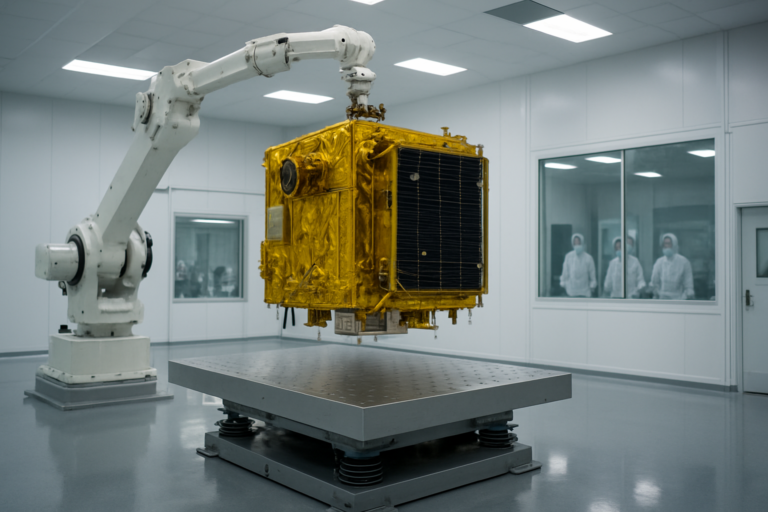
India’s ascent in global space exploration is no longer a story of the future—it is a present-day reality reshaping the technological and economic landscape. From launching record-breaking satellites to landing near the lunar south pole, the Indian Space Research Organisation (ISRO) has demonstrated that cost-effective, reliable, and innovative space missions are not just possible but are becoming the new global standard. This transformation is not only about national pride; it’s about how space technology drives innovation across industries, from agriculture to telecommunications.
The Rise of ISRO: A Model of Efficiency
What makes India’s space program truly remarkable is its ability to achieve high-impact results with modest budgets. Consider the Mars Orbiter Mission (Mangalyaan), which cost approximately $74 million—less than the budget of the Hollywood film Gravity. This efficiency has forced global space agencies and private players to rethink their approaches. ISRO’s success is built on a philosophy of frugal engineering, where indigenous innovation and resource optimization are paramount.
Key achievements that define India’s space leadership:
- Chandrayaan-3: First mission to successfully land near the lunar south pole, a feat no other nation has accomplished.
- OneWeb Constellation: ISRO’s commercial arm, NSIL, has launched hundreds of satellites for global broadband connectivity.
- Gaganyaan Mission: India’s first human spaceflight program, aiming to send astronauts to low-Earth orbit by 2025.
These milestones are not just technological trophies; they are catalysts for a growing space economy.
The Economic Impact: From Satellites to Startups
India’s space sector is projected to grow to a $44 billion economy by 2033, according to a report by EY and the Indian Space Association. This growth is fueled by two major trends: the privatization of space activities and the rise of space-tech startups.
Since the government opened the space sector to private players in 2020, over 150 space-tech startups have emerged in India. Companies like Skyroot Aerospace, which built India’s first privately developed rocket (Vikram-S), and Pixxel, which operates a constellation of hyperspectral imaging satellites, are now competing globally. This ecosystem is creating high-tech jobs in software, data analytics, and advanced manufacturing.
How space technology drives innovation on Earth:
- Agriculture: Satellite data from ISRO’s Resourcesat series helps farmers monitor crop health, predict yields, and optimize water usage.
- Disaster Management: The INSAT and GSAT satellites provide real-time data for cyclone tracking, flood mapping, and drought monitoring.
- Telecommunications: High-throughput satellites are enabling broadband connectivity in remote Himalayan villages and island communities.
- Navigation: The NavIC (Indian Regional Navigation Satellite System) provides accurate positioning data for everything from fishing vessels to train tracking.
This integration of space-based data into everyday applications is what makes India’s space program a driver of broader technological innovation.
Collaboration and Competition: India’s Role in Global Missions
India is not working in isolation. ISRO has become a preferred partner for international missions due to its reliability and cost-effectiveness. The NASA-ISRO Synthetic Aperture Radar (NISAR) mission, scheduled for launch in 2024, will map Earth’s surface in unprecedented detail, aiding climate research. Similarly, India’s launch services have carried satellites for over 30 countries, including the United States, the United Kingdom, and Singapore.
This collaborative approach has also led to technology transfers. For instance, ISRO’s expertise in miniaturization and thermal protection has been shared with Indian companies developing satellite components. This cross-pollination is creating a self-reliant ecosystem that reduces dependence on foreign suppliers.
The Technology Behind the Missions
India’s space capabilities rest on several core technologies that have matured over decades:
- Polar Satellite Launch Vehicle (PSLV): One of the most reliable launch vehicles in the world, with over 50 successful missions. It can place satellites in multiple orbits, making it ideal for commercial launches.
- Geosynchronous Satellite Launch Vehicle (GSLV): Equipped with an indigenous cryogenic engine, this heavy-lift rocket enables India to launch communication satellites into geostationary orbit.
- Reusable Launch Vehicle (RLV): ISRO is testing a space shuttle-like vehicle that could drastically reduce launch costs. The RLV-TD (Technology Demonstrator) has already completed successful landing tests.
These technologies are not static. ISRO is actively working on next-generation systems, including electric propulsion for satellites, advanced composite materials for lighter spacecraft, and artificial intelligence for autonomous navigation.
The Human Element: Skilling a New Generation
Behind every successful mission is a team of highly skilled scientists, engineers, and technicians. India’s space program has created a unique talent pipeline. The Indian Institute of Space Science and Technology (IIST) in Thiruvananthapuram produces graduates specifically trained for space research. Additionally, ISRO’s outreach programs, like the Young Scientist Programme (YUVIKA), inspire school students to pursue careers in science and technology.
Statistics highlight the scale of this workforce:
- ISRO employs over 17,000 people directly.
- The space ecosystem supports an estimated 50,000+ jobs in private companies and research institutions.
- Over 1,000 PhDs in space science and engineering are produced annually across Indian universities.
This human capital is India’s greatest asset in maintaining its competitive edge.
Challenges and the Road Ahead
Despite its successes, India’s space program faces significant challenges. The global space race is intensifying, with private players like SpaceX and Blue Origin pushing the boundaries of reusability and heavy lift capability. India must accelerate its own reusable launch vehicle development to remain cost-competitive.
Another challenge is the growing problem of space debris. With more satellites being launched, the risk of collisions increases. ISRO is investing in debris tracking and mitigation technologies, but international cooperation is essential.
Finally, funding remains a constraint. While India’s space budget has increased, it is still a fraction of NASA’s or the Chinese space program’s. Prioritizing key missions and maintaining operational efficiency will be crucial.
Conclusion: A New Frontier for Innovation
India’s role in global space exploration is a testament to what focused investment, indigenous innovation, and strategic collaboration can achieve. The technology developed for space is already transforming industries on Earth, from agriculture to telecommunications. As the space economy expands, India is well-positioned to be a major player—not just as a launch provider, but as a source of cutting-edge technology and talent. The journey from launching small satellites to landing on the Moon and planning human spaceflight is a story of relentless progress, and it is far from over.