
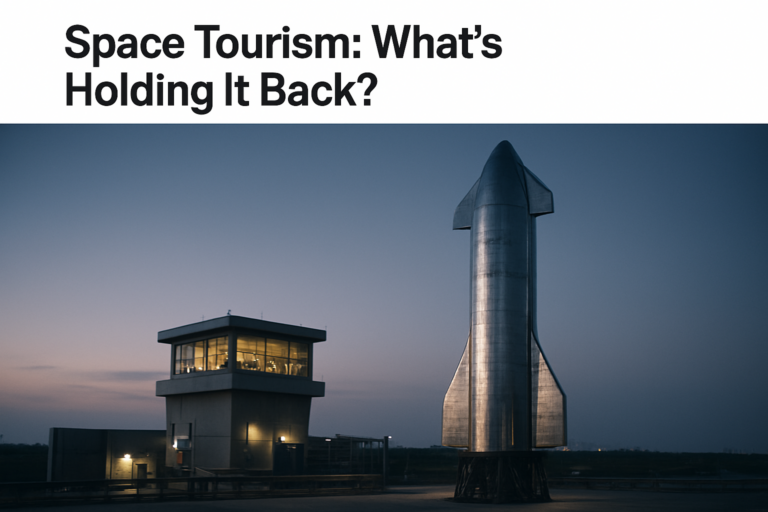
Space tourism promises the thrill of orbiting Earth for private citizens, but several formidable obstacles keep it from becoming a mainstream industry. While a handful of billionaire adventurers have already made the journey, the broader market remains nascent. Understanding these barriers—ranging from astronomical launch costs to evolving safety regulations—reveals where the industry is headed and how solving these problems could accelerate wider technological innovation.
The Price Tag of Leaving Earth
Rocket Production and Launch Expenses
- Manufacturing costs: Building a launch‑ready vehicle still requires high‑grade alloys, complex avionics, and extensive testing. Even with the advent of reusable rockets, a single launch can exceed $50 million.
- Fuel and operations: Propellant for orbital insertion is pricey, and each launch demands a dedicated ground crew, telemetry support, and range safety personnel.
- Economies of scale: Current flight frequencies are low—typically fewer than ten commercial seats per year—preventing manufacturers from spreading fixed costs across many customers.
Ticket Prices Remain Prohibitive
- Current market rates: Companies such as Virgin Galactic and Blue Origin price tickets between $250,000 and $450,000, while SpaceX’s private orbital missions can exceed $55 million per seat.
- Limited customer pool: These figures restrict sales to ultra‑high‑net‑worth individuals, keeping demand relatively flat.
Safety and Regulatory Hurdles
Stringent Certification Processes
- Human‑rated launch vehicles: Agencies like the FAA (U.S.) and EASA (Europe) require rigorous proof of reliability, mandating thousands of test minutes and redundant safety systems.
- Medical clearance: Passengers must meet strict health criteria, similar to astronaut standards, which narrows the eligible demographic.
Liability and Insurance
- Risk assessment: Insurers demand comprehensive risk models for each flight, often inflating premiums to $10‑15 million per mission.
- Legal frameworks: International space law, including the Outer Space Treaty, was drafted for nation‑state activities, leaving a gray area for private commercial passengers.
Infrastructure and Logistics
Launch Site Bottlenecks
- Limited pads: Only a handful of orbital launch complexes can accommodate commercial crewed flights, leading to scheduling constraints.
- Ground support: Specialized infrastructure—such as crew‑size life‑support systems, rapid‑turnaround fueling stations, and secure perimeters—requires substantial capital investment.
In‑Space Services
- Orbital habitats: No commercial space hotel exists yet, meaning most trips are sub‑orbital or brief orbital fly‑bys.
- Docking and return: Safe re‑entry capsules and reliable abort systems are still under development, adding layers of complexity.
Environmental and Sustainability Concerns
Space Debris
- Collision risk: Increased launch frequency raises the probability of adding to the existing debris cloud, threatening both commercial and scientific missions.
- Mitigation mandates: Regulators are beginning to require end‑of‑life de‑orbit plans, which can increase design costs.
Carbon Footprint
- Launch emissions: Rocket propulsion contributes to greenhouse gases; for example, a single Falcon 9 launch releases roughly 360 tons of CO₂.
- Public perception: Growing environmental awareness could pressure companies to adopt greener propellants, potentially raising costs in the short term.
Technological Bottlenecks
Reusability Limits
- Turnaround time: While first‑stage boosters can be reflown, refurbishing them for crewed missions still takes weeks, not days.
- Certification for humans: Reusing hardware that has experienced the stresses of previous flights requires additional validation, delaying schedules.
Microgravity Research Integration
- Scientific payloads: Aligning tourist schedules with research experiments demands flexible mission planning, which is currently difficult due to rigid launch windows.
- Technology spillover: Overcoming these scheduling challenges could accelerate the development of modular, plug‑and‑play payload bays, benefitting both tourism and research sectors.
Market Demand and Perception
Consumer Confidence
- Risk aversion: High‑profile accidents, such as the 2014 Soyuz launch failure, can dampen enthusiasm and affect ticket sales.
- Experience value: Travelers expect more than a brief sub‑orbital hop; they seek immersive experiences, which require additional infrastructure (e.g., orbital hotels, space‑based entertainment).
Economic Viability
- Revenue models: Companies are experimenting with subscription‑style access, corporate sponsorships, and “space‑flight as a service” to diversify income streams.
- Competitive landscape: Emerging players from China, India, and the United Arab Emirates could drive prices down through competition, but they also add regulatory complexity.
The Upside: How Solving These Issues Fuels Innovation
- Lower launch costs: Advances in additive manufacturing and fully autonomous launch operations could bring ticket prices under $50,000, opening the market to a broader demographic.
- Safety tech spin‑offs: Redundant life‑support systems and rapid‑abort mechanisms are already influencing aviation safety standards.
- Sustainable propulsion: Development of methane‑based or electric propulsion could reduce carbon emissions, benefitting both space and terrestrial transport.
- Infrastructure reuse: Modular launch pads and mobile ground support units can serve multiple sites, decreasing fixed‑cost overhead.
- Economic ripple effects: A thriving space‑tourism sector would stimulate supply chains ranging from advanced composites to AI‑driven mission planning, creating high‑skill jobs and new patents.
In summary, space tourism’s current constraints—cost, safety, regulation, infrastructure, and environmental impact—are interlinked challenges that require coordinated breakthroughs. As the industry tackles each obstacle, the resulting technologies promise to cascade into broader aerospace, energy, and material science domains, accelerating humanity’s push beyond Earth’s atmosphere.