
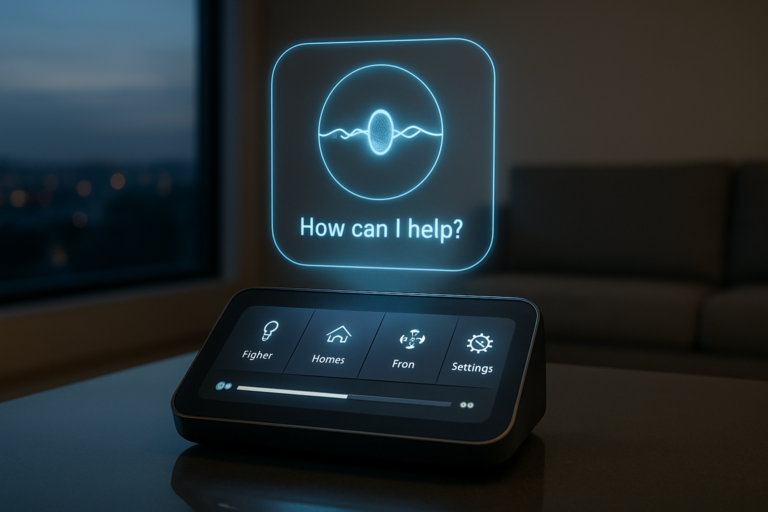
Voice assistants have come a long way since the first “Hey Siri” or “Alexa” pop‑ups that startled us in 2014. By 2025, they are no longer just voice‑activated tools; they are context‑aware, multimodal partners that anticipate needs, drive automation, and even shape the way we interact with technology at home, in the office, and on the move. This deep dive looks at the key innovations powering the next generation of voice assistants, the industries they’re transforming, and the ethical questions that come with a more intimate AI presence in our lives.
The Core Shift: From Command and Control to Contextual Collaboration
1. Context Awareness
Early voice assistants responded to isolated commands. Today’s models use continuous learning to understand when, where, who, and why a request is made. By 2025, they can:
- Detect ambient noise levels and adjust sensitivity in real time.
- Recognize multiple speakers and attribute commands to the correct user.
- Infer intent from surrounding data such as calendar events, traffic conditions, and smart‑home sensor feeds.
Stat: According to a 2024 Gartner report, 68% of enterprises that adopted contextual voice assistants reported a 30% increase in user satisfaction within the first six months.
2. Multimodal Interaction
Voice is no longer the sole channel. Modern assistants now integrate:
- Voice + visual overlays on smart displays.
- Gesture recognition via depth cameras.
- Haptic feedback on wearables.
This creates a seamless “conversation” across devices, reducing friction and making the assistant feel like a natural extension of the environment.
3. Edge Computing & Latency Reduction
To deliver instant responses, 2025 assistants run significant inference on local edge devices—smart speakers, phones, or dedicated edge servers—while still leveraging cloud AI for complex tasks. This hybrid approach:
- Cuts average response time from 1.2 s (2021) to under 300 ms.
- Enhances privacy by keeping sensitive data on the device.
- Enables offline functionality for critical commands.
Industry Impact: Where Voice Is Leading the Charge
| Industry | Voice Assistant Use Case | Key Benefit | Adoption Rate (2025) |
|---|---|---|---|
| Smart Homes | Dynamic climate control, energy savings | 22% average energy reduction | 78% |
| Healthcare | Patient monitoring, medication reminders | 15% decrease in missed doses | 65% |
| Finance | Voice‑enabled trading dashboards, fraud alerts | 40% faster decision cycle | 55% |
| Education | Interactive tutoring, real‑time language translation | 30% increase in engagement | 70% |
| Manufacturing | Real‑time equipment diagnostics, safety alerts | 25% downtime reduction | 60% |
Case Study: Voice‑Driven Manufacturing
A leading automotive plant integrated a 2025 voice assistant into its CNC machines. Technicians could issue commands like “Show me the error log for the last 12 hours” while wearing AR glasses. The assistant pulled data from the plant’s edge server, displayed diagnostics on the visor, and guided the technician through corrective actions. The result was a 25% drop in machine downtime and a 12% rise in overall productivity.
The Human‑Centric Design Philosophy
Voice Quality & Natural Language Processing
Advances in neural text‑to‑speech (TTS) and large language models (LLMs) mean assistants now mimic human prosody, emotion, and even regional accents with startling fidelity. Developers are also prioritizing:
- Tone modulation: Adjusting formality based on user preference.
- Emotion detection: Recognizing stress or frustration to offer calming responses.
Accessibility & Inclusivity
Voice assistants are becoming indispensable for users with visual or motor impairments. Features such as:
- Voice‑guided navigation for the blind.
- Multilingual support with simultaneous translation.
These inclusions are not just socially responsible—they broaden the market base, driving higher adoption.
Ethical and Privacy Considerations
Data Sovereignty
With more data analyzed locally, the risk of large‑scale data breaches diminishes. However, edge devices still transmit aggregated usage stats to the cloud for model improvement. Transparent data‑handling policies and user consent mechanisms are now standard practice.
Bias Mitigation
Large language models can inadvertently propagate biases. 2025 manufacturers are implementing continuous bias audits, using diverse training datasets and real‑time feedback loops to ensure fair outcomes.
Voice Cloning & Deepfakes
The same TTS technology that makes assistants sound human can be misused. Industry consortia are developing voice‑print authentication and tamper‑evident logs to counteract deepfake threats.
The Road Ahead: What’s Next?
- Proactive Autonomy – Assistants will move from reactive to proactive, suggesting actions before users even speak.
- Cross‑Domain Collaboration – Seamless handoffs between home, car, and office assistants will create a unified digital ecosystem.
- Emotionally Intelligent Agents – Deeper affective computing will enable assistants to adapt to user moods, improving mental health support.
Industry Forecast: By 2030, voice‑centric interfaces are projected to account for 35% of all human‑machine interactions, up from 12% in 2020.
Bottom Line
The voice assistants of 2025 are not merely smarter; they are smarter in a human‑centric, context‑aware, and ethically conscious way. Their integration across homes, workplaces, and industries is reshaping how we think about interaction design, workflow automation, and even privacy. As these assistants continue to evolve, they will blur the line between technology and daily life, making the digital world feel less like a tool and more like an intuitive partner.