
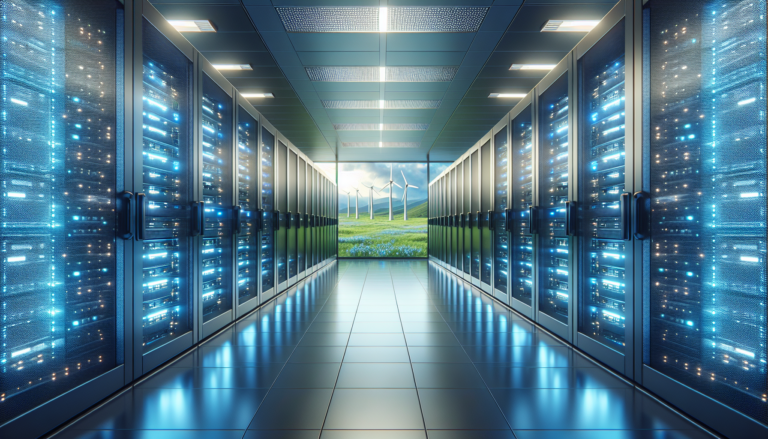
Every time you stream a high-definition movie, send an instant message, or prompt a generative AI model, a silent engine is working somewhere in the world. That engine is the data center. As our global reliance on cloud computing and artificial intelligence reaches a fever pitch, the sheer volume of data being processed has turned data centers into the backbone of modern civilization. However, this digital backbone comes with a heavy environmental price tag.
The energy demand of these facilities is skyrocketing. Recent estimates suggest that data centers currently account for approximately 1% to 2% of global electricity consumption. With the explosive growth of Large Language Models (LLMs) and massive AI training clusters, that number is projected to climb significantly. For industry leaders, the challenge is no longer just about uptime and latency; it is about decoupling digital growth from environmental degradation. This shift toward “Green Data Centers” is transforming how infrastructure is built, cooled, and powered.
The Energy Paradox: AI and the Demand for Power
The rise of Artificial Intelligence has introduced a new variable into the sustainability equation. Unlike traditional cloud workloads, which can be distributed relatively efficiently, AI training requires massive amounts of compute power concentrated in specific clusters. These clusters generate intense, localized heat, requiring even more energy to keep the hardware within safe operating temperatures.
To combat this, the industry is moving away from “growth at all costs” toward “efficiency by design.” The goal is to maximize the amount of work done per watt of electricity consumed. This is where the concept of Power Usage Effectiveness (PUE) becomes critical. PUE is the ratio of the total energy used by a data center to the energy delivered to the computing equipment. A perfect score of 1.0 would mean every bit of energy goes directly to the servers, with zero wasted on cooling or lighting. While the industry average has hovered around 1.5 to 1.8 for years, leaders in the green tech space are pushing toward 1.1 or lower.
Rethinking Cooling: From Air to Liquid
Traditionally, data centers have relied on Computer Room Air Conditioning (CRAC) systems. These systems use massive fans to circulate chilled air through aisles to prevent hardware from overheating. While effective for years, air is a relatively poor conductor of heat. As server density increases—especially with high-performance AI chips—air cooling is reaching its physical limits.
Enter liquid cooling. This technology is becoming the gold standard for sustainable, high-density computing. There are two primary methods gaining traction:
- Direct-to-Chip Cooling: This involves circulating liquid through small cold plates placed directly on the processors. Since liquid can carry away heat much more efficiently than air, it allows for much higher compute densities without the massive energy drain of industrial fans.
- Immersion Cooling: In this more radical approach, entire server blades are submerged in a non-conductive, dielectric fluid. The fluid absorbs heat directly from all components, eliminating the need for fans entirely.
By switching to liquid-based solutions, operators can significantly reduce their PUE and drastically lower the energy required for thermal management, which often accounts for nearly 40% of a data center’s total energy spend.
Powering the Future with Renewable Energy
A green data center is only as clean as the grid it plugs into. To achieve true carbon neutrality, infrastructure leaders are moving beyond simply buying “carbon offsets” and are instead becoming active participants in the renewable energy market.
Modern data center strategy now revolves around Power Purchase Agreements (PPAs). Through these long-term contracts, companies like Google, Microsoft, and Amazon provide the financial certainty needed for developers to build new wind farms and solar arrays. This creates a “additionality” effect—the data center’s demand actually helps bring new renewable energy onto the grid that wouldn’t have existed otherwise.
Furthermore, we are seeing a shift toward “24/7 Carbon-Free Energy” (CFE). Instead of matching annual consumption with annual renewable production, the goal is to ensure that every hour of operation is matched by local carbon-free energy. This requires sophisticated energy storage solutions, such as large-scale lithium-ion or flow batteries, to bridge the gap when the sun isn’t shining or the wind isn’t blowing.
The Circular Economy: Heat Recycling and Waste Recovery
One of the most exciting frontiers in green infrastructure is the concept of waste heat recovery. In a traditional setup, the heat generated by servers is treated as a nuisance to be exhausted into the atmosphere via cooling towers. In a circular economy model, that heat is treated as a resource.
In colder climates, several European cities are already implementing “district heating” projects. Data centers are connected to local municipal heating grids, where the excess thermal energy from the servers is piped into homes, offices, and even greenhouses to provide warmth. This turns a byproduct of computing into a community asset, effectively lowering the carbon footprint of both the data center and the surrounding urban environment.
Measuring Success Beyond Carbon
As the industry matures, the metrics for success are becoming more holistic. While PUE remains vital, the industry is placing increasing emphasis on:
- Water Usage Effectiveness (WUE): Traditional cooling towers consume millions of gallons of water through evaporation. As water scarcity becomes a global crisis, green data centers are pivoting to “waterless” cooling or closed-loop systems that recycle every drop.
- Embodied Carbon: This looks at the carbon footprint of the hardware itself—from the mining of rare earth metals for chips to the construction of the concrete facility.
- Hardware Longevity: Extending the lifecycle of servers through better thermal management reduces the frequency of e-waste, a growing environmental concern.
The Path Forward
The transition to green data centers is not merely a trend; it is a fundamental necessity for the continued expansion of the digital world. As AI continues to redefine what is possible, the infrastructure supporting it must be as intelligent and efficient as the software it runs. Through the marriage of liquid cooling, renewable energy integration, and circular economy principles, the industry is proving that we can power the digital age without compromising the health of our planet.
Is your organization ready to embrace sustainable digital infrastructure? Contact our experts today to learn how we can help optimize your cloud footprint for a greener tomorrow.