
The sun doesn’t always shine, and the wind doesn’t always blow. This simple truth has long been the Achilles’ heel of renewable energy. While solar and wind power are abundant and clean, their intermittency creates a significant challenge for grid operators who must match supply with demand in real-time. When a cloud passes over a solar farm, power output can drop by 70% in minutes. When the wind dies down, entire wind farms can go silent. For decades, this variability has forced utilities to keep fossil fuel plants on standby, ready to ramp up at a moment’s notice. But a quiet revolution is underway, one that doesn’t rely on chemical batteries but on something far more fundamental: heat.
Thermal energy storage (TES) is emerging as a powerful, cost-effective solution to bridge the gap between renewable generation and grid demand. By capturing excess energy as heat in materials like molten salts, phase-change materials, or even simple rocks, TES systems can store that energy for hours—or even days—and release it when needed. Unlike lithium-ion batteries, which store electricity directly, thermal storage works by converting electricity into thermal energy, storing it, and then converting it back to electricity (or using it directly for heating and cooling). This approach offers a unique combination of low cost, long duration, and scalability that makes it an ideal partner for solar and wind power.
The Science of Storing Heat
At its core, thermal energy storage is deceptively simple. The principle is to heat a material to a high temperature, insulate it to prevent heat loss, and then extract the heat later. The efficiency and practicality of the system depend on the storage material and the technology used. There are three primary categories of TES: sensible heat storage, latent heat storage (using phase-change materials), and thermochemical storage.
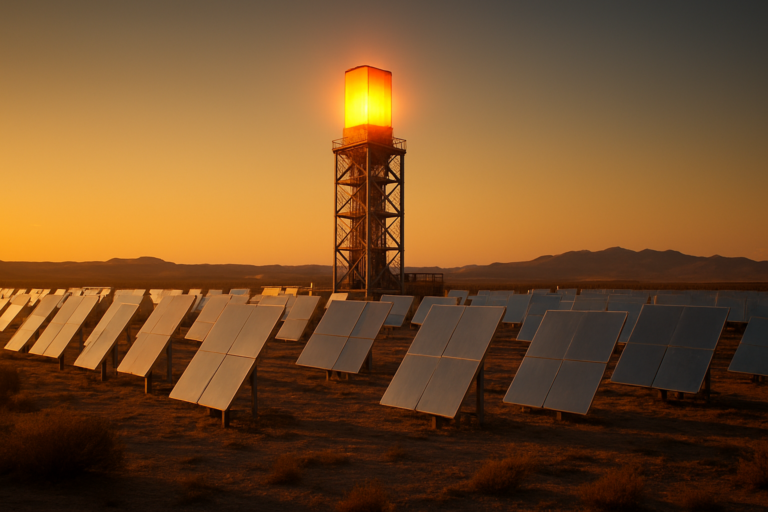
Sensible heat storage is the most mature technology. It involves heating a solid or liquid material—like water, concrete, or molten salt—without changing its phase. The amount of energy stored depends on the material’s specific heat capacity and the temperature difference. For large-scale applications, molten salt has become the industry standard. A mixture of 60% sodium nitrate and 40% potassium nitrate, molten salt is liquid at high temperatures (above 220°C) and can be heated to over 560°C. It is non-flammable, non-toxic, and relatively inexpensive. This is the technology behind the world’s largest concentrated solar power (CSP) plants, such as the Noor Complex in Morocco and the Crescent Dunes plant in Nevada.
Latent heat storage uses phase-change materials (PCMs) that absorb or release energy as they melt and solidify. For example, paraffin wax or salt hydrates can store large amounts of energy at a constant temperature—the melting point. This allows for higher energy density than sensible storage, meaning a smaller volume of material can store the same amount of heat. PCMs are particularly useful for applications requiring a steady output temperature, such as industrial process heat or building heating and cooling.
Thermochemical storage is the most experimental but potentially the most powerful. It uses reversible chemical reactions to store energy. For instance, the dehydration of calcium hydroxide (Ca(OH)₂) absorbs heat, and rehydration releases it. These systems can achieve very high energy densities and can store energy for months with minimal losses, making them ideal for seasonal storage. However, they are still in the research and pilot phase due to challenges with material stability and reactor design.
Why Thermal Storage Matters for the Grid
The real value of thermal energy storage lies in its ability to provide long-duration, dispatchable power. While lithium-ion batteries excel at short-duration storage (2–4 hours), they become prohibitively expensive for longer durations. Thermal storage, by contrast, can economically provide 6, 10, or even 12 hours of storage. According to the U.S. Department of Energy, the levelized cost of storage for molten salt TES can be as low as $50–$80 per megawatt-hour (MWh) for 10-hour systems, compared to $150–$200/MWh for lithium-ion batteries of similar duration.
This makes TES a perfect complement to solar power. A CSP plant with molten salt storage can generate electricity long after the sun goes down, providing power during the evening peak demand period. For example, the Gemasolar plant in Spain, with 15 hours of molten salt storage, can operate 24/7 during summer months. This capability is transforming how utilities plan their renewable portfolios. Instead of building solar farms that only produce power during daylight hours, they can now build solar-plus-storage plants that act like baseload power plants.
Beyond Electricity: Industrial Heat and District Heating
Thermal energy storage isn’t just for electricity generation. A staggering 20–25% of global energy consumption is used for industrial heat—processes like drying, baking, smelting, and chemical reactions. Many of these processes require temperatures between 100°C and 500°C, a range that TES can easily provide. By using excess renewable electricity to heat storage materials, factories can decarbonize their operations without relying on natural gas or coal.
In Europe, district heating networks are increasingly integrating TES. In Denmark, large pit thermal energy storage systems—essentially giant insulated water tanks—store solar heat collected during summer for use in winter. The Vojens plant, the world’s largest pit storage system, holds 200,000 cubic meters of water and supplies heat to over 2,000 homes. By combining solar thermal collectors with seasonal TES, the system achieves a solar fraction of over 50%.
The Road Ahead: Challenges and Innovations
Despite its promise, thermal energy storage faces significant hurdles. Round-trip efficiency (the ratio of electricity out to electricity in) for CSP plants is only about 40–55%, compared to 85–95% for lithium-ion batteries. This is because converting heat back to electricity using a steam turbine involves thermodynamic losses. However, new technologies like supercritical carbon dioxide (sCO₂) power cycles promise to push efficiency above 60%. Additionally, research into advanced PCMs and thermochemical materials is accelerating, with startups like Malta (a Google X spin-off) developing pumped heat energy storage systems that use heat pumps and heat engines.
The cost of thermal storage is also falling rapidly. The International Renewable Energy Agency (IRENA) projects that the cost of CSP with storage will drop by 50% by 2030, making it competitive with fossil fuels in many regions. Meanwhile, new hybrid systems that combine TES with heat pumps and electric heaters are emerging, allowing for even greater flexibility.
A Future Powered by Heat
The narrative of the clean energy transition has been dominated by solar panels, wind turbines, and lithium-ion batteries. But thermal energy storage is quietly proving that the answer to renewable intermittency may not be a chemical reaction inside a battery, but a simple, elegant application of heat. By storing excess renewable energy as thermal energy—whether in molten salt, phase-change materials, or heated water—we can create a grid that is not just renewable, but reliable, resilient, and round-the-clock.
As we continue to scale up solar and wind, the need for long-duration storage will only grow. Thermal energy storage, with its low cost, long lifespan, and versatility, is perfectly positioned to fill that gap. It is not a competitor to batteries but a complement—a tool that allows us to use every electron of clean energy, even when the sun isn’t shining and the wind isn’t blowing. The future of energy isn’t just about generating power; it’s about keeping it, and heat is the key.