
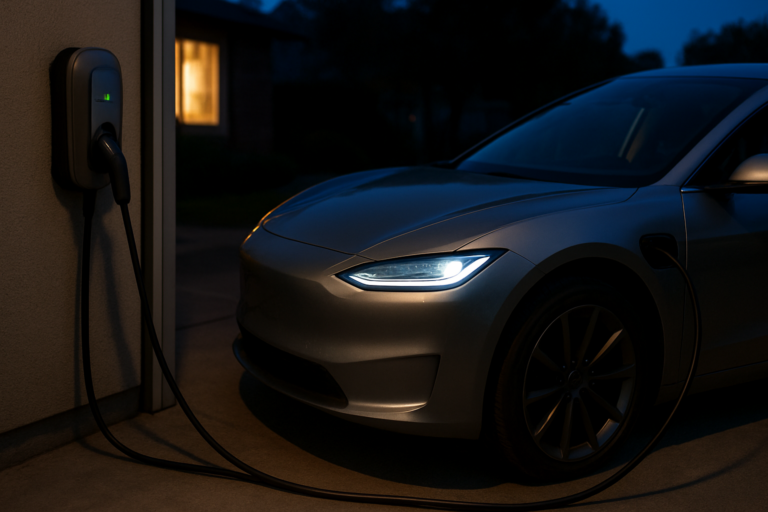
Imagine a future where the electric vehicle sitting in your garage isn’t just a mode of transport but a silent, powerful asset for the entire electricity grid. This isn’t science fiction; it’s the emerging reality of Vehicle-to-Grid (V2G) technology. As the world accelerates toward electric mobility, the potential of millions of EV batteries to act as distributed energy storage units is reshaping how we think about energy management. V2G technology allows electric vehicles to not only draw power from the grid but also send electricity back when needed, turning a fleet of parked cars into a virtual power plant. This bidirectional flow of energy promises to solve one of the biggest challenges of the renewable energy transition: grid stability.
At its core, V2G technology relies on bidirectional charging systems. Unlike standard chargers that only push electricity into the car’s battery, a V2G-enabled charger can reverse the flow, converting the EV’s DC power back to AC for the grid. This process is managed by smart software that communicates with the grid operator, determining when to charge and when to discharge based on real-time demand and supply. The concept is elegantly simple: most cars are parked 95% of the time, meaning their batteries are idle assets. By tapping into this idle capacity, V2G can provide critical grid services like frequency regulation, voltage support, and peak shaving—reducing the need for expensive, polluting peaker plants.
The benefits of V2G extend far beyond grid operators. For EV owners, it transforms a cost into a potential revenue stream. By participating in demand response programs, drivers can earn money or credits by allowing their car to discharge during peak hours when electricity prices are high, and charge during off-peak hours when prices are low. According to a 2023 study by the National Renewable Energy Laboratory (NREL), a typical EV owner could earn between $150 and $300 annually through V2G participation, depending on local energy markets and driving patterns. This financial incentive could accelerate EV adoption, making ownership more affordable while simultaneously supporting the grid.
From a grid perspective, V2G offers a flexible, fast-responding resource that can help integrate variable renewable energy sources like solar and wind. When the sun isn’t shining or the wind isn’t blowing, V2G-enabled EVs can discharge stored energy to fill the gap. Conversely, when renewable generation is high, excess power can be stored in EV batteries rather than being curtailed. The International Energy Agency (IEA) estimates that by 2030, the global fleet of EVs could provide over 1,000 gigawatt-hours of storage capacity—enough to power millions of homes for hours. This distributed storage network could reduce the need for new grid infrastructure investments, such as new transmission lines and large-scale battery farms.
However, widespread adoption of V2G faces several hurdles. Battery degradation is a primary concern among automakers and consumers. Frequent bidirectional cycling can theoretically accelerate battery wear, though modern lithium-ion batteries are more resilient than earlier generations. Research from the University of Warwick suggests that with smart charging algorithms, V2G can actually extend battery life by optimizing charge cycles. Still, automakers remain cautious, and warranty policies for V2G use are still evolving. Standardization is another challenge—different manufacturers use different communication protocols, and grid operators require uniform interfaces to manage millions of vehicles seamlessly.
Infrastructure costs also pose a barrier. Bidirectional chargers are currently more expensive than standard chargers, with prices ranging from $1,500 to $3,000 for a home unit, compared to $500–$700 for a unidirectional Level 2 charger. Additionally, utility companies must invest in advanced metering, communication networks, and software to manage V2G fleets. Despite these costs, pilot projects worldwide are proving the concept. In Denmark, the Parker project demonstrated that V2G-enabled EVs could provide frequency regulation services without compromising driver convenience. In the UK, the Electric Nation project is testing V2G in hundreds of homes, showing that participants can reduce their electricity bills by up to 10%.
The regulatory landscape is also catching up. In the European Union, the revised Renewable Energy Directive encourages member states to support smart charging and V2G. In the United States, California’s Self-Generation Incentive Program (SGIP) now includes V2G systems, offering rebates to homeowners. Japan has been a pioneer, with Nissan and Mitsubishi offering V2G-capable vehicles and home energy systems since the early 2010s. As policies evolve, the economic case for V2G will strengthen, making it a mainstream feature in future EVs.
Looking ahead, V2G is poised to become a cornerstone of the smart grid. Combined with vehicle-to-home (V2H) and vehicle-to-building (V2B) applications, it will enable energy independence for households and businesses. Imagine a future where your EV powers your home during a blackout or charges your neighbor’s electric scooter. The technology is already here; what remains is scaling it. As battery costs continue to fall and renewable energy penetration increases, the value proposition of V2G will only grow. By 2035, analysts at BloombergNEF predict that V2G could represent a $100 billion global market, transforming EVs from transportation tools into indispensable grid assets.
The road ahead is not without bumps, but the destination is clear. V2G technology represents a paradigm shift in how we view energy storage and transportation. It turns a passive asset—a parked car—into an active participant in the energy ecosystem. For grid operators, it offers a flexible, low-cost solution to the intermittency of renewables. For EV owners, it provides a tangible financial return. And for the planet, it accelerates the transition to a clean, resilient energy system. The next time you plug in your electric vehicle, remember: you’re not just charging a car—you’re powering a smarter, greener grid.