
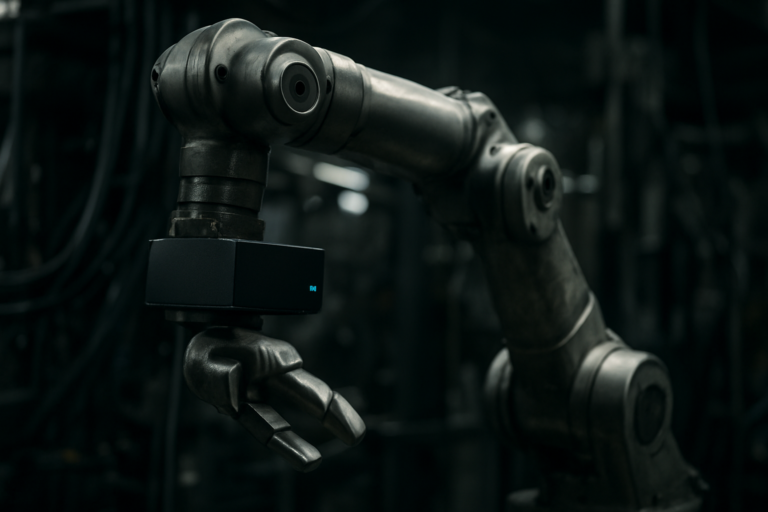
The race for speed in industrial automation is no longer just about faster motors or more agile joints. It’s about how quickly a machine can think. For years, robotic process automation (RPA) in manufacturing has relied on cloud-based intelligence, sending data to distant servers for analysis. This round trip, often measured in milliseconds, introduces a latency that can be the difference between a precise weld and a ruined part. Enter edge intelligence: the practice of running sophisticated AI models directly on the hardware, right on the factory floor.
This shift is fundamentally reshaping what’s possible in industrial robotics. By moving the brain closer to the body, manufacturers are unlocking new levels of precision, reliability, and autonomy. The traditional model—where a robot sends a video feed to the cloud for object recognition—is being replaced by systems that can identify, classify, and react to an object in a fraction of the time.
The Latency Problem in Cloud-Dependent Robotics
The core limitation of cloud-based robotic control is network dependency. In a typical setup, a robotic arm captures data from its sensors or cameras, compresses it, and transmits it over a local network or the internet to a central server. The server runs a complex AI model, generates a response, and sends it back. Even with high-speed 5G or fiber connections, this introduces a latency of 50 to 200 milliseconds.
For many applications, this is perfectly acceptable. However, for high-precision tasks—such as micro-welding, component placement in electronics, or real-time collision avoidance—this delay is a critical failure point. A 100-millisecond lag can cause a robot to overshoot a target, apply force incorrectly, or fail to adapt to a moving assembly line. Edge intelligence eliminates this bottleneck by processing data locally.
How Edge AI Works in Manufacturing
Edge AI for robotics involves deploying a specialized, often smaller, version of a machine learning model directly onto a microcontroller or a small computer attached to the robot. This device, sometimes called an “inference engine,” is optimized for low power consumption and real-time operation.
- Local Inference: The AI model runs on the edge device, not in the cloud. This means the camera feed is processed immediately without leaving the robot’s control unit.
- Real-Time Decision Making: The robot’s control loop—sense, think, act—is completed in microseconds. This allows for high-speed, adaptive movements.
- Reduced Data Transmission: Only essential metadata (e.g., “part is defective” or “torque threshold exceeded”) is sent to the central system for logging or analysis, drastically reducing network load.
- Offline Operation: The robot can continue to function at full capability even if the network connection to the cloud is interrupted, ensuring production continuity.
Precision Gains in Manufacturing Arms
The most immediate benefit of edge intelligence is a measurable increase in precision. In a recent deployment at an automotive parts manufacturer, a robotic arm equipped with an edge AI model for visual servoing achieved a positional accuracy of ±0.02 millimeters, compared to ±0.1 millimeters with a cloud-based system. This 80% improvement in precision was directly attributed to the elimination of network latency.
This level of accuracy is critical for tasks like:
- Pick-and-Place: Handling delicate components like microchips or lenses without damage.
- Assembly: Inserting pins, screws, or connectors with exact force and alignment.
- Quality Inspection: Using on-board cameras to detect surface defects or dimensional errors in real-time, allowing the robot to reject a part immediately.
- Adaptive Welding: Adjusting the weld path and parameters based on the real-time geometry of the workpiece.
Challenges of Implementing Edge Intelligence
While the benefits are clear, deploying edge AI is not without its challenges. The primary hurdles include:
- Hardware Constraints: Edge devices have limited computational power, memory, and storage compared to cloud servers. AI models must be optimized—often through techniques like quantization and pruning—to run efficiently on these constrained systems.
- Model Maintenance: Updating an AI model across a fleet of robots is more complex when the model lives on the edge. A robust, secure over-the-air (OTA) update mechanism is essential.
- Security: Edge devices are physically accessible and can be a point of entry for cyberattacks. They require strong encryption, secure boot processes, and regular security patches.
- Data Management: While edge AI reduces data transmission, it does not eliminate the need for data. Manufacturers must decide what data to process locally and what to send to the cloud for long-term analysis and model retraining.
The Future: Swarm Intelligence and Federated Learning
The next evolution of edge intelligence in robotics is likely to involve collaboration between multiple robots on the same factory floor. This concept, often called swarm intelligence, allows robots to share local learnings and coordinate actions without a central cloud server.
For example, if one robot arm identifies a new type of defect in a raw material, it can broadcast this information to nearby robots via a local mesh network. They can then adjust their own parameters to handle the material differently. This creates a self-optimizing production line that learns and adapts in real-time.
Federated learning is another promising approach. Instead of sending raw data to a central server, each robot trains a local model on its own data. Only the model updates (the “learnings”) are sent back to a central server, which aggregates them into a global model. This preserves data privacy while allowing the entire fleet to benefit from the collective experience.
For manufacturers, the decision to adopt edge intelligence is not a question of if, but when. The technology is maturing rapidly, with off-the-shelf edge computing modules now capable of running complex computer vision and reinforcement learning models. As the cost of hardware continues to drop and the performance of optimized models improves, edge AI will become the standard for any robotic application that demands speed and precision.
The factory of the future is not a place where robots wait for instructions from a distant cloud. It is a place where they think for themselves, react instantly, and continuously improve their own performance. Edge intelligence is the engine driving that transformation.