
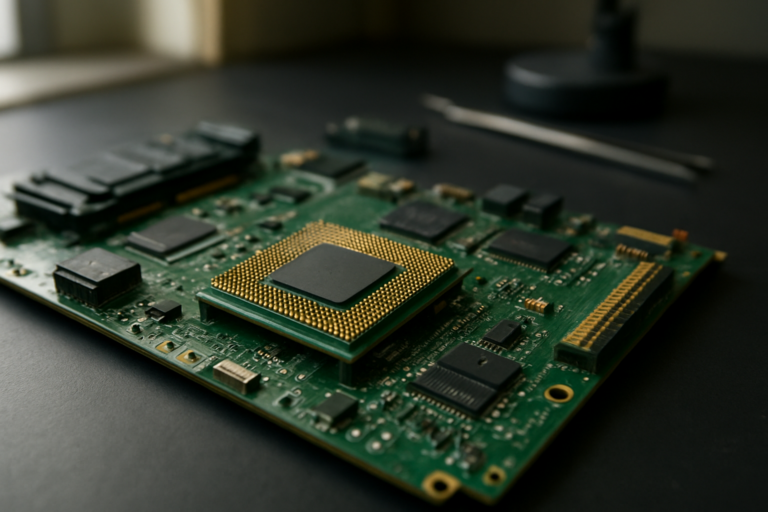
The industrial sector is undergoing a quiet revolution. For decades, the lifecycle of industrial hardware followed a linear path: extract raw materials, manufacture components, assemble products, use them until failure, and then discard them into landfills. This “take-make-dispose” model has fueled unprecedented technological progress, but at a staggering environmental cost. Today, a new paradigm is emerging—circularity—which promises to fundamentally reshape how we design, use, and reuse industrial hardware.
At its core, the circular economy for hardware is about keeping materials and components in use for as long as possible, extracting maximum value from them, then recovering and regenerating products and materials at the end of each service life. For industrial hardware, this means moving away from sealed, non-repairable units towards modular, upgradeable, and repairable systems. The shift is not just an environmental imperative; it is becoming a competitive advantage.
The Problem with Linear Hardware
The scale of the challenge is immense. According to the Global E-waste Monitor, a record 62 million tonnes of electronic waste was generated in 2022, a number that is projected to grow by 30% by 2030. Industrial hardware, from programmable logic controllers (PLCs) to sensor arrays and motor drives, forms a significant portion of this waste. These devices often contain hazardous materials like lead, mercury, and cadmium, while also housing valuable resources such as gold, silver, copper, and rare earth elements.
The traditional design philosophy prioritized performance, miniaturization, and cost at the point of sale. This resulted in:
- Soldered and glued components: Making repair and component-level replacement nearly impossible.
- Proprietary designs: Preventing third-party repairs or upgrades.
- Planned obsolescence: Software and hardware updates that intentionally rendered older devices obsolete.
- Complex disassembly: Products requiring specialized tools or destructive methods to open.
The result is a system where a single failed capacitor on a control board can necessitate the disposal of the entire unit, sending kilograms of perfectly functional materials to a landfill.
The Rise of Modular Electronics
The solution lies in modularity. Designing hardware with standardized, interchangeable modules that can be easily removed, replaced, or upgraded is the cornerstone of circularity. This approach is already proving successful in consumer electronics, with frameworks like Project Ara (though commercially unsuccessful) and Framework Laptops demonstrating consumer demand for repairable devices. The industrial sector is now adapting these principles at scale.
Key principles of modular industrial hardware include:
- Standardized Interfaces: Using common connectors, bus systems (like USB-C, PCIe, or industrial-specific standards), and physical form factors. This allows modules from different manufacturers to interoperate.
- Hot-Swappable Components: The ability to replace a power supply, I/O module, or processor without shutting down the entire system—critical for continuous industrial operations.
- Tool-less Design: Snap-fit assemblies and captive fasteners that allow for quick, intuitive disassembly without specialized tools.
- Clear Labeling: Marking components with material types, recycling symbols, and disassembly instructions directly on the hardware.
For example, a modern modular industrial controller might consist of a base chassis, a processor module, several I/O modules, a power supply, and a communication module. If the processor becomes obsolete, it can be swapped for a newer generation without replacing the entire chassis or I/O system. If a power supply fails, it can be unplugged and replaced in minutes, minimizing downtime and waste.
Beyond Modularity: Lifecycle Thinking
Modular design is just one piece of the puzzle. True circularity requires a holistic view of the entire hardware lifecycle, from raw material extraction to end-of-life recovery.
This lifecycle approach encompasses several critical strategies:
- Design for Disassembly (DfD): Engineers must consider the end of a product’s life from the very first sketch. This means avoiding adhesives, minimizing the variety of fasteners, and designing components that can be easily separated by type (e.g., metals, plastics, circuit boards).
- Material Selection: Choosing materials that are recyclable, non-toxic, and have a lower environmental footprint. This includes using recycled plastics, bio-based polymers, and avoiding composite materials that are difficult to separate.
- Component Reuse and Remanufacturing: Instead of recycling materials, the highest value is in reusing functional components. A motor drive from a decommissioned assembly line can be tested, refurbished, and sold as a “certified pre-owned” unit for a fraction of the energy cost of manufacturing a new one. Remanufacturing goes a step further, restoring a product to like-new condition with a full warranty.
- Software Longevity: Circularity is not just about hardware. Software updates that continue to support older hardware generations—rather than forcing upgrades—are crucial. This reduces the pressure to replace perfectly functional devices.
- Reverse Logistics: Establishing efficient systems for taking back used hardware from customers. This requires a robust supply chain for collection, sorting, testing, and either resale or recycling.
The Business Case for Circularity
The environmental benefits are clear, but the business case is equally compelling. Companies that embrace circular design are seeing tangible returns.
- Reduced Material Costs: Using recycled or reused components significantly lowers raw material procurement costs. A 2023 report by Accenture estimated that circular economy models could unlock $4.5 trillion in economic growth by 2030.
- New Revenue Streams: The resale and remanufacturing markets for industrial hardware are growing rapidly. Companies can offer hardware-as-a-service (HaaS) models, where customers pay for uptime or performance rather than owning the equipment outright, incentivizing the manufacturer to build durable, repairable machines.
- Enhanced Brand Reputation: Increasingly, corporate procurement decisions factor in environmental, social, and governance (ESG) criteria. Demonstrating a commitment to circularity can be a powerful differentiator in winning contracts.
- Supply Chain Resilience: By relying on a pool of reusable components, companies become less vulnerable to disruptions in the supply of virgin materials, such as semiconductor shortages or geopolitical instability affecting rare earth metal mining.
Challenges and the Path Forward
Despite the clear advantages, widespread adoption faces significant hurdles. The upfront cost of designing for modularity can be higher than traditional monolithic design. There is a lack of industry-wide standards for modular interfaces and component labeling. Furthermore, the cultural shift from a “buy and forget” mentality to a “care and maintain” one requires changes in customer behavior and sales models.
However, regulatory pressure is accelerating the transition. The European Union’s “Right to Repair” legislation and the Ecodesign for Sustainable Products Regulation (ESPR) are forcing manufacturers to provide spare parts, repair information, and design for longevity. Similar regulations are being considered in other major economies.
The future of industrial hardware is not about faster, smaller, and cheaper at all costs. It is about smarter, longer-lasting, and more adaptable. By embracing circularity, the industry can decouple economic growth from resource consumption, reduce its environmental footprint, and build a more resilient and profitable future. The shift from a linear to a circular model is not just an engineering challenge; it is a fundamental rethinking of value itself. The hardware we build today will shape the world we live in tomorrow, and circularity is the only path forward that makes sense.