
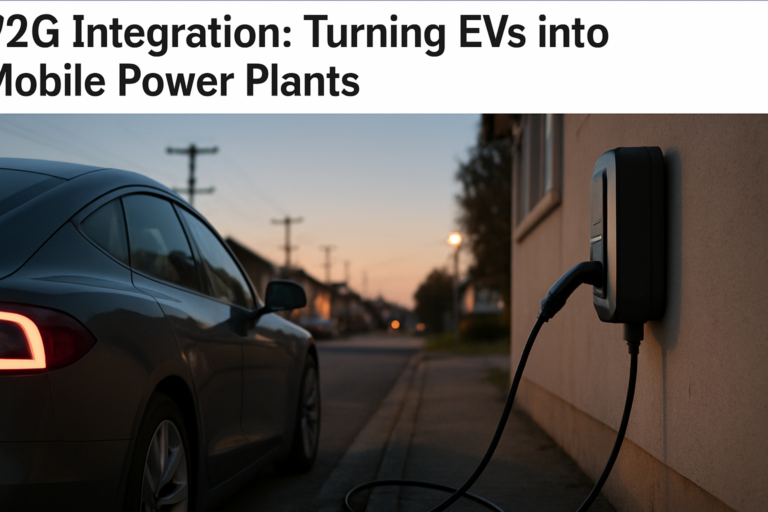
The vision of electric vehicles as mere transportation tools is rapidly evolving. Today, a new paradigm is taking shape: your parked EV could become a mobile power plant, feeding energy back into the grid when demand spikes and absorbing it when supply is abundant. This is the promise of Vehicle-to-Grid (V2G) integration—a technology that turns millions of idle car batteries into a distributed, responsive energy reservoir.
How V2G Works: The Bidirectional Dance
At its core, V2G relies on bidirectional charging. Unlike conventional chargers that only draw electricity from the grid, a bidirectional charger can reverse the flow, sending stored energy from the EV battery back to the grid. This is made possible by power electronics that convert DC from the battery into AC compatible with the grid.
The process is coordinated by a central aggregator—a software platform that monitors grid conditions, electricity prices, and the state of charge of thousands of connected vehicles. When the grid needs extra power (e.g., during peak hours or a sudden drop in renewable generation), the aggregator signals participating EVs to discharge. When demand is low or renewable generation is high, it signals them to recharge. Each car’s battery acts as a tiny, fast-responding power plant.
The Grid Stability Problem V2G Solves
Modern power grids face two major challenges: peak demand surges and the intermittency of renewable energy sources like solar and wind. Traditional solutions involve building expensive natural gas peaker plants that run only a few hundred hours per year, or investing in large-scale stationary battery storage.
V2G offers a cheaper, faster, and more distributed alternative. The global fleet of EVs already contains enormous storage capacity. According to BloombergNEF, by 2030, the combined battery capacity of all EVs could exceed 1,000 gigawatt-hours—enough to power the entire U.S. for about a day. Even a fraction of that capacity, if made available through V2G, could dramatically smooth out grid fluctuations.
Benefits Beyond Grid Stability
Economic Gains for EV Owners
Drivers who participate in V2G programs can earn money by selling electricity back to the grid during high-price periods. Some pilot projects show annual earnings of $500–$1,000 per vehicle, depending on local electricity markets and driving patterns.
Reduced Infrastructure Costs
Utilities can avoid building new power plants and transmission lines by leveraging existing EV batteries. A study by the National Renewable Energy Laboratory found that V2G could save the U.S. grid $8–$10 billion annually by 2030.
Enhanced Renewable Energy Integration
Solar and wind power are variable. With V2G, EVs can store excess renewable energy when it’s abundant (e.g., midday sun) and feed it back when generation drops (e.g., evening peaks). This makes renewables more reliable and reduces curtailment.
Backup Power for Homes and Businesses
V2G also enables Vehicle-to-Home (V2H) and Vehicle-to-Building (V2B) applications. During a grid outage, an EV can power a home for several days, acting as a mobile emergency generator without fossil fuels.
Real-World Deployments and Pilot Projects
V2G is not theoretical. Several large-scale pilots have demonstrated its viability:
- UK’s Electric Nation project connected over 300 EVs to the grid, providing frequency regulation services.
- Denmark’s Parker Project used Nissan Leafs to balance wind power fluctuations.
- California’s V2G trial with school buses showed that a fleet of 40 buses could supply 2 MW of power for up to four hours.
- China has announced plans to equip 10,000 buses with V2G chargers in Beijing alone.
Automakers like Nissan, Mitsubishi, Hyundai, and Ford already offer bidirectional-capable models, and the list is growing. The new generation of EVs with 800-volt architectures and larger batteries (like the Ford F-150 Lightning and Hyundai Ioniq 5) are especially suited for V2G.
Challenges to Overcome
Despite the promise, V2G faces several hurdles:
- Battery Degradation: Frequent cycling may accelerate wear. However, modern battery management systems and smart charging algorithms can minimize impact. Studies suggest V2G could add only 3–5% extra degradation over a decade.
- Standardization: Different automakers use different protocols (CHAdeMO, CCS, Tesla’s proprietary). The industry is moving toward ISO 15118, a global standard for bidirectional communication, but adoption is slow.
- Regulatory Barriers: Many regions still lack tariffs that compensate V2G fairly. Net metering rules and interconnection requirements vary widely.
- User Convenience: Drivers must plug in and allow remote control of their battery. Programs that guarantee a minimum state of charge (e.g., 80%) for driving needs help alleviate range anxiety.
- Grid Integration Costs: Upgrading transformers and distribution infrastructure to handle two-way power flow can be expensive, though often less than building new generation.
The Role of Aggregators and Smart Charging
A key enabler of V2G is the aggregation platform. Companies like Kaluza, ev.energy, and Fermata Energy provide cloud-based software that communicates with chargers, vehicles, and grid operators. These platforms use machine learning to predict driving patterns and grid needs, optimizing charging schedules to maximize revenue while ensuring driver mobility.
Smart charging—where the grid controls when an EV charges (but not discharges)—is a simpler precursor. V2G extends this concept by allowing discharge as well. Many utilities are deploying smart charging first to build trust and infrastructure, then transitioning to V2G.
Future Outlook: From Niche to Mainstream
The V2G market is projected to grow from $2.5 billion in 2023 to over $15 billion by 2030, according to MarketsandMarkets. Key drivers include falling battery costs, supportive policies (e.g., California’s SB 100 requiring 100% clean electricity by 2045), and the growing urgency of grid decarbonization.
In the long term, V2G could enable a fully distributed energy system where millions of EVs, stationary batteries, and smart appliances form a virtual power plant. This would reduce the need for centralized power stations and make the grid more resilient to natural disasters and cyberattacks.
Conclusion
Turning electric vehicles into mobile power plants is no longer science