
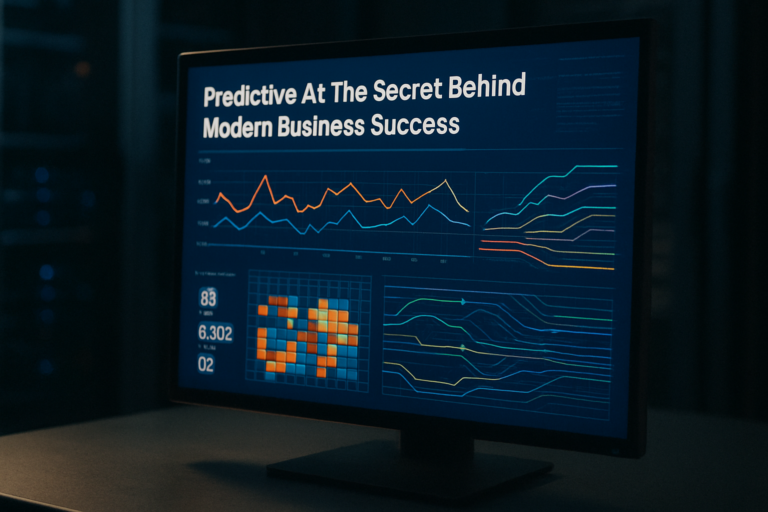
Predictive AI is no longer a futuristic concept—it’s the engine driving some of the most successful businesses today. From retail giants forecasting inventory needs to banks detecting fraud before it happens, predictive analytics powered by machine learning is reshaping how companies operate. In fact, a 2023 McKinsey report found that organizations using AI for predictive tasks saw a 20–30% increase in revenue compared to peers. But what exactly makes predictive AI so transformative? Let’s break down the technology, its applications, and why it’s become the secret weapon for modern business success.
What is Predictive AI?
Predictive AI refers to algorithms that analyze historical data to identify patterns and forecast future outcomes. Unlike traditional analytics, which simply describes what happened, predictive AI uses machine learning models to answer what will happen next. These models learn from vast datasets—customer transactions, sensor readings, market trends—and generate probabilities for future events.
The core components include:
- Historical data (structured and unstructured)
- Feature engineering to extract meaningful variables
- Model training using regression, classification, or time-series algorithms
- Validation and deployment in real-time systems
Why Businesses Are Racing to Adopt Predictive AI
The business case for predictive AI is compelling. According to a 2024 Gartner survey, 60% of large enterprises have already deployed at least one predictive AI application. The reasons are clear:
1. Enhanced Customer Experience
Predictive models anticipate customer needs, enabling personalized recommendations, dynamic pricing, and proactive support. For example, Netflix uses predictive AI to suggest content, boosting user engagement by 75%.
2. Operational Efficiency
Manufacturers use predictive maintenance to reduce downtime by up to 50%. Sensors on machinery feed data into AI models that flag potential failures before they occur, saving millions in repairs.
3. Risk Mitigation
Banks and insurers leverage predictive AI for fraud detection. JPMorgan Chase reported a 40% reduction in false positives after implementing machine learning models that analyze transaction patterns in real time.
4. Revenue Growth
Retailers like Walmart use predictive analytics to optimize inventory, reducing stockouts by 30% and increasing sales by 15%. The ability to forecast demand accurately translates directly to higher profits.
Real-World Applications Across Industries
Predictive AI isn’t limited to tech giants. Small and medium businesses are also tapping into its power through affordable cloud-based solutions. Here are some notable examples:
- Healthcare: Hospitals predict patient readmission risks, improving outcomes and reducing costs. A study by Nature Medicine showed that AI models cut readmissions by 25%.
- Supply Chain: Logistics companies forecast shipping delays and reroute shipments automatically. DHL reported a 20% improvement in on-time deliveries using predictive AI.
- Marketing: Campaigns are optimized by predicting which customers will convert. HubSpot’s predictive lead scoring increased conversion rates by 30%.
- Energy: Utilities predict electricity demand to balance grids, saving billions in infrastructure costs. Google’s DeepMind reduced cooling energy in data centers by 40%.
The Technology Behind the Magic
At its core, predictive AI relies on several key techniques:
| Technique | Use Case | Example |
|---|---|---|
| Regression | Forecasting continuous values | Predicting sales revenue |
| Classification | Categorizing outcomes | Loan default prediction |
| Time-series | Sequential data analysis | Stock price forecasting |
| Clustering | Identifying patterns | Customer segmentation |
Modern tools like TensorFlow, PyTorch, and cloud platforms (AWS SageMaker, Google AI Platform) make it easier than ever to build and deploy models. However, success depends on data quality. Garbage in, garbage out—clean, relevant data is non-negotiable.
Challenges and Considerations
Despite its promise, predictive AI isn’t without hurdles. Common pitfalls include:
- Data bias: Models trained on biased data can produce unfair or inaccurate predictions.
- Interpretability: Many AI models are “black boxes,” making it hard to explain decisions to stakeholders.
- Integration: Legacy systems may not support real-time data feeds.
- Cost: High-quality data storage and compute resources can be expensive for smaller firms.
To overcome these, businesses should invest in data governance, adopt explainable AI frameworks, and start with small, high-impact projects.
The Future of Predictive AI in Business
The trend is accelerating. By 2027, the global predictive analytics market is projected to reach $41.5 billion, growing at a CAGR of 24.5% (Grand View Research). Advances in deep learning, edge computing, and generative AI will further expand capabilities. Imagine predictive models that not only forecast but also recommend actions—like automatically adjusting a supply chain or sending personalized offers in real time.
For businesses, the message is clear: those who embrace predictive AI will outperform competitors who rely on intuition alone. It’s not about replacing human judgment but augmenting it with data-driven insights. The secret to modern business success lies in the ability to see around corners—and predictive AI provides that vision.