
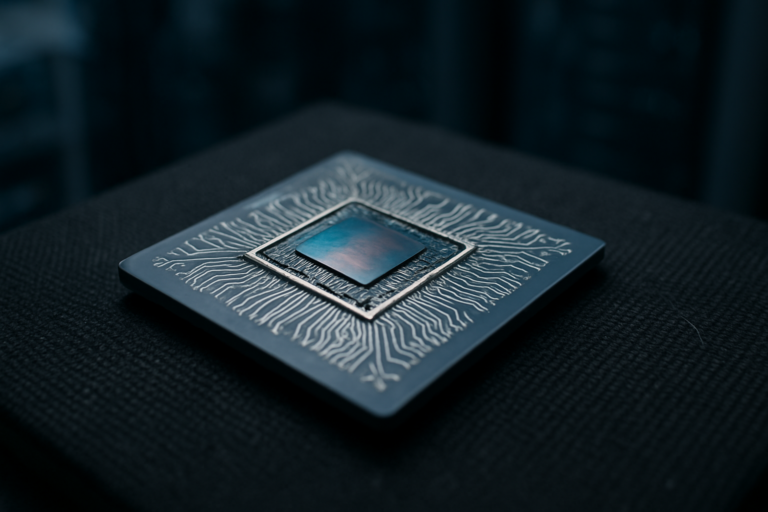
The smartphone in your pocket, the laptop on your desk, and the cloud servers powering your favorite apps all share a quiet but profound upgrade: dedicated AI chips. Once a niche component found only in research labs, these specialized processors have become the invisible engine driving everything from real-time language translation to autonomous driving. This is the silent revolution of AI chips—a shift that is reshaping how devices think, learn, and respond without ever calling attention to itself.
For decades, the central processing unit (CPU) was the brain of every computer. It handled general-purpose tasks efficiently, but when artificial intelligence algorithms demanded massive parallel computations, CPUs struggled. Enter the AI chip: a processor designed from the ground up to accelerate machine learning workloads. Unlike traditional chips, AI chips excel at performing thousands of simple mathematical operations simultaneously—exactly what neural networks require.
The most visible players in this space are graphics processing units (GPUs), originally built for rendering video games. Companies like NVIDIA transformed GPUs into AI workhorses, powering the training of large language models and image recognition systems. But the revolution goes far beyond data centers. Today, nearly every flagship smartphone includes a neural processing unit (NPU) or AI accelerator that runs models locally, keeping your data private and reducing latency. Apple’s Neural Engine, Google’s Tensor Processing Unit (TPU), and Qualcomm’s Hexagon DSP are all examples of chips that quietly handle facial recognition, voice assistants, and computational photography without draining the battery.
The Anatomy of an AI Chip
To understand why AI chips matter, it helps to look under the hood. A typical AI chip contains thousands of small processing cores arranged in a systolic array or a dataflow architecture. These cores are optimized for matrix multiplication and convolution—the bread and butter of deep learning. They also include dedicated memory hierarchies that minimize data movement, a major bottleneck in traditional computing.
Modern AI chips also incorporate on-chip SRAM and high-bandwidth memory (HBM) to feed data to the cores at blazing speeds. Some designs, like Google’s TPU v4, use interconnects that allow hundreds of chips to work together as a single supercomputer. Others, like Intel’s Gaudi, focus on balancing compute and memory for training efficiency.
But the real innovation lies in energy efficiency. A GPU might consume 300 watts while training a model, but a mobile NPU can perform the same inference task using just a few milliwatts. This efficiency is what enables on-device AI—the ability to run complex models without an internet connection. For example, the latest Samsung Galaxy phones can translate live phone calls in real time using an NPU, with no data leaving the device.
Where AI Chips Are Making a Difference
AI chips are no longer confined to flagship phones. They are appearing in:
- Smart home devices: Amazon’s Echo uses a custom AI chip to process wake words locally, reducing cloud dependency.
- Laptops and PCs: Apple’s M-series chips integrate a 16-core Neural Engine that accelerates video editing, photo enhancement, and voice dictation.
- Automotive: Tesla’s Full Self-Driving computer uses two AI chips to process camera feeds and make driving decisions in milliseconds.
- Healthcare: Portable ultrasound devices now include AI accelerators that help clinicians detect anomalies in real time.
- Industrial IoT: Sensors on factory floors use tiny AI chips to predict equipment failures before they happen.
The market for AI chips is exploding. According to a report by Grand View Research, the global AI chip market was valued at $15.3 billion in 2023 and is expected to grow at a compound annual growth rate (CAGR) of 38.4% from 2024 to 2030. This growth is fueled by the demand for edge AI, where processing happens on the device rather than in the cloud.
The Edge vs. Cloud Debate
One of the most significant trends in AI hardware is the shift toward edge computing. Cloud-based AI offers immense computational power, but it introduces latency, privacy concerns, and bandwidth costs. Edge AI chips solve these problems by running models locally. For example, a smart security camera with an AI chip can detect a package thief instantly without sending video to a server.
However, not all tasks can be moved to the edge. Training large models still requires the massive parallel compute of cloud data centers. The future likely involves a hybrid model: training in the cloud and inference on the edge. Companies like NVIDIA are already building chips that seamlessly bridge both worlds, such as the Jetson series for robotics and the A100 for data centers.
The Challenges Ahead
Despite the rapid progress, AI chips face several hurdles. First, manufacturing advanced chips at 3nm and below is extremely expensive and requires cutting-edge fabrication facilities. Only a handful of companies—TSMC, Samsung, and Intel—can produce these chips, creating a supply chain bottleneck.
Second, software optimization is lagging behind hardware. An AI chip is only as good as the software that programs it. Developers need to use specialized frameworks like TensorFlow, PyTorch, and ONNX to take full advantage of the hardware. Moreover, each chip vendor has its own software stack, making portability difficult.
Third, power consumption remains a concern for data centers. While AI chips are more efficient than CPUs, the sheer scale of modern AI training jobs—like GPT-4, which reportedly used thousands of GPUs for months—consumes enormous amounts of electricity. Researchers are exploring analog computing and photonic chips to drastically reduce energy needs.
What’s Next? The Future of AI Chips
The next generation of AI chips will likely move beyond digital transistors. Companies like IBM and Lightmatter are developing optical processors that use photons instead of electrons, promising 100x improvements in speed and efficiency. Another frontier is neuromorphic computing—chips that mimic the brain’s structure using spiking neural networks. Intel’s Loihi 2 is already demonstrating the potential for ultra-low-power learning.
In the consumer space, we can expect AI chips to become as common as CPUs. By 2025, most mid-range smartphones will include an NPU, and laptops will routinely have AI accelerators for tasks like background blur and noise cancellation. Even smart glasses, like Meta’s Ray-Ban Stories, rely on tiny AI chips to process video and audio on the fly.
The silent revolution of AI chips is also reshaping the semiconductor industry. Startups like Groq, Cerebras, and SambaNova are challenging incumbents with novel architectures. Meanwhile, hyperscalers like Google, Amazon, and Microsoft are designing their own custom chips to reduce reliance on NVIDIA. This competition is driving innovation and lowering costs, which will ultimately benefit every device we use.
In conclusion, AI chips are the unsung heroes of modern technology. They work silently in the background, enabling features we now take for granted—from unlocking your phone with your face to getting real-time captions during a video call. As these chips become smaller, faster, and more energy-efficient, they will unlock possibilities we haven’t yet imagined. The revolution is already here; it’s just not making any noise.