
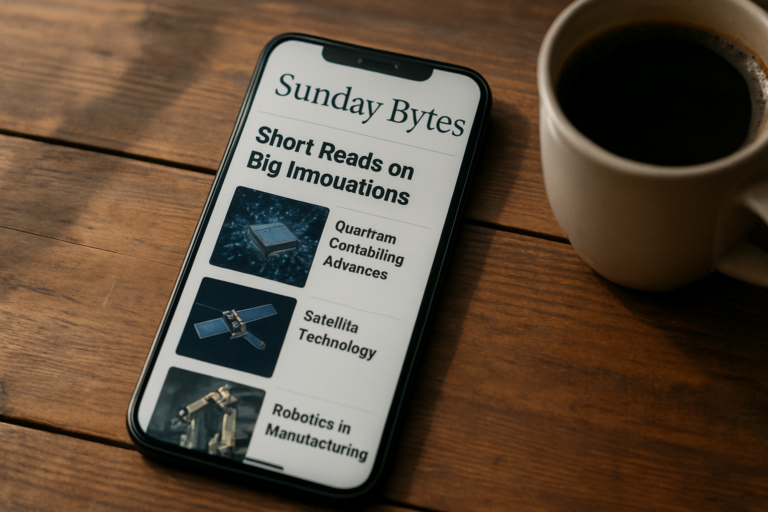
A typical week in technology feels like drinking from a firehose. Between breakthrough AI models, quantum computing milestones, satellite launches, semiconductor advances, and a hundred smaller updates, even the most dedicated enthusiast can’t keep up. The average professional spends over 600 hours per year just scrolling through news feeds, most of it wasted on repetitive or irrelevant content. That’s where Sunday Bytes steps in — a simple, elegant concept built for the way we actually read today: short, sharp, and packed with meaning.
Sunday Bytes is not just another newsletter or blog. It’s a weekly ritual designed to distill the week’s most consequential innovations into a set of focused, bite-sized reads. Each piece is crafted to deliver the core insight, the practical impact, and just enough context to make you feel genuinely informed. It strips away the noise, the hype, and the redundant commentary, leaving only the bytes that matter.
The Power of Curation in a Noisy World
The modern information landscape is chaotic. Over 4 million blog posts are published every day, alongside thousands of news articles, research papers, and press releases. No human can process that volume. Yet our instincts push us to try, creating a constant background hum of anxiety — the fear of missing out on something important. Curation solves this problem not by hiding information, but by applying a layer of editorial judgment.
Sunday Bytes embraces this principle wholeheartedly. Instead of listing every minor product update, it selects ten to twelve stories that represent genuine leaps forward. This is not aggregation; it’s interpretation. A human editor with deep domain understanding weighs each development, asks whether it changes the trajectory of a field, and then writes a summary that respects your time.
This kind of curation has proven value. Studies show that curated news consumption reduces cognitive strain by up to 30% while increasing retention of key facts. When you read a well-structured short read, you’re more likely to remember the essential takeaway than if you’d skimmed three longer articles on the same subject.
Why Short Reads Work for Complex Innovations
You might think that deep topics like quantum computing or brain-computer interfaces require long-form explanations. That’s partially true. But the skill of a short read lies in what it chooses to leave out. Sunday Bytes uses a “tiered insight” approach. The opening paragraph gives you the headline outcome — what happened and why it matters. The next few lines explain the mechanism in plain language, using analogies from everyday life. A final sentence or two provides a forward-looking perspective.
For example, take a story about a new semiconductor architecture. A traditional article might spend 3,000 words walking through transistor design, material science, and manufacturing yields. A Sunday Bytes piece will instead say: “A new chip design extends Moore’s Law by switching to a vertical transistor layout. This could double processing power by 2027 while reducing energy consumption by 40%.” That’s enough for a busy executive to grasp the significance, and enough for a curious reader to follow up on technical details elsewhere.
The psychology behind this is simple. Our working memory can hold only a limited number of chunks at once. Short reads structure information into digestible blocks that fit neatly into those chunks. This leads to better comprehension, not worse. A 2023 survey of tech professionals found that 68% preferred weekly summary formats over daily feeds because it allowed them to allocate dedicated time to learning instead of constant switching.
The Impact of Sunday Bytes on Tech Culture
Beyond individual convenience, the rise of curated short reads has shifted how the tech industry communicates. Companies now prepare their announcements with the knowledge that a concise summary might become the primary narrative. This pushes them to clarify their own messaging, which benefits everyone. Instead of burying key facts deep in a press release, they lead with the innovation.
Sunday Bytes also democratizes access to knowledge. Not everyone has a technical background, but a well-written short read can make complex topics accessible. When you explain the significance of a new satellite constellation in terms of global internet coverage, or describe a breakthrough in fusion energy as “containing a miniature sun on Earth,” you bridge the gap between scientists and the public. This helps build a more informed society, one that can participate in conversations about technology policy, ethics, and investment.
The format also naturally combats misinformation. By linking each byte to original sources and including a “further reading” note, Sunday Bytes encourages verification. Readers learn that they can trust the digest because it consistently points to peer-reviewed papers, official announcements, and reputable journals. Over time, this builds a loyal following of readers who value accuracy over sensationalism.
Examples of Innovations That Shine in Short Form
Some breakthroughs are perfectly suited to the Sunday Bytes treatment. Here are a few categories that frequently appear:
- AI and Machine Learning: New model releases, training efficiency improvements, and real-world deployments.
- Quantum Computing: Qubit stability breakthroughs, error correction progress, and commercial cloud access.
- Space Economy: Private satellite launches, lunar landers, and the growing ecosystem around earth observation.
- Semiconductors: Chip architecture changes, EUV lithography advancements, and supply chain innovations.
- Biotech and Healthcare: CRISPR trials, nanomedicine developments, and wearable diagnostic tools.
- Green Technology: Solid-state batteries, carbon capture, and grid-scale storage solutions.
Each of these topics can be condensed into a compelling 300-word read without losing the essence. The key is identifying the single most important consequence of the innovation. For instance, a new qubit design might be fascinating from a physics standpoint, but the short read will focus on how it reduces error rates, which brings practical quantum computers closer.
The Science of a “Byte”
What exactly constitutes a