
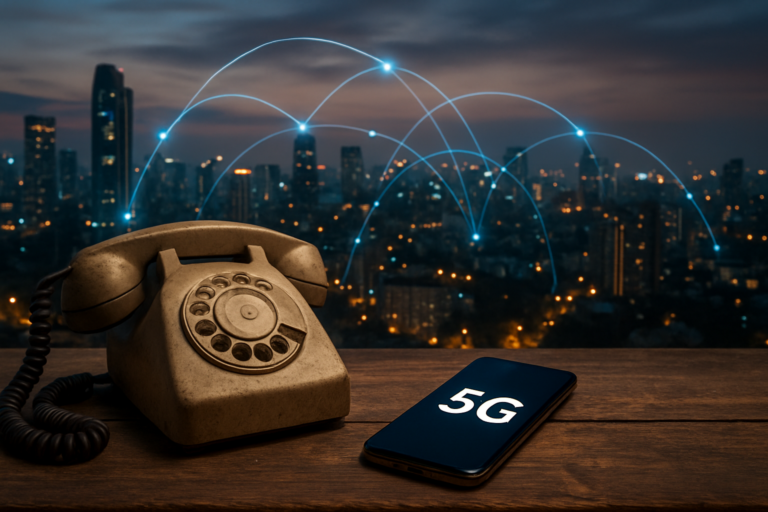
The story of the Indian internet is not a linear timeline of cables and routers; it is a sprawling, chaotic, and utterly human saga of ambition, scarcity, and sudden, explosive abundance. From the agonizing screech of a dial-up modem to the instant gratification of 5G, the evolution of connectivity in India has fundamentally rewired the nation’s economy, culture, and sense of possibility. To understand where Indian technology is headed, we must first look back at the dial-up days, the cyber cafes, and the data packs that turned a billion people into digital natives.
The Dial-Up Era: A Luxury for the Few
In the mid-1990s, the internet was not a utility; it was a novelty reserved for the urban elite and academic institutions. The journey began in earnest on August 15, 1995, when Videsh Sanchar Nigam Limited (VSNL) launched public internet access for the first time. The experience was anything but seamless. Connecting required a landline, a computer that cost several months’ salary, and the patience of a saint to endure the infamous dial-up connection speeds of 9.6 kbps to 56 kbps.
This era was defined by the “cyber cafe.” For most Indians, the cyber cafe was the gateway to the World Wide Web. It was a communal, almost sacred space where people queued up to check emails, create their first Hotmail accounts, or explore Yahoo! for the first time. The cost was prohibitive—often Rs. 50 to Rs. 100 per hour—making it a significant expense for students and young professionals. The internet was slow, expensive, and unreliable, but it planted a critical seed: the understanding that the world could be accessed from a screen.
The Broadband Revolution and the Rise of the “Common Man”
The early 2000s saw a gradual shift. The introduction of cable internet and early ADSL connections improved speeds, but the real game-changer was the proliferation of the personal computer in middle-class homes. This period also marked the beginning of the dot-com boom in India, with portals like Rediff.com and Indiatimes.com becoming household names. However, the internet remained largely a text-based, information-heavy medium. Social interaction was still limited to chat rooms and message boards.
The true inflection point arrived with the mobile phone. While the first mobile internet was painfully slow and expensive, the launch of affordable 2G and then 3G services in the late 2000s began to democratize access. The internet was no longer tied to the physical location of a desktop computer. It was now in your pocket. This mobility, combined with the falling cost of smartphones, set the stage for a revolution that would change the face of Indian society.
The Jio Effect: Data Becomes a Birthright
No discussion on the evolution of the Indian internet is complete without acknowledging the tectonic shift triggered by Reliance Jio’s launch in September 2016. By offering free voice calls and drastically cheap data, Jio didn’t just disrupt the telecom market; it created a new one. Overnight, the internet transformed from a premium service into a mass commodity.
The statistics from this period are staggering. In 2015, India had roughly 300 million internet users. By 2020, that number had exploded past 700 million, and it continues to climb. The average data consumption per user skyrocketed, with India becoming one of the largest consumers of mobile data globally. This was not just about streaming videos; it was about the digitization of daily life. Payments moved to UPI, education shifted to online platforms, and local businesses discovered the power of WhatsApp and Instagram for marketing. The internet ceased to be a separate entity; it became the fabric of commerce and communication.
The Broadband Backbone and the Digital Divide
While the mobile internet story is one of triumph, the wired broadband story is more complex. The BharatNet project, aimed at connecting gram panchayats (village councils) with optical fiber, has been a monumental undertaking. As of recent reports, the project has connected hundreds of thousands of villages, bringing high-speed broadband to rural areas. This is critical infrastructure, not just for entertainment, but for telemedicine, e-governance, and agricultural technology.
However, the digital divide remains a persistent challenge. While urban India enjoys gigabit speeds, rural areas often struggle with connectivity and electricity reliability. The evolution of the internet is not just about speed; it is about accessibility. The government’s push for digital literacy, combined with the private sector’s drive to create affordable devices, is slowly bridging this gap. The future of Indian internet depends on ensuring that the last mile is as robust as the first.
From Consumption to Creation: The New Digital Economy
The most profound impact of internet evolution in India is the shift from passive consumption to active creation. In the early days, Indians were consumers of Western content. Today, they are creators of a unique digital culture. The rise of regional language content on platforms like YouTube and ShareChat has unlocked the potential of non-English speaking users. India’s internet is now a multi-lingual, multi-cultural space where a creator in a small town can reach a global audience.
This has fueled the startup ecosystem. The availability of cheap data and a massive user base has made India a hotbed for tech innovation. From fintech solutions like PhonePe and Paytm to edtech platforms and hyper-local delivery services, the internet has enabled entrepreneurs to solve uniquely Indian problems. The digital public infrastructure—like Aadhaar, UPI, and the ONDC (Open Network for Digital Commerce)—is a testament to how the internet can be leveraged for inclusive growth.
The 5G Frontier and Beyond
As we look at the current landscape, 5G is rolling out across the country, promising ultra-low latency and massive device connectivity. This is not just about faster video downloads. It is the foundation for the Internet of Things (IoT), autonomous vehicles, and advanced AI applications in agriculture and healthcare. The evolution of the Indian internet is moving from human-to-human communication to machine-to-machine communication.
The next decade will likely see the convergence of the internet with other emerging technologies like blockchain and edge computing. The challenge for India will be to harness this power responsibly, addressing concerns around data privacy and cybersecurity. The internet has evolved from a novelty to a necessity, and its next iteration will define the future of Indian innovation on the global stage.
The journey from the first dial-up connection to the current digital ecosystem is a testament to India’s resilience and adaptability. It is a story of how a nation leapfrogged technological barriers to build a digital economy that is uniquely its own. The internet in India is no longer a tool; it is the very infrastructure of modern life, and its evolution is far from over.