
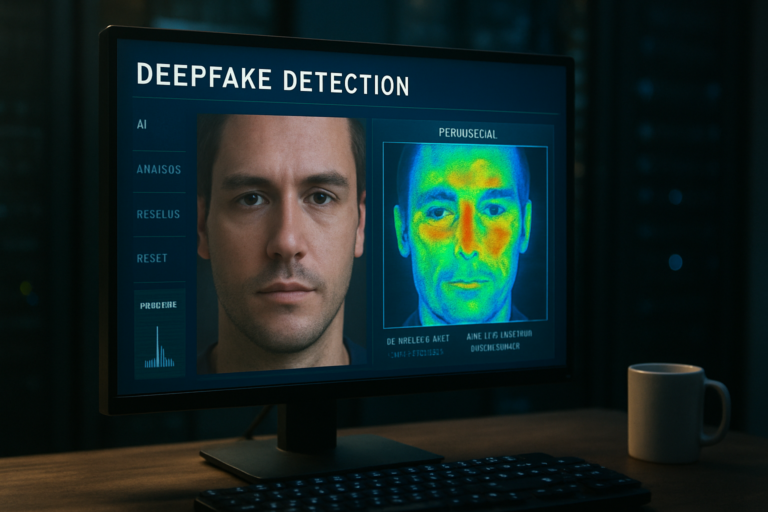
In the span of a few years, deepfakes have evolved from internet curiosities into potent tools for misinformation, fraud, and reputational damage. Today, a convincing synthetic video can be created with minimal effort and released at scale, threatening everything from democratic elections to corporate security. The same technology that powers generative AI – deep learning models like GANs and diffusion networks – is now being weaponized. But the fightback is just as advanced. Deepfake detection tools are emerging as the digital forensics equivalent of an arms race, leveraging artificial intelligence to spot what the human eye cannot.
The Deepfake Threat: Why Detection Matters
Deepfakes are not just about celebrity impersonations. They have been used to impersonate CEOs in fraudulent phone calls, fabricate evidence in legal cases, and spread political disinformation during elections. According to a 2023 report by Sensity AI, the number of deepfake videos online has been doubling every six to nine months, with over 95% of them used for non-consensual pornography, fraud, or political manipulation. The financial impact is also staggering: the Federal Trade Commission reported that deepfake-related scams cost victims over $1 billion in 2022 alone.
The challenge is that deepfakes are becoming harder to detect. Early versions had visible glitches – unnatural blinking, mismatched lighting, or strange ear shapes. Modern deepfakes, powered by diffusion models and real-time rendering, can fool even trained observers. That’s where AI-driven detection tools become essential.
How AI Detection Works
Deepfake detection tools are trained to identify subtle artifacts left behind by generative models. These algorithms look for inconsistencies that are invisible to the human eye. Common detection methods include:
- Spatial analysis: Examining pixel-level patterns for anomalies in texture, color, or edges.
- Temporal analysis: Analyzing frame-to-frame consistency – unnatural movements, flickering, or changes in blink rates.
- Frequency domain analysis: Using Fourier transforms to detect high-frequency noise or compression artifacts typical of synthetic media.
- Biometric signals: Checking for irregular heart-rate patterns (via subtle skin color changes) or micro-expressions that deepfake algorithms struggle to replicate.
Many detection tools combine multiple approaches in an ensemble, boosting accuracy. For instance, Facebook’s Deepfake Detection Challenge (DFDC) dataset, which spawned numerous models, showed that ensemble methods can achieve over 90% accuracy on curated test sets.
Leading Deepfake Detection Tools
Several organizations and startups are now offering commercial and open-source detection solutions. Here are some notable ones:
- Microsoft Video Authenticator: Analyzes videos frame by frame, outputting a confidence score for manipulation. It can detect blending boundaries, fading edges, and reduced grayscale values. However, it’s designed for professional use and is not publicly available.
- Deepware Scanner: An open-source tool that scans videos for deepfake indicators. It supports multiple detection models and runs locally, making it accessible for journalists and researchers.
- Sensity AI: A platform that monitors the dark web for deepfake content and provides detection APIs. It focuses on combating identity fraud in financial services.
- Intel FakeCatcher: A real-time tool that analyzes blood flow patterns (photoplethysmography) from facial video. It claims 96% accuracy and works within milliseconds.
- WeVerify: A browser extension that helps fact-checkers verify multimedia content by cross-referencing metadata and detecting deepfakes.
Each tool has trade-offs between accuracy, speed, and scalability. No single solution is perfect, especially against adversarial deepfakes designed to evade detection.
Challenges and Limitations
Despite progress, detection tools face significant hurdles:
- Generalization gap: A model trained on one type of deepfake (e.g., GAN-generated faces) may fail against new methods like diffusion models or face-swapping apps.
- Adversarial attacks: Attackers can intentionally add perturbations to deepfakes that fool detectors, much like adversarial attacks on other classifiers.
- Compression and resampling: Videos shared on social media are heavily compressed, stripping away many artifacts detectors rely on.
- Scalability: Real-time detection at internet scale requires massive computational resources, which most organizations lack.
A 2024 study from MIT found that the best current detectors degrade from 95% to under 70% accuracy when tested on deepfakes from an unknown generator. This underscores the need for continuous adaptation.
The Future: AI vs. AI Arms Race
The battle between deepfake creators and detectors is becoming a cat-and-mouse game. Generative models are evolving rapidly, so detection must be dynamic. Future approaches include:
- Deep learning watermarking: Embedding imperceptible digital signatures into authentic media so any manipulation is traceable.
- Blockchain-based provenance: Using cryptographic hashes to verify the origin and integrity of videos.
- Multi-modal detection: Combining video, audio, and metadata analysis (e.g., device signatures, timestamps) for a holistic verdict.
- Federated learning: Training detection models across decentralized data without sharing sensitive video content, helping them generalize better.
Government regulation is also advancing. The EU’s Digital Services Act and proposed AI Act include provisions for labeling synthetic media. In the US, the DEEPFAKES Accountability Act mandates disclosure and