
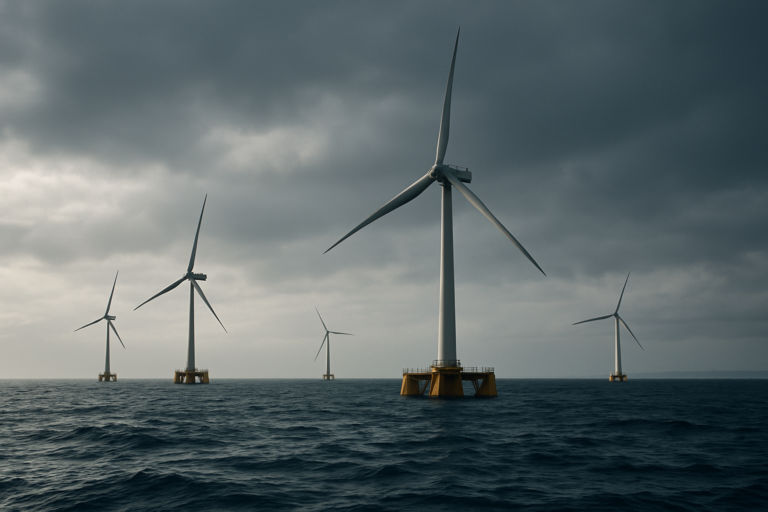
Deep-water offshore wind platforms represent a bold leap forward in renewable energy, tapping into the relentless power of high-velocity winds that blow far from shore. Unlike traditional offshore wind farms anchored to shallow seabeds, these floating structures are engineered to operate in depths exceeding 60 meters, opening up vast ocean expanses where wind speeds are stronger and more consistent. This isn’t just an incremental upgrade—it’s a paradigm shift in how we harvest oceanic power, driven by breakthroughs in marine engineering and materials science. As the world races to decarbonize, these platforms offer a pathway to clean energy at scale, promising to reshape coastlines and energy grids alike.
The allure of deep-sea wind lies in its raw resource potential. According to the International Energy Agency, offshore wind has the capacity to generate more than 18 times the current global electricity demand, with roughly 80% of that potential residing in waters deeper than 60 meters. Fixed-bottom turbines simply cannot reach these zones, leaving a staggering energy trove untapped. Floating platforms solve this puzzle by decoupling the turbine from the seafloor, using mooring lines and dynamic positioning to stay stable. By venturing further out, developers also sidestep visual pollution and conflicts with coastal industries, making these installations socially and environmentally more acceptable. The technology is maturing rapidly, with pilot projects already proving commercial viability, and costs are falling—floating wind costs have dropped by over 60% since 2015, according to industry tracker BloombergNEF.
The Evolution of Offshore Wind
Offshore wind began in shallow waters, with monopile foundations hammered into the seabed at depths of up to 30 meters. These early farms, pioneered in Denmark and the UK, demonstrated that wind turbines could thrive at sea, where winds are steadier and less turbulent than on land. But as developers pushed further out, the economics of fixed foundations hit a wall. Deeper water demands larger, heavier steel structures, driving up installation costs and limiting sites to continental shelves. This constraint spurred a search for alternatives, leading to the concept of floating platforms—designs borrowed from the offshore oil and gas industry, which had already mastered deep-water drilling technology.
From Fixed to Floating
The transition to floating turbines mirrors the evolution of nautical engineering. Instead of rigidly standing on the seabed, these platforms use buoyancy and mooring systems to maintain position. Three main designs dominate the current landscape: the spar-buoy, which uses a deep, ballasted cylinder for stability; the semi-submersible, with multiple columns connected by pontoons; and the tension-leg platform, which anchors vertically with taut mooring lines. Each offers distinct advantages—spar-buoys excel in very deep water, semi-submersibles simplify assembly and towing, and tension-legs minimize motions in rough seas. These innovations allow turbines to be assembled in port and towed to site, significantly de-risking installation and maintenance.
Why Deep-Water Wind Matters
The economic and environmental case for deep-water wind is compelling. By moving farther offshore, turbines access wind speeds typically 20-30% higher than those near shore, directly boosting energy yields. This efficiency gain offsets the higher upfront costs of floating platforms, which currently run about 30-50% more expensive than fixed-bottom systems. Yet, as scale grows and supply chains mature, costs are set to converge—industry analysts at Wood Mackenzie predict floating wind will reach grid parity with fixed-bottom by 2030. Moreover, deep-water farms avoid the crowded nearshore zones, reducing conflicts with shipping lanes, fishing grounds, and coastal tourism, which often complicate newer installations.
The benefits extend beyond energy generation. Floating platforms can be sited in strategic locations close to major demand centers, like the California coast or the North Sea, where waters drop quickly. This proximity slashes transmission losses and infrastructure costs. Additionally, these systems are inherently modular; if a platform fails, it can be towed to port for repair, avoiding costly in-situ servicing. This operational flexibility is a game-changer for remote sites, making maintenance more predictable and less weather-dependent.
Floating Platform Technologies
The core of deep-water wind is the floating substructure, which must keep the turbine upright in waves exceeding 15 meters. Engineers have developed sophisticated control systems that adjust ballast and mooring tensions in real-time, ensuring stability within a few degrees of tilt. Key components include:
- Spar-buoy platforms: A long, cylindrical hull with a deep draft, offering exceptional stability but requiring deep water for installation.
- Semi-submersibles: Three or four columns connected by pontoons, providing large deck areas and easy tow-out.
- Tension-leg platforms: Vertical moorings that tension the structure to the seabed, minimizing heave and pitch motions.
Beyond the hull, the turbines themselves are being upscaled. Modern units exceed 15 megawatts, with rotor diameters over 220 meters—roughly the size of the London Eye. These giants capture more energy per tower, reducing the number of platforms needed per farm and driving down per-megawatt costs. Floating platforms have proven compatible with these large units, with demonstrators like the 2.3 MW TetraSpar and the 8.4 MW WindFloat Atlantic operating successfully in test conditions.
Challenges and Solutions
Despite its promise, deep-water wind faces formidable engineering and logistical hurdles. Mooring systems must withstand decades of cyclic loading in corrosive saltwater, necessitating advanced materials like carbon-fiber ropes and monitoring sensors. Installation remains tricky, requiring specialized vessels capable of towing and positioning multi-thousand-ton structures. Then there are ecological concerns—undersea noise, turbine collisions with birds, and potential disruption to benthic habitats. However, solutions are emerging: environmentally friendly mooring coatings, radar-based bird detection systems, and careful siting corridors that avoid migratory paths.
Cost is perhaps the largest barrier. Floating platforms currently cost between $5,000 and $6,000 per kilowatt, compared to $3,000–$4,000 for fixed-bottom. Yet, the learning curve is steep. Industry body WindEurope notes that every doubling of cumulative capacity cuts costs by 10-15%, similar to what was seen in early offshore wind. With dedicated auctions in the UK, France, and the US, developers are gaining the confidence to invest at scale, and innovation is accelerating—from pre-stressed concrete hulls to autonomous inspection drones.
Key Statistics and Growth
The numbers underscore a sector on the brink of takeoff. As of 2023, global floating wind capacity stood at just 200 MW, but the pipeline of announced projects tops 54 GW, according to renewable energy consultancy 4C Offshore. Countries like Norway, Scotland, and Japan lead the charge, with the UK’s ScotWind leasing round alone accounting for 15 GW of planned capacity. The US, holding promising sites off California and Hawaii, is poised to award its first floating wind leases in 2025. By 2030, BloombergNEF forecasts floating wind will reach 10 GW globally, triple the current scale of fixed-bottom offshore wind in 2010. This growth trajectory mirrors the early days of solar PV, suggesting explosive adoption once cost parity is achieved.
Future Outlook
Looking ahead, deep-water offshore wind platforms are set to become a cornerstone of the global energy mix. Innovations in dynamic cables, secondary mooring redundancy, and hydrogen co-generation—where excess wind power converts seawater into green hydrogen—will add further value. Emerging markets, particularly in Southeast Asia and the Mediterranean, are investigating floating wind to meet climate goals without compromising coastal ecosystems. The technology is also moving into hybrid configurations, pairing floating turbines with wave energy converters or solar panels to create energy islands. As the industry matures, standard designs and shared infrastructure will drive costs down, making deep-water wind not just viable but increasingly competitive against fossil fuels. The ocean’s boundless energy is finally within reach, and floating platforms are the key to unlocking it.