
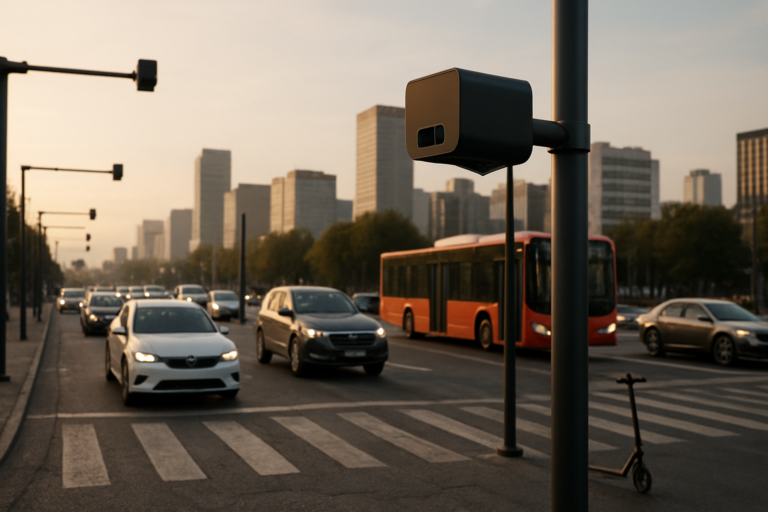
Every morning, millions of commuters enter a silent, collective negotiation with their city’s streets. They press brakes, accelerate, and idle—often inching forward without knowing that the traffic light above them is already learning. Across the globe, a quiet revolution in road infrastructure is taking shape, one that replaces rigid timers with adaptive intelligence. This is the era of Intelligent Urban Mobility Systems, where data pulses alongside fuel.
Urban congestion is not merely an inconvenience; it is a drag on productivity and air quality. According to a 2023 INRIX study, drivers in the United States lost an average of 51 hours to traffic delays annually, costing the economy over $81 billion. Traditional traffic management—static signal cycles and manual observation—cannot scale with growing populations. The solution lies in embedding intelligence directly into the asphalt, signal cabinets, and vehicle-to-infrastructure (V2I) communication networks.
Neural networks are at the heart of this transformation. Unlike rule-based algorithms, these systems ingest thousands of data points from cameras, radar, and inductive loop sensors embedded under road surfaces. They learn patterns over time: a surge of vehicles exiting a sports stadium, the ripple effect of an accident on a parallel artery, or the seasonal rhythm of a school drop-off zone. In controlled trials in European cities like Barcelona and Zurich, neural-network-managed intersections have reduced average wait times by 25–35% and lowered emissions by up to 20%.
Real-time sensor integration is the bedrock of these systems. Modern intersections are fitted with edge computing units that process video feeds locally, sending only anonymized metadata to central servers. This reduces latency to milliseconds—critical when a pedestrian steps off a curb or an emergency vehicle approaches. The sensors don’t just count cars; they classify them. A heavy truck requires a longer yellow phase than a sedan. A bicycle arriving mid-cycle can trigger a short green extension. The system becomes aware of its environment with granularity impossible for human controllers.
The infrastructure itself is evolving. Smart poles now house LiDAR scanners, environmental monitors, and high-bandwidth communication modules. They are designed to be unobtrusive, yet they form a nervous system across the urban body. In Singapore, a nationwide network of over 3,000 smart nodes coordinates traffic based on real-time demand, integrating with the city’s dynamic road pricing system. The result: during peak hours, main arterials run at nearly 85% of theoretical capacity—a figure that static systems rarely approach.
But the greatest challenge is not technical; it is systemic integration. Most cities operate siloed departments—traffic, transit, utilities—with disconnected data. An Intelligent Urban Mobility System requires a unified digital twin of the entire transport network, updated in near real-time. Cities like Helsinki and Los Angeles are building these platforms, layering train schedules, bike-share availability, weather data, and event calendars into a single optimization engine. The goal is not just to move cars faster, but to balance all modes of movement.
Security and privacy remain critical concerns. A networked traffic grid is a potential attack surface. In 2021, a ransomware attack on a European city’s traffic control system forced manual operation for several days. Modern architectures address this with micro-segmentation and encrypted over-the-air updates. Data privacy is respected through on-device processing and strict retention policies that anonymize individual vehicle identifiers.
The human element, however, cannot be eliminated. Transit authorities still need to override systems during special events or emergencies. The smartest systems are those that learn to recognize exception conditions—a marathon route, a parade, or a sudden hazardous material spill—and suggest deviations while preserving overall network stability. In these cases, the AI acts as an expert advisor rather than an autonomous dictator.
Investment in these systems is accelerating. McKinsey estimates that smart mobility infrastructure could add up to $900 billion in global value by 2030, driven by fuel savings, time recovery, and reduced accident costs. Cities that have already invested report a rapid return: often within 18 months, due to lowered maintenance costs and improved transit efficiency.
The road ahead is not just about technology. It is about designing systems that adapt to the texture of daily life—the impatient cyclist, the delivery truck double-parked for just a moment, the bus running three minutes late. Intelligent Urban Mobility does not erase friction; it learns to navigate it with speed and elegance. As these networks become more capable, the idea of waiting for a red light while no cross-traffic exists will seem as antiquated as a manually cranked window.
The future of city movement is not paved with more concrete. It is woven from signals, predictions, and the quiet whir of processors under the streetlights.