
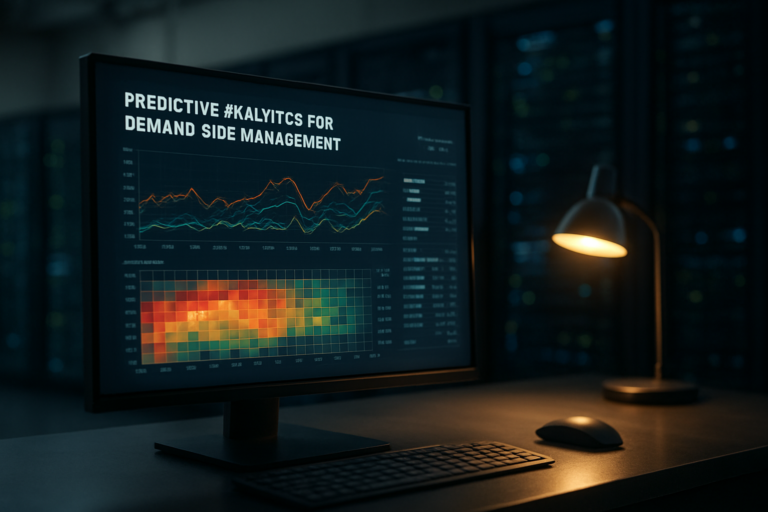
The way we consume and distribute energy is undergoing a radical transformation. For decades, utilities relied on historical averages and simple regression models to predict how much electricity people would need at any given hour. But as renewable sources like solar and wind introduce volatility, and as electric vehicles and smart homes reshape demand patterns, those old methods simply aren’t good enough. Enter predictive analytics for demand-side management — a powerful application of machine learning that forecasts consumer behavior with remarkable accuracy, enabling utilities to optimize energy distribution in real time.
What Is Demand-Side Management?
Demand-side management (DSM) refers to the strategies utilities use to influence consumer energy usage — encouraging off-peak consumption, reducing peak loads, and improving overall grid efficiency. Traditionally, DSM relied on price signals, rebates, and manual load shedding. But modern DSM goes far beyond that, leveraging data from smart meters, IoT sensors, weather forecasts, and even social media trends to anticipate demand shifts before they happen.
The Role of Predictive Analytics
Predictive analytics uses historical and real-time data to forecast future events. In the context of DSM, machine learning models analyze thousands of variables — time of day, day of week, temperature, humidity, economic indicators, holiday schedules, and even local events — to predict energy consumption patterns at the household, neighborhood, or city level.
Key Machine Learning Techniques
- Time Series Forecasting – Models like ARIMA, Prophet, and LSTM networks excel at capturing seasonal patterns and trends in energy usage data.
- Regression Models – Linear and polynomial regression help quantify the impact of external factors like weather on demand.
- Clustering Algorithms – K-means or DBSCAN group consumers with similar behavior profiles, enabling targeted demand response programs.
- Reinforcement Learning – Advanced systems use RL to dynamically adjust pricing or load control strategies in real time to balance supply and demand.
How It Optimizes Energy Distribution
Once a predictive model generates a forecast, utilities can act proactively rather than reactively. Here’s how:
- Load Balancing – By knowing exactly when and where demand will spike, grid operators can reroute power from underutilized areas or activate backup generators.
- Dynamic Pricing – Utilities can send time-of-use pricing notifications to consumers an hour in advance, encouraging them to shift usage to cheaper, lower-demand periods.
- Renewable Integration – Accurate forecasts allow grid managers to schedule solar and wind output more effectively, reducing curtailment and reliance on fossil fuel peaker plants.
- Preventive Maintenance – Predictive models can flag transformers or substations at risk of overload, allowing repairs before failures occur.
Real-World Impact
The results speak for themselves. According to a 2023 study by the International Energy Agency, utilities that deployed AI-driven demand forecasting reduced peak demand by an average of 12–18%, while overall energy waste dropped by up to 30%. A pilot program by a major European utility using LSTM-based models achieved a 22% improvement in load prediction accuracy compared to traditional methods, saving millions in operational costs.
Case Study: Pacific Gas & Electric (PG&E)
PG&E implemented a machine learning platform that integrates weather data, smart meter readings, and customer demographics. The system now predicts demand with 96% accuracy for the next 72 hours. This allowed the utility to reduce the number of expensive “peaker” plant activations by 40% during heatwaves.
Challenges and Considerations
Despite its promise, predictive analytics for DSM isn’t without hurdles:
- Data Quality – Smart meters can malfunction or transmit incomplete data. Models need robust preprocessing to handle gaps.
- Privacy Concerns – Granular consumption data reveals sensitive information about when people are home or what appliances they use. Anonymization and strict access controls are essential.
- Model Drift – Consumer behavior changes over time (e.g., new devices, work-from-home trends). Models must be retrained regularly.
- Interpretability – Complex deep learning models can be black boxes. Utilities need explainable AI to justify decisions to regulators and customers.
The Future of Demand-Side Management
As edge computing and 5G roll out, predictive analytics will move closer to the consumer. Smart home hubs will run lightweight models that anticipate individual household usage and automatically adjust thermostats, EV chargers, and water heaters. Utility companies are also experimenting with federated learning, where models train across multiple data centers without sharing raw customer data, preserving privacy while improving accuracy.
Another frontier is the integration of behavioral economics into predictive models. By analyzing how consumers respond to different nudges — like push notifications, gamification, or social comparisons — AI can tailor demand response programs that are both effective and non-intrusive.
Why This Matters
Climate goals depend on making our energy grid smarter and more efficient. Predictive analytics for demand-side management is not just a cost-saving tool for utilities; it’s a critical enabler of the renewable transition. Every kilowatt-hour we don’t waste is one less ton of CO2 emitted. And as machine learning models become more sophisticated, the gap between energy supply and demand will continue to narrow.
From the macro level of grid operators to the micro level of a smart thermostat in your living room, predictive analytics is quietly reshaping how we use energy. The forecasts are in — and the future looks efficient.