
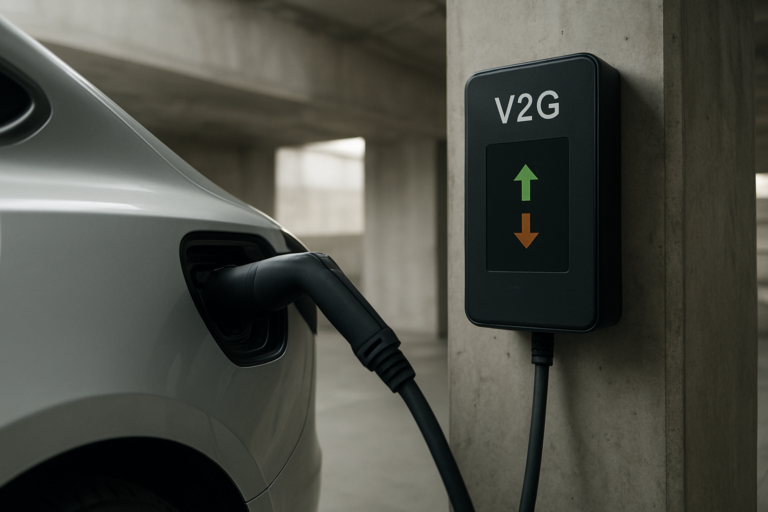
The idea of electric vehicles (EVs) sitting idle for most of the day is a massive untapped resource. While millions of cars remain parked, their batteries collectively hold gigawatt-hours of energy—enough to power entire neighborhoods during peak hours. Vehicle-to-Grid (V2G) integration turns this latent capacity into a dynamic asset, allowing EVs to act as mobile energy storage units that feed electricity back into the grid when demand spikes or supply falters. This isn’t just a futuristic concept; it’s a real-world solution already being deployed in pilot projects across Europe, North America, and Asia.
How V2G Works: The Bidirectional Dance
Traditional EV charging is unidirectional—power flows from the grid to the car. V2G flips that flow using bidirectional chargers and smart communication protocols. When the grid needs extra power, the car’s battery discharges electricity back into the local distribution network. When demand is low, the car recharges. The entire process is orchestrated by a central aggregator that coordinates thousands of vehicles to behave like a single, massive battery.
- Bidirectional Charger: Converts DC from the battery to AC for the grid and vice versa.
- Communication Protocol: Standards like ISO 15118 enable the car and charger to negotiate power flow.
- Aggregation Software: Manages charging schedules, state of charge, and grid signals in real time.
This bidirectional capability transforms EVs from passive loads into active participants in grid stability. Instead of stressing the grid during evening charging, V2G-enabled cars can actually support it.
Balancing Peak Demand Without Building New Power Plants
Peak demand periods—typically early evenings when people return home and crank up air conditioning—strain the grid. Utilities often resort to firing up expensive, polluting peaker plants that run only a few hundred hours per year. V2G offers a cleaner alternative.
A single EV with a 60 kWh battery can discharge about 10–15 kW back to the grid. Multiply that by a fleet of 10,000 vehicles, and you have a virtual power plant (VPP) capable of delivering 100–150 MW—enough to replace a small peaker plant. During a heatwave in 2022, a V2G pilot in the UK demonstrated that a fleet of 320 Nissan Leafs could provide 1 MW of flexible capacity, reducing strain on local transformers.
Key Benefits of Peak Shaving with V2G
- Reduces need for new generation capacity
- Lowers electricity costs by avoiding peak pricing
- Decreases carbon emissions from fossil-fuel peakers
- Improves grid resilience during extreme weather events
Supply Fluctuations: V2G as a Renewable Energy Buffer
Solar and wind power are inherently variable. A cloudy afternoon or a sudden drop in wind can create rapid supply gaps. Batteries are the natural solution, but building utility-scale storage is expensive and slow. V2G leverages assets that already exist—EVs parked in garages, office lots, and curbside spots.
When solar generation dips, V2G-enabled cars can inject stored energy within seconds. When wind blows strong at night, the same cars can absorb excess power that would otherwise be curtailed. This bidirectional flow smooths out the renewable energy curve, making high-penetration renewables more viable.
Real-World Example: The Netherlands
The Netherlands has one of the highest densities of V2G chargers globally. A project in Utrecht uses 1,000 bidirectional chargers to balance the local grid. During sunny afternoons, EVs charge from rooftop solar; during evening peaks, they discharge. The city estimates this reduces grid congestion by 15–20% without requiring new transformers.
The Role of Aggregators in the Distributed Grid
A single EV cannot make a meaningful impact on the grid. But thousands, coordinated by an aggregator, become a formidable resource. Aggregators use cloud-based platforms to monitor each vehicle’s state of charge, departure time, and battery health. They then bid into wholesale electricity markets or provide frequency regulation services.
- Frequency Regulation: EVs can respond to grid frequency deviations in milliseconds—faster than gas turbines.
- Demand Response: Utilities pay aggregators to reduce load or inject power during critical periods.
- Capacity Markets: VPPs can bid firm capacity, displacing conventional generators.
The business model is compelling: EV owners earn revenue by letting the aggregator control their battery during idle hours. Studies show that a typical EV owner could earn $200–$600 per year from V2G services, offsetting a significant portion of charging costs.
Infrastructure Requirements and Challenges
V2G is not plug-and-play. It requires investment in hardware, software, and grid upgrades. Key challenges include:
- Bidirectional Charger Costs: Currently 2–3x more expensive than standard chargers, though costs are falling.
- Battery Degradation: Frequent cycling can accelerate wear, but modern LFP batteries and smart algorithms minimize impact. A 2023 study by the University of Warwick found that V2G cycling increased degradation by only 2–5% over ten years.
- Standardization: Not all EVs support bidirectional charging. Nissan, Mitsubishi, Hyundai, and Ford offer it; Tesla has yet to enable it widely.
- Regulatory Hurdles: Many regions lack tariffs that compensate V2G fairly. Net metering rules often favor solar over V2G.
Despite these hurdles, the momentum is building. The global V2G market is projected to grow from $1.2 billion in 2023 to $8.5 billion by 2030, according