
As renewable energy sources like solar and wind continue to expand, the need for reliable long-duration storage becomes increasingly critical. While lithium-ion batteries excel at short-term buffering—typically four to six hours—they struggle to provide backup for days or even weeks when the sun doesn’t shine or the wind doesn’t blow. This is where thermal energy storage (TES) steps in, using materials like molten salt and phase-change compounds to store vast amounts of energy at a fraction of the cost. By bridging the gap during extended renewable intermittency, TES is emerging as a cornerstone of grid stability and energy independence.
The Challenge of Long-Duration Storage
The global push toward decarbonization has accelerated renewable deployment, but the intermittent nature of solar and wind creates a fundamental problem: how to keep the lights on during multi-day lulls. Traditional pumped hydro storage offers long duration but is geographically limited. Lithium-ion batteries, while fast-responding, become prohibitively expensive for durations beyond four to eight hours. According to the U.S. Department of Energy, achieving a 100% renewable grid will require at least 10 hours of storage capacity across most regions, with some areas needing up to 100 hours.
Thermal energy storage fills this gap by storing energy as heat or cold, then releasing it on demand. Unlike electrochemical batteries, TES systems can hold energy for hours to days with minimal self-discharge, and their capital costs drop significantly as duration increases. This makes them ideal for buffering renewable generation over multiple cloudy or windless days.
Molten Salt: The Proven Workhorse
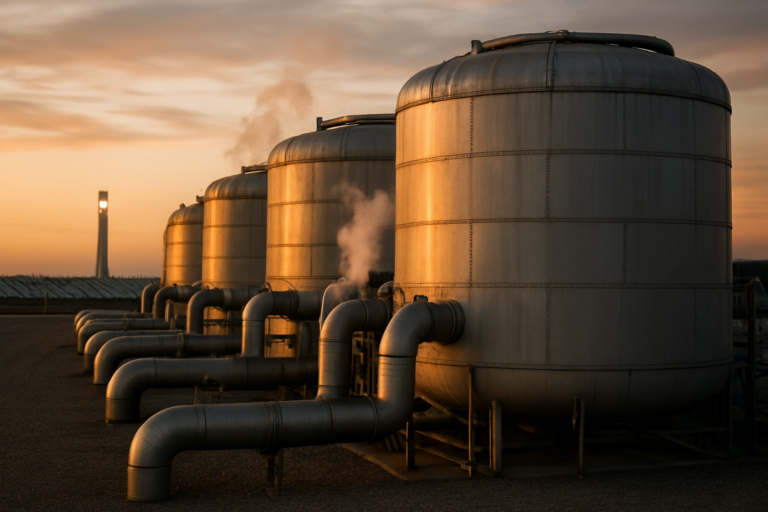
Molten salt storage is the most commercially mature TES technology, primarily deployed in concentrated solar power (CSP) plants. These systems use a mixture of sodium nitrate and potassium nitrate, which melts at around 220°C and can be heated to over 560°C. During the day, solar mirrors focus sunlight onto a receiver, heating the salt. The hot molten salt is then stored in insulated tanks. When electricity is needed, the salt is pumped through a heat exchanger to produce steam that drives a turbine.
- Efficiency: Modern molten salt plants achieve round-trip efficiencies of 70–80%, with storage durations ranging from 6 to 15 hours. Some designs aim for 24-hour capacity.
- Cost: Levelized cost of storage for molten salt is around $20–50 per kilowatt-hour (kWh) of thermal energy, compared to $200–300/kWh for lithium-ion batteries.
- Scalability: Existing CSP plants with molten salt storage, like the 110 MW Crescent Dunes facility in Nevada, can store 1.1 GWh of thermal energy—enough to power 75,000 homes for 10 hours.
The technology is not limited to CSP. Newer designs integrate molten salt with electric heaters powered by excess wind or solar, decoupling storage from solar collection. This allows TES to function as a standalone “thermal battery” for any renewable source.
Phase-Change Materials: A New Frontier
Phase-change materials (PCMs) offer an alternative approach by leveraging the latent heat absorbed or released during a material’s phase transition—typically from solid to liquid. Because latent heat is far greater than sensible heat (the heat needed to raise temperature), PCMs can store 5 to 14 times more energy per unit volume than water or rock.
Common PCMs include paraffin waxes, salt hydrates, and eutectic mixtures. For long-duration backup, high-temperature PCMs such as aluminum-silicon alloys (melting around 577°C) are being researched. These materials can store energy at higher densities than molten salt, reducing tank size and cost.
- Energy density: PCMs can achieve 150–250 kWh/m³, compared to 50–80 kWh/m³ for molten salt.
- Temperature range: Depending on the material, PCMs operate from -50°C to over 1000°C, enabling applications from building heating to industrial process heat.
- Challenges: Encapsulation and corrosion remain hurdles. Researchers are developing advanced containers and additives to improve cycle life.
Pilot projects, such as the 1 MWh PCM storage unit at the University of Birmingham, demonstrate that these systems can deliver consistent power over 10–12 hours. Commercial deployment is expected within the next five years.
Other Thermal Storage Technologies
Beyond molten salt and PCMs, several other TES methods are gaining traction:
- Concrete and ceramic blocks: Sensible heat storage using solid materials. Simple and cheap, with costs as low as $10/kWh thermal. Used in industrial heat applications.
- Thermochemical storage: Uses reversible chemical reactions (e.g., hydration/dehydration of salts) to store energy with near-zero losses over months. Ideal for seasonal storage.
- Cryogenic storage: Liquefies air or CO₂, then expands it through a turbine. Offers long duration but lower round-trip efficiency (~50%).
- Pumped thermal storage: