
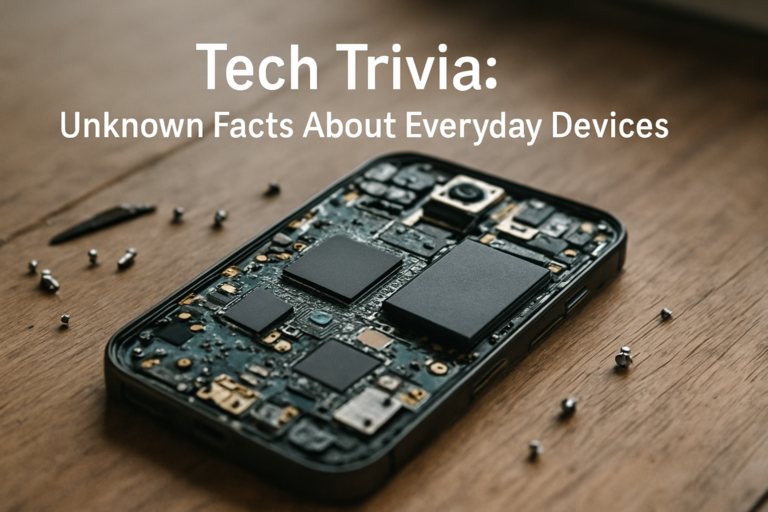
You probably don’t think twice about the smartphone in your pocket or the microwave humming in your kitchen. Yet each of these everyday devices carries a backstory that’s as surprising as it is ingenious. From accidental inventions to design choices that changed the world, the gadgets we rely on are packed with hidden history. Let’s pull back the curtain on some of the most fascinating tech trivia behind the devices we use daily.
The Smartphone: A Computer in Your Palm with a Secret Past
Your smartphone is more powerful than the computers that guided Apollo 11 to the moon. But did you know the first smartphone, IBM’s Simon Personal Communicator, launched in 1994? It had a touchscreen, email, and even apps — but only 50,000 units were sold. Today, over 6.8 billion people own a smartphone, and the average user touches their phone over 2,600 times a day.
One lesser-known fact: the modern smartphone’s Gorilla Glass was originally developed for car windshields. Corning spent years perfecting a chemically strengthened glass that could resist scratches, but it wasn’t until Steve Jobs demanded a durable screen for the first iPhone that the technology found its true home.
The Microwave Oven: A Melted Candy Bar Changed Dinner Forever
The microwave oven was a complete accident. In 1945, engineer Percy Spencer was testing a magnetron (a vacuum tube used in radar) when he noticed a chocolate bar in his pocket had melted. Intrigued, he tried popcorn kernels — and they popped. Within a year, the first commercial microwave oven, the Radarange, hit the market. It weighed 750 pounds and cost $5,000 (over $50,000 today).
Today, over 90% of American households own a microwave. Yet the device’s core technology — the magnetron — remains nearly unchanged from Spencer’s original design. The next time you heat leftovers, remember you’re using a piece of wartime radar tech.
The USB Port: Designed to Be Annoying
Ever wondered why USB plugs never seem to go in the right way the first time? That’s by design — but not a good one. The original USB-A connector was intentionally made asymmetrical to prevent incorrect insertion. However, the lack of a reversible design has frustrated users for decades. In fact, a 2015 study found that people fail to insert a USB plug correctly on the first try about 50% of the time.
The USB Implementers Forum finally introduced USB-C in 2014, which is fully reversible. But the old USB-A standard is still everywhere — over 10 billion USB ports have been shipped worldwide. Fun fact: the USB logo itself is a trident, inspired by the Greek god Poseidon.
The QR Code: Born in a Japanese Factory for Car Parts
QR codes feel like a modern pandemic-era necessity, but they were invented in 1994 by Denso Wave, a Toyota subsidiary. The goal was to track car parts quickly and accurately. Traditional barcodes could only hold 20 characters, but QR codes can store up to 7,089 numeric characters or 4,296 alphanumeric characters. The “QR” stands for “Quick Response” — because the code could be read ten times faster than a standard barcode.
During the COVID-19 pandemic, QR code usage surged by 433% in the U.S. as restaurants and businesses adopted contactless menus. Yet the technology remains free to use — Denso Wave chose not to enforce its patent, allowing anyone to generate QR codes without licensing fees.
The Touchscreen: Invented Before You’d Expect
Touchscreens feel futuristic, but the first touchscreen was invented in 1965 by E.A. Johnson at the Royal Radar Establishment in the UK. It was a capacitive touchscreen — the same basic technology used in today’s iPhones. However, it could only register one touch at a time and was used mostly for air traffic control.
The first resistive touchscreen (the kind that works with a stylus) came in 1971 from Dr. Sam Hurst. It wasn’t until 2007 that Apple’s multi-touch capacitive screen revolutionized the smartphone industry. Today, over 1.5 billion touchscreen devices are shipped each year, and the global touchscreen market is worth over $80 billion.
The Computer Mouse: A Wooden Block with a Wire
The computer mouse was invented by Douglas Engelbart in 1964. His first prototype was carved from a block of wood, had two metal wheels (one for horizontal, one for vertical movement), and a single button. The name “mouse” came from the tail-like wire trailing behind.
Engelbart’s team demonstrated the mouse in 1968 during what’s now called “The Mother of All Demos” — a landmark event that also introduced hypertext, video conferencing, and collaborative editing. Yet the mouse didn’t become mainstream until Apple popularized it with the Macintosh in 1984. Today, over 1 billion mice are in use worldwide, and the average office worker clicks a mouse over 5,000 times per day.
The LED Light Bulb: A Nobel Prize–Winning Invention
LEDs (light-emitting diodes) are everywhere — from your phone’s notification light to your home’s ceiling fixtures. But the blue LED, which made white light possible, was considered impossible for decades. In the 1990s, three Japanese scientists — Isamu Akasaki, Hiroshi Amano, and Shuji Nakamura — finally cracked the problem using gallium nitride. Their work earned them the 2014 Nobel Prize in Physics.
Today, LED bulbs use at least 75% less energy than incandescent bulbs and can last up to 25 times longer. If every American home replaced just one incandescent bulb with an LED, the energy savings would prevent 9 billion pounds of greenhouse gas emissions per year — equivalent to taking 800,000 cars off the road.
The Hard Drive: From Room-Sized to Pocket-Sized
The first hard drive, the IBM 350 RAMAC,