
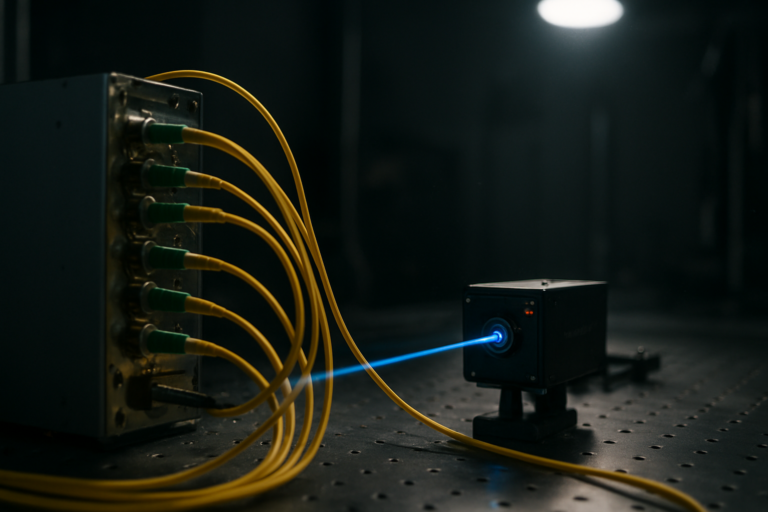
If you’ve ever sent a text message, made an online payment, or logged into an email account, you’ve relied on encryption. Every day, billions of transactions are protected by algorithms that scramble data so only the intended recipient can read it. But that security is about to face a reckoning. The very computers that promise to revolutionize medicine, logistics, and artificial intelligence also threaten to crack the cryptographic foundations of the internet. The solution? Quantum encryption — a technology that doesn’t just make hacking harder, but theoretically impossible.
In this article, we’ll explore what quantum encryption is, how it works, why it matters now, and what it means for the future of online security.
The Encryption Crisis We’re Facing
Most modern encryption, from HTTPS to banking apps, relies on mathematical problems that are extremely difficult for classical computers to solve. For example, factoring large prime numbers or computing discrete logarithms takes years, even with the most powerful supercomputers. But quantum computers operate differently. They use qubits — quantum bits that can exist in multiple states at once — to perform calculations in parallel. In 1994, mathematician Peter Shor proved that a sufficiently powerful quantum computer could factor large numbers exponentially faster than any classical machine.
A 2022 study by McKinsey estimated that a quantum computer capable of breaking RSA-2048 encryption (the standard for secure online communications) could be built within 10 to 15 years. That means every piece of data encrypted today using current methods could be decrypted retroactively once that machine exists. Bank records, government secrets, medical histories — all vulnerable.
This has spurred a global race to develop “quantum-safe” encryption methods. But the most radical approach doesn’t just patch the old system — it builds a new one from the ground up.
How Quantum Encryption Works
Quantum encryption, more formally known as quantum key distribution (QKD) , uses the laws of physics — not mathematics — to secure communication. At its core is a simple principle: measuring a quantum system inevitably disturbs it.
Here’s a simplified version of the process:
- A sender (often called Alice) sends photons — individual particles of light — in random quantum states (e.g., different polarizations) to a receiver (Bob).
- Bob measures the photons using random bases.
- After the transmission, Alice and Bob compare which bases they used (not the actual data) over a public channel.
- They discard any measurements where the bases didn’t match.
- The remaining bits form a shared secret key.
Crucially, if an eavesdropper (Eve) intercepts the photons, her measurement disturbs their quantum states, introducing errors that Alice and Bob can detect. If they detect interference, they discard the key and try again. This means that any attempt to listen in is immediately discovered — making the communication provably secure.
“The beauty of quantum key distribution is that it’s not based on computational complexity,” says Dr. Jane Chen, a quantum physicist at the University of Cambridge. “It’s based on the fundamental laws of quantum mechanics. No amount of computing power can break that.”
The Different Flavors of Quantum Encryption
QKD isn’t the only quantum approach. Several variants exist, each with its own strengths:
- Prepare-and-Measure QKD: The simplest form, as described above. Common protocols include BB84 (invented in 1984) and B92.
- Entanglement-Based QKD: Uses pairs of entangled photons. Measuring one instantaneously fixes the state of the other, even across long distances. This method is more robust but requires more complex hardware.
- Measurement-Device-Independent QKD: Eliminates vulnerabilities in the detector hardware, closing security loopholes.
- Continuous-Variable QKD: Encodes information in the amplitude and phase of light, rather than single photons. Easier to integrate with existing fiber-optic networks.
Each method has trade-offs between speed, distance, and cost. But all share the same core advantage: security that is physics-verifiable, not mathematician-dependent.
Real-World Implementations Already Happening
Quantum encryption is not a futuristic theory. It’s already being deployed in commercial networks.
- China’s Micius Satellite: In 2017, China launched the world’s first quantum communications satellite. It successfully transmitted entangled photons between ground stations over 1,200 kilometers. The satellite is now used for secure government communications.
- Vienna’s Quantum Ring: A metropolitan QKD network spanning 200 km of fiber in Austria, connecting banks, hospitals, and government offices.
- Swiss Quantum Network: Switzerland has a QKD link between its financial hub and the national bank, protecting high-value transactions.
- Quantum Key Distribution in the UK: The UK’s Quantum Communications Hub has deployed a testbed linking government sites in London, using standard telecom fiber.
According to a 2023 report by MarketsandMarkets, the global quantum cryptography market is projected to grow from $1.2 billion in 2023 to $4.3 billion by 2028. That’s a compound annual growth rate of 29%.
The Challenges Holding Quantum Encryption Back
Despite its promise, quantum encryption faces significant hurdles:
- Distance Limitations: Single photons lose intensity over long distances. Current fiber-based QKD is limited to about 100–200 km without repeaters. Satellite-based QKD helps, but satellites are expensive.
- Data Rate: QKD generates keys at a rate of only a few hundred kilobits per second — far slower than classical encryption methods. This makes it unsuitable for bulk data encryption, so it’s often used only for key exchange.
- Hardware Cost: QKD systems require specialized photon sources, detectors, and cryogenic cooling (for some types). A single unit can cost hundreds of thousands of dollars.
- Integration with Existing Infrastructure: Most