
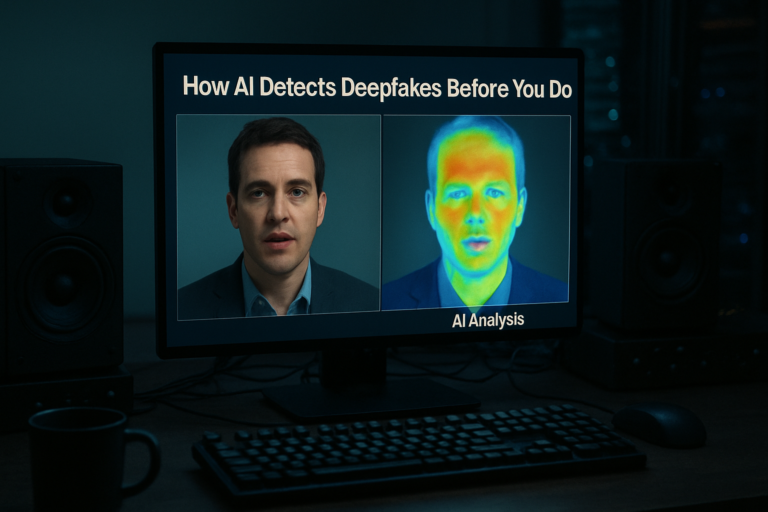
In an era where seeing is no longer believing, deepfakes have emerged as one of the most insidious threats to digital trust. These hyper-realistic AI-generated videos, audio clips, and images can make anyone say or do anything—and they are becoming increasingly difficult to spot with the naked eye. But while humans struggle to keep up, artificial intelligence itself is stepping into the ring. AI-powered deepfake detection systems are now capable of identifying synthetic media with astonishing accuracy, often before a viewer even suspects something is wrong. This blog explores how these systems work, the techniques they use, and why they are essential for preserving truth in the digital age.
What Are Deepfakes and Why Are They Dangerous?
Deepfakes leverage generative adversarial networks (GANs) to produce media that mimics real people. Two neural networks—a generator and a discriminator—compete to create increasingly realistic output. The result can be indistinguishable from authentic footage to the untrained eye. According to a 2023 report by Deeptrace Labs, the number of deepfake videos online has been doubling every six months, with over 85% targeting political figures or celebrities. The consequences range from reputation damage and fraud to political disinformation and national security risks. As the technology becomes more accessible, the need for robust detection methods has never been more urgent.
How AI Detects Deepfakes: The Core Techniques
AI detection systems rely on subtle inconsistencies that human vision often misses. Here are the primary methods:
1. Forensic Analysis of Visual Artifacts
Deepfakes leave behind microscopic traces—irregularities in pixel patterns, lighting, and facial geometry. AI models trained on millions of real and fake images can spot these anomalies. For example:
- Blinking inconsistencies: Deepfakes often fail to replicate natural blinking patterns. Detection algorithms track blink frequency and duration to flag fakes.
- Skin texture and color: Subtle differences in skin tone or graininess across frames can indicate manipulation.
- Edge anomalies: Around the jawline, hair, or glasses, deepfakes may produce blurring or mismatched boundaries.
2. Temporal Analysis of Video Sequences
While a single frame might look perfect, deepfakes often break down over time. AI analyzes:
- Head movement and pose: Real videos have smooth, continuous motion; deepfakes may show jittery or unnatural head turns.
- Lip-sync accuracy: Audio and video are cross-referenced. If the mouth movements don’t match the spoken words with millisecond precision, the system flags it.
- Frame-to-frame consistency: Changes in lighting, shadows, or background that flicker inconsistently across frames are red flags.
3. Frequency Domain Analysis
This technique transforms video frames into frequency representations. Deepfakes often have distinct frequency signatures due to the upsampling and blending steps in GANs. AI can detect these patterns using Fourier transforms or wavelet analysis, revealing artifacts invisible to the naked eye.
4. Neural Network-Based Classifiers
Modern detection systems use deep learning models like convolutional neural networks (CNNs) and recurrent neural networks (RNNs) trained on massive datasets. These models learn to distinguish real from fake by extracting high-level features. Some state-of-the-art detectors achieve over 98% accuracy on benchmark datasets like FaceForensics++ and Celeb-DF.
Real-World Applications of Deepfake Detection
AI detection is already deployed across industries:
- Social media platforms: Facebook, Twitter, and TikTok use automated tools to flag suspicious content before it goes viral.
- News organizations: Reuters and the Associated Press employ AI to verify video evidence submitted by citizen journalists.
- Financial institutions: Banks use voice and video deepfake detection to prevent identity fraud during remote verification.
- Legal and forensic teams: Courts increasingly rely on AI analysis to authenticate evidence in trials.
A 2022 study by the University of Albany found that AI detectors could identify deepfakes with 94.7% accuracy, even when the videos were compressed or degraded—conditions that fool human viewers 70% of the time.
Challenges and Limitations
Despite impressive progress, AI detection is not foolproof. Key challenges include:
- Adversarial attacks: Deepfake creators can tweak their models to evade detection, leading to an arms race.
- Generalization: Detectors trained on one dataset may fail on new types of deepfakes from different generators.
- Computational cost: High-accuracy models require significant processing power, making real-time detection difficult.
- Privacy concerns: Scanning all media for deepfakes raises questions about surveillance and data storage.
Researchers are actively working on more robust, lightweight, and privacy-preserving solutions, including federated learning and synthetic data augmentation.
The Future of Deepfake Detection
The battle between deepfake creation and detection is accelerating. Emerging trends include:
- Blockchain-based verification: Embedding cryptographic signatures in original media to prove authenticity.
- Multimodal detection: Combining video, audio, and text analysis for a holistic approach.
- Collaborative databases: Shared repositories of known deepfake patterns to train detectors faster.
- Human-in-the-loop systems: AI flags suspicious content, but human reviewers make final decisions for high-stakes scenarios.
As deepfake technology evolves, so too will the AI that fights it. The goal is not just to detect fakes, but to build a digital ecosystem where truth is verifiable by default.
Why AI Detection Matters More Than Ever
Deepfakes undermine the very foundation of trust in visual media. In a world where a single fake video can sway elections or tank a company’s stock, AI detection is our best line of defense. It acts as a silent guardian—working behind the scenes to analyze, flag, and alert before the deception spreads. While no system is perfect, the combination of forensic analysis, neural networks, and ongoing research offers a powerful countermeasure. The next time you watch a viral video, remember: AI might already know if it’s real or fake—long before you do.