
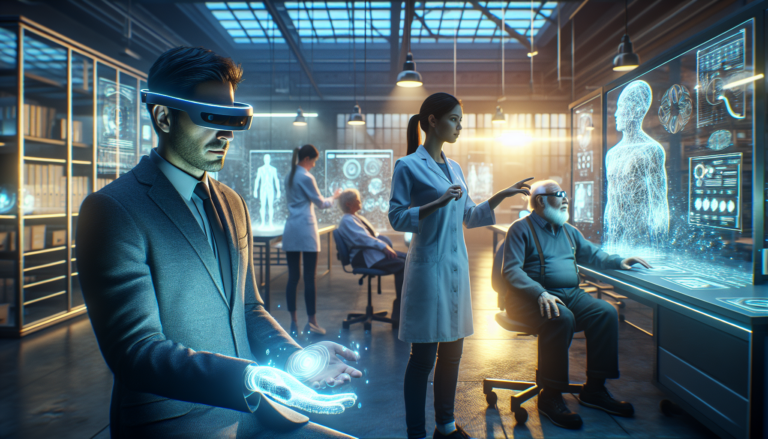
For years, the Internet of Things (IoT) has steadily woven a tapestry of interconnected devices into the fabric of our daily lives, transforming everything from smart homes to industrial operations. We’ve become accustomed to our thermostats talking to our phones, our cars navigating with real-time data, and our fitness trackers monitoring our every move. But what if our interactions with technology could transcend mere data exchange and instead tap directly into our senses? Enter the Internet of Senses (IoS) – a revolutionary concept poised to take the digital revolution beyond mere connectivity to truly immersive, multi-sensory experiences that could redefine what it means to be human in the digital age.
The Internet of Senses isn’t just an upgrade; it’s a paradigm shift. While IoT focuses on connecting devices and collecting data to make our environments smarter, IoS aims to connect our minds and bodies directly to the digital realm, enabling us to see, hear, taste, smell, and touch digital content as if it were real. This isn’t science fiction anymore; it’s the cutting edge of technological innovation, promising a future where our senses become the ultimate interface.
What Exactly is the Internet of Senses?
At its core, the Internet of Senses envisions a future where technology can digitally transmit sensory experiences to our brains. Imagine being able to “feel” a texture in a virtual reality environment, “smell” the aroma of a dish being cooked miles away, or “taste” a digital recipe before you prepare it. This goes far beyond the visual and auditory stimuli that dominate our current digital interactions.
The concept was notably popularized by Ericsson’s ConsumerLab, which has predicted that by 2030, many consumers will regularly use IoS technologies. This vision builds upon advancements in several key areas:
- Augmented Reality (AR) and Virtual Reality (VR): The foundation for immersive visual and auditory experiences.
- Haptic Feedback: Technologies that simulate the sense of touch through vibration, motion, or force.
- Olfactory Interfaces: Devices capable of synthesizing and releasing specific scents.
- Gustatory Interfaces: Technologies designed to stimulate taste buds, replicating flavors.
- Brain-Computer Interfaces (BCI): The ultimate frontier, allowing direct communication between the brain and external devices.
Unlike IoT, which primarily deals with data from inanimate objects, IoS centers on human perception and experience. It seeks to bridge the gap between our biological senses and digital information, creating a seamless blend of the physical and virtual worlds.
The Pillars of Sensory Immersion
To fully grasp the scope of IoS, it’s essential to look at how each sense is being digitally enhanced:
- Sight: While AR and VR headsets have made significant strides, IoS aims for even more seamless visual integration. Think lightweight smart glasses that overlay digital information directly onto your field of vision with perfect clarity, holographic projections that appear solid, or even contact lenses that offer visual enhancements without external hardware.
- Sound: Beyond spatial audio, IoS envisions personalized sound bubbles where you hear what you want without disturbing others, or “silent communication” where thoughts or whispered words are digitally transmitted directly to another’s auditory cortex, bypassing conventional speakers.
- Touch (Haptics): This is a rapidly evolving area. Advanced haptic gloves and suits are already allowing users to “feel” textures, weight, and resistance in VR. From feeling a virtual pet’s fur to manipulating remote machinery with tactile feedback, haptics will make digital interaction profoundly more physical.
- Smell (Olfactory Interfaces): Digital scent dispensers are still in their nascent stages, but the potential is immense. Imagine an online shopping experience where you can smell a perfume before buying it, or a virtual travel experience where you can breathe in the scent of a pine forest. Companies are researching how to precisely combine chemical compounds to create a vast array of digital aromas.
- Taste (Gustatory Interfaces): This is perhaps the most challenging sense to replicate digitally, but progress is being made. Electrical stimulation of the tongue can mimic basic tastes like sweet, salty, sour, and bitter. Research in this area could lead to virtual dining experiences or even dietary aids that make healthy foods taste more appealing.
- Beyond the Five: Intuition and Emotion: Some researchers extend IoS to include aspects like digitally transmitting feelings, intuitions, or even memories through advanced BCIs. While this is further down the line, the ambition is clear: to digitize the full spectrum of human experience.
From Theory to Reality: Current Applications and Emerging Technologies
While the full vision of IoS is still unfolding, many foundational technologies are already in play or rapidly developing:
- Gaming and Entertainment: This sector is a primary driver. High-fidelity VR headsets, haptic controllers, and even full-body haptic suits are making virtual worlds incredibly immersive. The future promises truly believable digital avatars with whom you can physically interact.
- Healthcare: IoS holds transformative potential. Remote surgery could incorporate haptic feedback, allowing surgeons to “feel” tissue resistance miles away. Rehabilitation could utilize VR environments with tactile elements to help patients regain motor skills. Sensory aids for people with disabilities could offer new ways to perceive the world.
- Education: Experiential learning will reach new heights. Students could virtually dissect a frog with tactile feedback, or take a historical journey that allows them to “feel” the cobblestones of ancient Rome and “smell” the atmosphere of a bustling market.
- Retail and Marketing: Imagine trying on clothes in a virtual store and feeling the texture of the fabric, or smelling the fragrance of a candle before adding it to your cart. Personalized sensory advertising could become incredibly compelling.
- Work and Collaboration: Remote work could become truly collaborative. Engineers could virtually “touch” and manipulate 3D prototypes, architects could “walk through” and feel the spaces they design, and remote teams could have a stronger sense of presence during virtual meetings.
The Transformative Impact of IoS
The ramifications of IoS extend far beyond individual experiences:
- Enhanced Human Experience: Our interaction with digital information will become more intuitive, natural, and profound, enriching daily life, work, and leisure.
- New Industries and Services: IoS will spawn entirely new sectors, from sensory content creators and digital scentographers to haptic engineers and taste programmers, driving innovation and job creation. The global AR/VR market alone is projected to reach hundreds of billions of dollars by the end of the decade, with IoS components playing a crucial role.
- Accessibility: IoS could break down barriers for people with disabilities, offering new ways to perceive, communicate, and interact with the world, such as digital touch for the visually impaired or enhanced sensory input for the hearing impaired.
- Personalization: Imagine waking up to the smell of your favorite coffee, perfectly tailored to your preferences, or a meditation app that guides you through a digital forest with real-time haptic feedback and custom soundscapes.
Navigating the Challenges and Ethical Considerations
Like any powerful technology, IoS comes with significant challenges and ethical dilemmas that must be addressed:
- Privacy and Data Security: Our sensory data is profoundly personal. How will this sensitive information be protected? The potential for misuse, from tracking preferences to manipulating moods, is immense.
- Ethical Quandaries: The ability to digitally manipulate senses raises questions about authenticity, reality distortion, and potential addiction. Could people become so engrossed in digital sensory experiences that they struggle to distinguish them from reality? Who controls the sensory inputs, and what are the implications for propaganda or advertising?
- Technological Hurdles: Miniaturization, power consumption, latency, and the sheer complexity of replicating sensory experiences accurately and affordably are significant engineering challenges.
- Digital Divide: Ensuring equitable access to these transformative technologies will be crucial to prevent the creation of new forms of societal inequality.
The Road Ahead: A Glimpse into the Sensory Future
The Internet of Senses isn’t just about adding more pixels or faster processing; it’s about adding depth, texture, aroma, and flavor to our digital lives. It represents a fundamental shift towards more empathetic, human-centric technology. As AR and VR become more sophisticated, and haptic, olfactory, and gustatory interfaces mature, we can expect a gradual but profound integration of IoS into our daily routines.
This journey will require interdisciplinary collaboration between technologists, neuroscientists, ethicists, and policymakers to ensure that the Internet of Senses evolves responsibly, enriching human experience without compromising our well-being or understanding of reality. It’s a future where our minds and bodies will seamlessly interact with a digitally enhanced world, pushing the boundaries of what it means to perceive and connect.
The Internet of Senses is not just the next big leap after IoT; it’s potentially the next big leap in human evolution, blurring the lines between the physical and digital in ways we are only just beginning to comprehend.